‘Debt traps’: Pakistan removes 120 illegal loan apps from Google, Apple stores

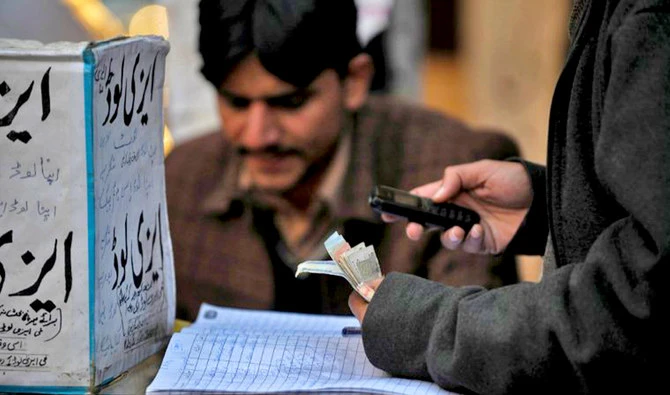
A Pakistani vendor counts currency notes at his roadside stall in Islamabad, Pakistan, on December 15, 2011. (AFP/File)
Short Url
Updated 16 August 2023
Follow

‘Debt traps’: Pakistan removes 120 illegal loan apps from Google, Apple stores

  • Issue came to light in July when a Pakistani man took his life after receiving threats from illegal loan apps
  • SECP advises borrowers to obtain loans only from licensed Non-Banking Financial Companies (NBFCS)

ISLAMABAD: The Securities and Exchange Commission of Pakistan (SECP) said on Wednesday it had removed 120 illegal personal loan apps from Google and Apple stores to safeguard people from falling into “debt traps.”

Pakistan has been cracking down on loan apps involved in extorting money through threats and blackmail since July when the death by suicide of a 40-year-old man from Rawalpindi made headlines in the country. The man was unable to return the money he borrowed from loan apps, with his wife telling police threats and blackmail compelled her husband to take his life.

While Pakistan has reported a surge in the number of people personal finance apps in the last two years, the boom has led to a surge in complaints about illegal lenders that routinely abuse customers’ data and use aggressive recovery tactics including threats and blackmail.

“In order to safeguard the public from falling into debt traps of illegal loan apps, the Securities and Exchange Commission of Pakistan (SECP), in coordination with Google, Apple, and the PTA, has ensured the removal of 120 illegal Loan apps that were previously available at Google and Apple Stores,” the SECP said in a press release.

The finance regulator said illegal personal loan apps have recently raised concerns of mis-selling, data privacy violations, and coercive recovery tactics. The SECP said it had identified 120 “unlawfully running apps” through complaints and surveillance, adding that it had referred them to the Federal Investigation Agency (FIA) for further action.

“As a result of SECP’s efforts and continuous engagement, Google has introduced Pakistan’s Personal Loan App Policy, according to which Google only allows SECP-approved Personal Loan Apps for placement on its Google Play Store,” it added.

The regulator advised borrowers to obtain loans only from licensed Non-Banking Financial Companies (NBFCs).

Pakistan is seeing a rise in the number of users seeking loans from personal finance apps as the country continues to suffer from staggering inflation. Pakistan reported inflation at 28.3 percent in July while in May, the inflation rate jumped to a record high of 38 percent.

Reflecting a jump in smartphone use, the number of Pakistanis using personal finance apps more than doubled to 19 percent in 2022 from two years earlier, boosting low rates of financial inclusion, according to a survey earlier this year by Karandaaz Pakistan, a nonprofit.
Pakistan’s OGDC ramps up unconventional gas plans

Updated 4 sec ago
Follow

Pakistan’s OGDC ramps up unconventional gas plans

  • Pakistan has long been viewed as having potential in tight and shale gas but commercial output has yet to be proved
  • OGDC says has tripled tight-gas study area to 4,500 square km after new seismic, reservoir analysis indicates potential

ISLAMABAD: Pakistan’s state-run Oil & Gas Development Company is planning a major expansion of unconventional gas developments from early next year, aiming to boost production and reduce reliance on imported liquefied natural gas.

Pakistan has long been viewed as having potential in both tight and shale gas, which are trapped in rock and can only be released with specialized drilling, but commercial output has yet to be proved.

Managing Director Ahmed Lak told Reuters that OGDC had tripled its tight-gas study area to 4,500 square kilometers (1,737 square miles) after new seismic and reservoir analysis indicated larger potential. Phase two of a technical evaluation will finish by end-January, followed by full development plans.

The renewed push comes after US President Donald Trump said Pakistan held “massive” oil reserves in July, a statement analysts said lacked credible geological evidence, but which prompted Islamabad to underscore that it is pursuing its own efforts to unlock unconventional resources.

“We started with 85 wells, but the footprint has expanded massively,” Lak said, adding that OGDC’s next five-year plan would look “drastically different.”

Early results point to a “significant” resource across parts of Sindh and Balochistan, where multiple reservoirs show tight-gas characteristics, he said.

SHALE PILOT RAMPS UP

OGDC is also fast-tracking its shale program, shifting from a single test well to a five- to six-well plan in 2026–27, with expected flows of 3–4 million standard cubic feet per day (mmcfd) per well.

If successful, the development could scale to hundreds or even more than 1,000 wells, Lak said.

He said shale alone could eventually add 600 mmcfd to 1 billion standard cubic feet per day of incremental supply, though partners would be needed if the pilot proves viable.

The company is open to partners “on a reciprocal basis,” potentially exchanging acreage abroad for participation in Pakistan, he said.

A 2015 US Energy Information Administration study estimated Pakistan had 9.1 billion barrels of technically recoverable shale oil, the largest such resource outside China and the United States.

A 2022 assessment found parts of the Indus Basin geologically comparable to North American shale plays, though analysts say commercial viability still hinges on better geomechanical data, expanded fracking capacity and water availability.

OGDC plans to begin drilling a deep-water offshore well in the Indus Basin, known as the Deepal prospect, in the fourth quarter of 2026, Lak said. In October, Turkiye’s TPAO with PPL and its consortium partners, including OGDC, were awarded a block for offshore exploration.

A combination of weak gas demand, rising solar uptake and a rigid LNG import schedule has created a surplus of gas that forced OGDC to curb output and pushed Pakistan to divert cargoes from Italy’s ENI and seek revised terms with Qatar.