


Japanese mountaineer dies, another injured while climbing mountain in northern Pakistan

Pakistani guide Muhammad Ibrahim shows a picture of Japanese climbers, Semba Takayasu with Shinji Tamura (right), who was died during summiting highest and unscaled peaks, in his mobile, in Skardu, Pakistan, on August 15, 2023. (Photo courtesy: AP)
Short Url
Updated 16 August 2023
Follow

Japanese mountaineer dies, another injured while climbing mountain in northern Pakistan

  • The two mountaineers from Japan were taking part in a climbing expedition organized by a local tour operator
  • The purpose of the expedition was to summit a never-before scaled peak in the Andaq Valley in Pakistan’s north

ISLAMABAD: A Japanese climber died and a fellow mountaineer was injured when an apparent rock fragment hit them while trying to scale one of the highest peaks in northern Pakistan, a mountaineering official and the injured climber said Tuesday. 

The two mountaineers from Japan were taking part in a climbing expedition organized by a local tour operator, said Karrar Haidri, secretary of the Alpine Club of Pakistan. 

He said the purpose of the expedition was to summit a never-before scaled peak in the Andaq Valley in the country’s north. Haidri said that while ascending the mountain Friday, Shinji Tamura slipped and fell at an altitude of 5,380 meters (17,650 feet). 

Haidri told The Associated Press that the man’s colleague, Semba Takayasu, was injured when he was hit by something, presumably a piece of rock. However, he said Takayasu later safely managed to reach the base camp to seek help from local authorities. 

Haidri said a search team was quickly sent to the area where the climber slipped, but rescuers failed to find Tamura until Monday when the operation was called off, declaring the death of the Japanese climber. 

“We have been informed by local authorities that the Japanese fell from a great height into the rocks and there were piles of snow and apparently he was buried there. Some of his belongings were found but there is no trace of his body,” Haidri said. “There is no chance of survival in such incidents, and the injured Japanese Semba Takayasu had also seen him falling from a great height, and rescuers went to the area for the search.” 
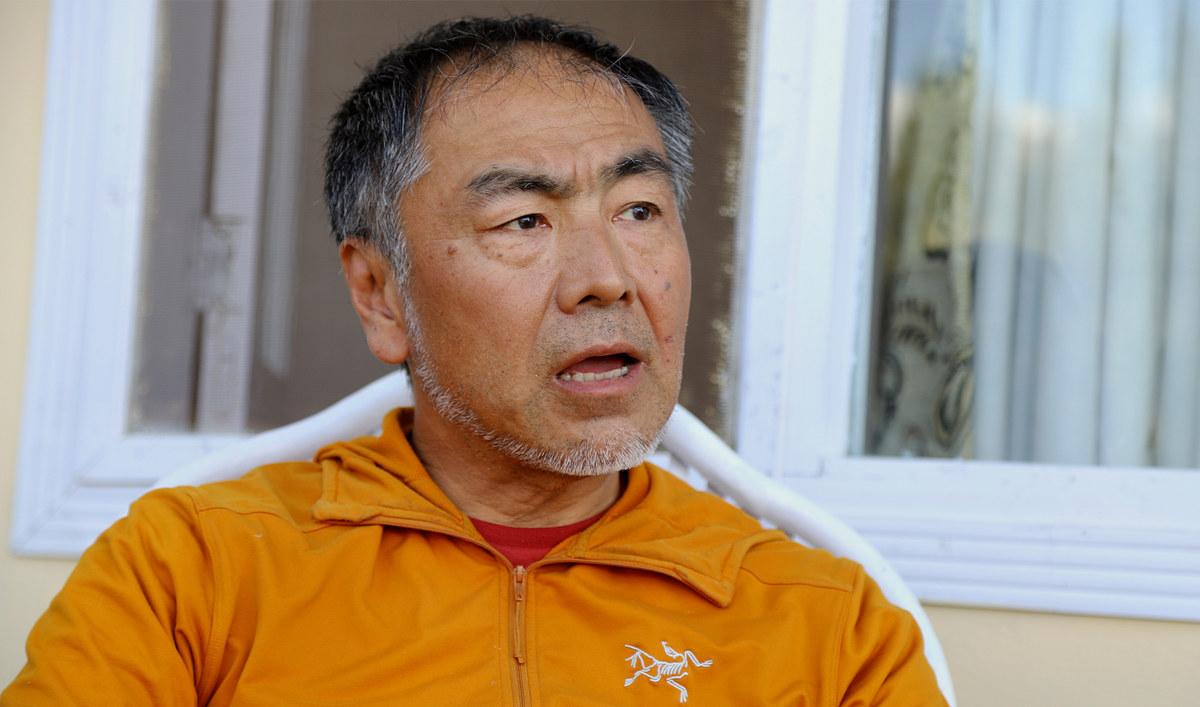


Japanese climber Semba Takayasu speaks with the Associated Press about the incident and death of his fellow climber Shinji Tamura, in Skardu, Pakistan, on August 15, 2023. (Photo courtesy: AP)

Local authorities in the region also confirmed the death of the Japanese climber. 

According to Takayasu, Tamura was seriously injured when he slipped and fell after being hit by something, apparently a piece of rock, which seriously injured him. Takayasu said he was also injured but managed to reach the base camp, from where rescuers launched the operation. 

He told an AP reporter the body of Tamura could not be found after days of searching. 

Tamura said he was rescued from the base camp by a helicopter and later arrived at Skardu, the main town in northern Pakistan, which is known as the gateway to K2, the world’s second-highest mountain. 

Every year, hundreds of local and foreign climbers visit northern Pakistan, where some of the world’s tallest mountains are located. 

Pakistani authorities said Saturday they were conducting an investigation into the death of a Pakistani porter near the peak of K2, the world’s most treacherous mountain. 


New PIA owner plans more GCC flights, lower airfares

Updated 4 sec ago
Follow

New PIA owner plans more GCC flights, lower airfares

  • New management will focus on religious tourism to Makkah, Madinah and other sites to expand global reach
  • Owner Arif Habib says airfares will be rationalized to make PIA flights affordable for low-income Pakistanis

KARACHI: Pakistan’s recently privatized national carrier, the Pakistan International Airlines (PIA), plans to increase its flights to the Gulf Cooperation Council (GCC) region as part of its post-privatization business strategy to achieve 7.5% annual revenue growth, its new owner said this week.

A Pakistani consortium, led by Arif Habib Group, clinched a 75% stake in PIA for Rs135 billion ($482 million) on Dec. 23 after a competitive bidding process, in a deal that valued the airline at Rs180 billion ($643 million).

The sale marked Pakistan’s most ambitious effort in decades to reform the debt-ridden airline that had accumulated over Rs784 billion ($2.8 billion) in losses. The government said it aimed to end decades of state-funded bailouts and support the airline’s revival.

In an exclusive interview with Arab News, Arif Habib, chairman of Arif Habib Group, shared that he aims to attract around 70 million Pakistanis, who travel annually via different airlines, by making airfares more affordable.

“That [GCC region] is our biggest market... We would definitely try to increase the frequency of flights, increase the number of planes there, and try to capture more market share in that area,” Habib told Arab News on Monday.

“So, there we see a lot of opportunity.”

The new management of PIA, which currently caters to 4 million passengers annually, aims to target religious tourism, which Habib called a “captive market” in Pakistan and the Middle East.

According to PIA spokesperson Abdullah Hafeez Khan, the airline runs around 20 flights daily to the Middle East.

Habib plans to invest around Rs112 billion ($400 million) in PIA to turn the airline around, implementing short- and long-term improvements ranging from upgrading seats to tripling the 19-aircraft fleet, and engaging a foreign airline as a technical partner through strategic divestment over the next seven to eight years.

The group also intends to reduce PIA fares to make air travel more affordable for passengers from Pakistan’s low-income groups.

“Yes, we have been advised that in order to increase our market share, we will have to rationalize the airfares,” Habib said. “That is in the plan, and we will unfold it as it comes.”

The new owners have engaged a global advisory firm, Seabury Aviation Partners, to identify viable markets for the newly privatized airline and expand its presence both locally and internationally.

Habib aims for up to 7.5% annual growth in PIA’s operational revenues to make it profitable and the new management is targeting European and North American markets, particularly routes to and from the United Kingdom, the United States and Canada, for this purpose.

“The UK is the most lucrative market where I think there is a lot of demand,” he said, adding they would also be seeking more flight destinations. “Even for USA there is demand there.”

Habib, however, said the airline would take time to deliver “reasonable” returns to its investors, including AKD Group Holdings, Fatima Fertilizer Company, City Schools, Lake City Holdings and Fauji Fertilizer Company, a publicly listed firm owned by Pakistan’s military.

“In initial period of one to two years, we may see some losses but into medium term, I think, that would be turned around,” he concluded.

PIA posted a pre-tax profit of Rs11.5 billion ($41 million) for the January–June 2025 period, its first such profit for this timeframe in nearly two decades, according to a Reuters report in September. The airline recorded losses during the same period in 2024.

Once considered one of Asia’s leading carriers, PIA struggled with chronic mismanagement, political interference, overstaffing, mounting debt, and operational issues that led to a 2020 ban on flights to the European Union, the UK, and the US following a pilot licensing scandal. The EU and UK have since lifted their bans, giving the airline renewed momentum, while the US ban remains in place.

On Tuesday, PIA announced that the airline will be expanding its UK operations and will operate four weekly flights from Islamabad to London starting Mar. 29.

“The flights are being resumed after a long gap of six years,” PIA spokesman Khan said in a statement. “PIA is already operating three weekly flights to Manchester.”