

North Korea denounces US plans for an open UN Security Council meeting on its human rights record

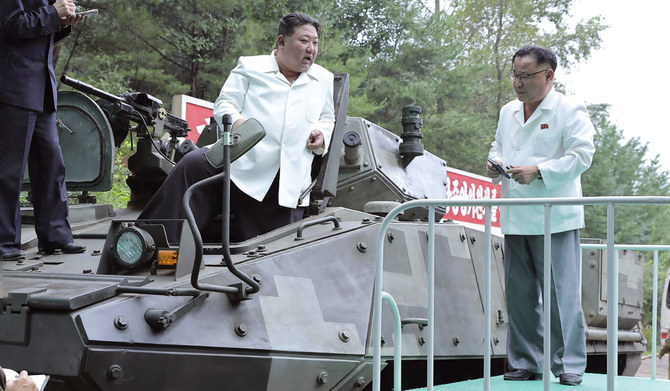
In this undated photo provided on Monday, Aug. 14, 2023, by the North Korean government, North Korean leader Kim Jong Un, center, rides on an armored vehicle during his Aug. 11-12 visit to a military factory in North Korea. (AP)
Short Url
Updated 16 August 2023
Follow

North Korea denounces US plans for an open UN Security Council meeting on its human rights record

  • Russia and China, which have close ties to North Korea, have blocked any Security Council action since vetoing a US-sponsored resolution in May 2022 that would have imposed new sanctions over the North’s spate of intercontinental ballistic missile launche

UNITED NATIONS: North Korea on Tuesday denounced US-led plans for an open Security Council meeting on its human rights record as “despicable” and only aimed at achieving Washington’s geopolitical ambitions.
Vice Foreign Minister Kim Son Gyong called the United States a “declining” power and said if the council dealt with any country’s human rights, the US should be the first “as it is the anti-people empire of evils, totally depraved due to all sorts of social evils.”
The United States, which holds the Security Council presidency this month, scheduled the meeting on human rights in the Democratic People’s Republic of Korea, North Korea’s official name, for Thursday.
It will be the first open council meeting on the DPRK rights issue since 2017. US Ambassador Linda Thomas-Greenfield told reporters last week that UN human rights chief Volker Türk and Elizabeth Salmon, the UN’s independent investigator on human rights in the reclusive northeast Asia country, would brief council members.
The Security Council “must address the horrors, the abuses and crimes being perpetrated” by North Korean leader Kim Jong Il’s regime against its own people as well as the people of Japan and South Korea, Thomas-Greenfield, flanked by the ambassadors from Albania, Japan and South Korea, said when making the announcement.
Nate Evans, the spokesperson for the US Mission to the United Nations, responded to Kim Son Gyong’s remarks by reiterating that North Korea’s ongoing human rights violations and abuses “go against the very principles of the UN Charter and are directly linked to Pyongyang’s unlawful weapons of mass destruction and ballistic missile programs.”
“North Koreans are suffering while the DPRK regime diverts a large share of its budget and resources to weapons development,” Evans said in a statement to The Associated Press.
Russia and China, which have close ties to North Korea, have blocked any Security Council action since vetoing a US-sponsored resolution in May 2022 that would have imposed new sanctions over the North’s spate of intercontinental ballistic missile launches. The council therefore is not expected to take any action at Thursday’s meeting.
China and Russia could protest holding an open meeting, which requires support from at least nine of the 15 council members, but US officials have said the meeting will take place.
Kim, the DPRK’s vice minister for international organizations, warned countries “blindly following the US” to “behave themselves properly.” And he called on all council members “to take a correct stand and attitude,” and said they should understand that the real US intention “has nothing to do with the universal conception of human rights protection and it is only for realizing its narrow-minded and hegemonic geopolitical purpose.”
Kim also warned that North Korea would “resolutely counter any hostile act of the US threatening peace and security on the Korean peninsula and the rest of the world and absolutely defend the sovereignty of the state, the supreme human rights, and the interests of the popular masses.”


Geoeconomic confrontation tops global risks in 2026: WEF report

Updated 4 sec ago
Follow

Geoeconomic confrontation tops global risks in 2026: WEF report

  • Also armed conflict, extreme climate, public polarization, AI
  • None ‘a foregone conclusion,’ says WEF’s MD Saadia Zahidi

DUBAI: Geoeconomic confrontation has emerged as the top global risk this year, followed by state-based armed conflict, according to a new World Economic Forum report.

The Global Risks Report 2026, released on Wednesday, found that both risks climbed eight places year-on-year, underscoring a sharp deterioration in the global outlook amid increased international competition.

The top five risks are geoeconomic confrontation (18 percent of respondents), state-based armed conflict (14 percent), extreme weather events (8 percent), societal polarization (7 percent) and misinformation and disinformation (7 percent).

The WEF’s Managing Director Saadia Zahidi said the report “offers an early warning system as the age of competition compounds global risks — from geoeconomic confrontation to unchecked technology to rising debt — and changes our collective capacity to address them.

“But none of these risks are a foregone conclusion.”

The report assesses risks across three timeframes: immediate (2026); short-to-medium term (next two years); and long term (next 10 years).

Economic risks show the largest overall increase in the two-year outlook, with both economic downturn and inflation jumping eight positions.

Misinformation and disinformation rank fifth this year but rise to second place in the two-year outlook and fourth over the 10-year horizon.

The report suggests this reflects growing anxiety around the rapid adoption of artificial intelligence, with adverse outcomes linked to AI surging from 30th place in the two-year timeframe to fifth in the 10-year outlook.

Uncertainty dominates the global risk outlook, according to the report.

Surveyed leaders and experts view both the short- and long-term outlook negatively, with 50 percent expecting a turbulent or stormy global environment over the next two years, rising to 57 percent over the next decade.

A further 40 percent and 32 percent, respectively, describe the outlook as unsettled across the two- and 10-year timeframes, while just 1 percent anticipate a calm global outlook in either period.

Environmental risks ease slightly in the short-term rankings. Extreme weather fell from second to fourth place and pollution from sixth to ninth. Meanwhile, critical changes to Earth systems and biodiversity loss dropped seven and five positions, respectively.

However, over the next decade, environmental threats re-emerge as the most severe, with extreme weather, biodiversity loss, and critical changes to Earth systems topping the global risk rankings.

Looking ahead over the next decade, around 75 percent of respondents anticipate a turbulent or stormy environmental outlook, making it the most pessimistic assessment across all risk categories.

Zahidi said that “the challenges highlighted in the report underscore both the scale of the potential perils we face and our shared responsibility to shape what comes next.”

Despite the gloomy outlook, Zahidi signaled a positive shift in global cooperation.

 “It is also clear that new forms of global cooperation are already unfolding even amid competition, and the global economy is demonstrating resilience in the face of uncertainty.”

Now in its 21st year, the Global Risks Report highlights a core message: global risks cannot be managed without cooperation.

As competition intensifies, rebuilding trust and new forms of collaboration will be critical, with the report stressing that today’s decisions will shape future outcomes.

The report was released ahead of WEF’s annual meeting, which will be held in Davos from Jan. 19 to 23.