India and US to address barriers to trade and cooperation

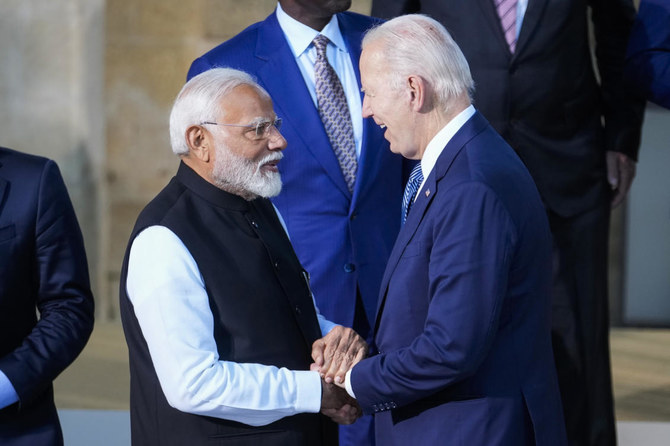
Indian Prime Minister Narendra Modi, left, talks to US President Joe Biden prior a group photo at the G7 in Borgo Egnazia, near Bari in southern Italy, Friday, June 14, 2024. (AP)
Updated 17 June 2024
Follow

India and US to address barriers to trade and cooperation

NEW DELHI: India and the United States on Monday committed to action to address barriers to bilateral strategic trade, technology and industrial cooperation.
The commitment was made at a meeting between the national security advisers of the two countries, Ajit Doval and Jake Sullivan, during Sullivan’s two-day visit to New Delhi.
The US and India are forging deeper strategic ties, with mutual concerns about an ascendant China in the Indo-Pacific region, even though India has maintained its close relationship with Russia despite its invasion of Ukraine in 2022.
Sullivan and his Indian counterpart chaired the second meeting of the India-US initiative on Critical and Emerging Technology, which they launched in January 2023.
Without naming any country, a joint fact sheet of the meeting shared by the Indian government said Sullivan and Doval “resolved to prevent the leakage of sensitive and dual-use technologies to countries of concern.”
They also launched a new strategic semiconductor partnership between US and Indian companies for precision-guided ammunition and other national security-focused electronics platforms, it said.
They also agreed to co-invest in a lithium resource project in South America and a rare earths deposit in Africa “to diversify critical mineral supply chain” and committed to soon conclude a bilateral critical minerals pact for graphite, gallium and germanium.
Last year, during Modi’s state visit to Washington, India had announced buying 31 MQ-9B drones from General Atomic, and the two countries had started discussions to jointly produce General Electric’s fighter jet engines by Hindustan Aeronautics in India, which is yet to be finalized.
Sullivan and Doval also discussed possible co-production of land warfare systems.
The visit is the first by a high-ranking US official since Prime Minister Narendra Modi returned to office with the help of allies as his party failed to win a majority.
Modi met US President Joe Biden on the sidelines of the G7 Summit in Italy last week. Sullivan met Modi and Foreign Minister Subrahmanyam Jaishankar earlier in the day.
The relationship between Washington and New Delhi has been tested after the US accused Indian government agents of plotting to murder a Sikh separatist leader on US soil last year, after Canada made similar allegations. India dismissed the Canadian accusations, but initiated an investigation into the US allegations.
The US has extradited an Indian national from the Czech Republic, whom it has indicted for the foiled assassination plot.
There have also been some concerns raised about the treatment of minorities in India.


Trump insists he struck Iran on his own terms

Updated 04 March 2026
Follow

Trump insists he struck Iran on his own terms

  • “We are now a nation divided between those who want to fight wars for Israel and those who just want peace and to be able to afford their bills and health insurance,” Marjorie Taylor Greene posted on X.
  • Rubio himself doubled down on Tuesday after meeting with US House and Senate members, while insisting that “No, I told you this had to happen anyway”

WASHINGTON, United States: President Donald Trump and his team scrambled Tuesday to reclaim the narrative on why he decided to attack Iran, after his top diplomat suggested the US struck only after learning of an imminent Israeli strike.
Secretary of State Marco Rubio alarmed Democrats — who say only Congress can declare war — as well as many of Trump’s MAGA supporters on Monday when he said: “We knew that there was going to be an Israeli action.”
“We knew that that would precipitate an attack against American forces, and we knew that if we didn’t pre-emptively go after them before they launched those attacks, we would suffer higher casualties,” Rubio told reporters.
Administration officials quickly backpedalled, insisting Trump authorized the strikes because Tehran was not seriously negotiating an accord on limiting its nuclear ambitions, and the United States needed to destroy Iran’s missile capabilities.
“No, Marco Rubio Didn’t Claim That Israel Dragged Trump into War with Iran,” White House Press Secretary Karoline Leavitt posted Tuesday on X.
At an Oval Office meeting later with Germany’s chancellor, Trump went further, saying that “Based on the way the negotiation was going, I think they (Iran) were going to attack first. And I didn’t want that to happen.”
“So, if anything, I might have forced Israel’s hand.”

- Had to happen? -

Rubio himself doubled down on Tuesday after meeting with US House and Senate members, while insisting that “No, I told you this had to happen anyway.”
“The president made a decision. The decision he made was that Iran was not going to be allowed to hide... behind this ability to conduct an attack.”
Critics seized on the muddied messaging to accuse Trump of precipitating the country into a war without a clear rationale, without informing Congress — and without a clear idea of how it might end.
They noted that just two weeks ago, Israel Prime Minister Benjamin Netanyahu pressed Trump again in Washington to take a hard line, in their seventh meeting since Trump’s return to power last year.
Some Republican allies rallied behind the president, with Senator Tom Cotton, chairman of the Senate Intelligence Committee, insisting that “No one pushes or drags Donald Trump anywhere.”
“He acts in the vital national security interest of the United States,” Cotton told the “Fox & Friends” morning show.
But as crucial US midterm elections approach that could see Republicans lose their congressional majority, Trump risks shedding supporters who had welcomed his pledge to end foreign military interventions.
“We are now a nation divided between those who want to fight wars for Israel and those who just want peace and to be able to afford their bills and health insurance,” Marjorie Taylor Greene, a top former Trump ally and a major figure in the populist and isolationist hard right, posted on X.