

Egypt, Jordan, Iraq FMs discuss stronger economic ties at Cairo meeting

1 / 2
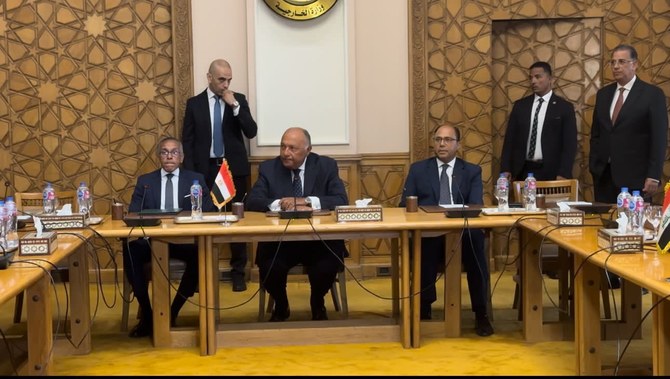
Cairo hosts a tripartite cooperation mechanism meeting between Egypt, Jordan and Iraq. (Twitter/@MfaEgypt)
2 / 2
Cairo hosts a tripartite cooperation mechanism meeting between Egypt, Jordan and Iraq. (Twitter/@MfaEgypt)
Short Url
Updated 16 August 2023
Follow

Egypt, Jordan, Iraq FMs discuss stronger economic ties at Cairo meeting

LONDON: Egyptian Foreign Minister Sameh Shoukry held a meeting in Cairo on Tuesday with his Jordanian counterpart Ayman Safadi and Iraqi counterpart Fuad Hussein to discuss the framework of a cooperation mechanism between the three countries.
Egyptian Foreign Ministry spokesman Ahmed Abu Zeid said that the tripartite mechanism is an important platform as part of joint efforts to strengthen economic cooperation between the three countries.

It also aims to build on consultations and coordination on regional and international issues in order to preserve Arab unity, as well as the security and stability of countries and peoples of the region, he added in a statement.
Abu Zeid said that the three foreign ministers agreed to hold follow-up talks on the sidelines of UN General Assembly meetings in New York in September.


Syrian refugee returns set to slow as donor support fades

Updated 5 sec ago
Follow

Syrian refugee returns set to slow as donor support fades

  • Some aid officials say Syria is one of the first crises to be hit by aid funding cuts because the end of the war means it no longer counts as an emergency, eligible for priority funding

GENEVA: More than 3 million Syrians have returned home since the collapse of Bashar Assad’s rule a year ago but a decline in global funding could deter others, the UN refugee agency said on Monday.
Some 1.2 million refugees in addition to 1.9 million internally displaced people have gone back home following the civil war that ended with Assad’s overthrow, but millions more are yet to return, according to UNHCR.
The agency said much more support was needed to ensure the trend continues.
“Syrians are ready to rebuild – the question is whether the world is ready to help them do it,” said UNHCR head Filippo Grandi. Over 5 million refugees remain outside Syria’s borders, mostly in neighboring countries like Jordan and Lebanon.

RISK OF REVERSALS
Grandi told donors in Geneva last week that there was a risk that those Syrians who are returning might even reverse their course and come back to host states.
“Returns continue in fairly large numbers but unless we step up broader efforts, the risk of (reversals) is very real,” he said.
Overall, Syria’s $3.19 billion humanitarian response is 29 percent funded this year, according to UN data, at a time when donors like the United States and others are making major cuts to foreign aid across the board.
The World Health Organization sees a gap emerging as aid money drops off before national systems can take over.
As of last month, only 58 percent of hospitals were fully functional and some are suffering power outages, affecting cold-chain storage for vaccines.
“Returnees are coming back to areas where medicines, staff and infrastructure are limited – adding pressure to already thin services,” Christina Bethke, Acting WHO Representative in Syria, told reporters.
The slow pace of removing unexploded ordnance is also a major obstacle to recovery, said the aid group Humanity & Inclusion, which reported over 1,500 deaths and injuries in the last year. Such efforts are just 13 percent funded, it said.
Some aid officials say Syria is one of the first crises to be hit by aid funding cuts because the end of the war means it no longer counts as an emergency, eligible for priority funding.
Others may have held back as they wait to see if authorities under President Ahmed Al-Sharaa make good on promises of reform and accountability, including for massacres of the Alawite minority in March, they say.