

Dollar appreciates by Rs3 in interbank market after Dar’s departure, amid rise in demand

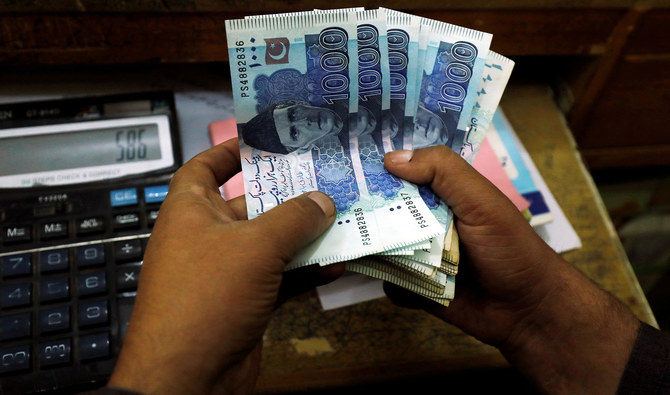
A trader counts Pakistani rupee notes at a currency exchange booth in Peshawar, Pakistan, on December 3, 2018. (Photo courtesy: REUTERS/File)
Short Url
Updated 15 August 2023
Follow

Dollar appreciates by Rs3 in interbank market after Dar’s departure, amid rise in demand

  • The greenback closed at Rs291.51 against the rupee in the interbank market as compared to Friday’s close of Rs288.49
  • Under a $3 billion IMF deal, Pakistan is required to keep exchange rate gap between open and interbank market at 1.5%

KARACHI: Pakistan national currency lost its value by 1.04 percent on Tuesday against United States (US) dollar, currency dealers said, following the departure of finance minister Ishaq Dar from office and amid a surge in demand for import payments. 

The greenback closed at Rs291.51 in the interbank market as compared to Friday’s close of Rs288.49, according to the State Bank of Pakistan and Exchange Companies Association of Pakistan (ECAP). The Pakistani currency also depreciated in the open market, with the dollar rising by Rs4 to Rs300. 

“The departure of Ishaq Dar is also a factor behind the currency depreciation as he was considered a hurdle in the freefall of rupee,” Malik Bostan, the ECAP chairman, told Arab News. 

When Dar assumed charge last year, his arrival was seen as favorable for the rupee. It was followed by a 4.32 percent gain in the value of Pakistani currency in September last year. 

However, the rupee could not continue to strengthen during his stay in office and subsequently lost its value by around 20 percent. 

High demand from Pakistanis going to perform the Umrah pilgrimage is also contributing to pressure on the rupee, according to Bostan. The government has allowed importers to arrange dollars for oil imports on their own, which is also one of the factors behind the rupee’s fall. 

“The importers are arranging dollars from the open market and other sources to make payments for the import of fuel oils that is why the pressure on the rupee is building up,” he said. 

The South Asian nation, under an agreement with the International Monetary Fund (IMF), is bound to keep the exchange rate gap between open and interbank markets not more than 1.5 percent in any five consecutive days, according to Samiullah Tariq, a research director at the Pakistan Kuwait Investment Company. 

However, the gap widened to around 3 percent on Tuesday. 

As Pakistan entered the election phase with the appointment of a caretaker prime minister this week, analysts said the currency market was also jittery as the caretakers would have to make some tough decisions in line with the IMF agreement.  

The stock market remained range-bound and closed up by 141 points at 48,565-level on the back of strong valuation. 

“Pakistan stocks closed higher led by selected scrips across the board on strong valuations though late session pressure was witnessed on falling global crude oil prices and concerns for over Rs2.3 trillion unresolved power sector circular debt issue,” said Ahsan Mehanti, CEO of Arif Habib Corporation brokerage house. 


Pakistan slashes power tariff for industries by Rs4.4 per unit to spur growth

Updated 6 sec ago
Follow

Pakistan slashes power tariff for industries by Rs4.4 per unit to spur growth

  • The development comes as Pakistan navigates a long path to economic recovery under a $7 billion IMF program
  • The reduction in electricity tariffs will allow exporters to offer more competitive prices, increase profits margins

ISLAMABAD: Prime Minister Shehbaz Sharif on Thursday announced a Rs4.4 cut electricity tariffs for industrial consumers, saying the move is aimed at lowering production costs and spurring economic activity in Pakistan.

Sharif made the announcement while addressing businessmen and exporters at a ceremony in Islamabad, at which he presented awards to business figures who made significant contributions to the national economy.

He said the government would devise all future economic policies in consultation with the business community and there was no alternative to export-driven economic growth.

“Four rupees and four paisas per unit are being reduced in electricity tariffs for industry,” the prime minister announced at the ceremony.

“If it were up to me, I would reduce it by another 10 rupees, but my hands are tied.”

The development comes as Pakistan, which has long struggled with boom-bust cycles, seeks to boost foreign investment and increase exports, navigating a long path to economic recovery under a $7 billion International Monetary Fund (IMF) program.

The reduction in electricity tariffs for industrial consumers is expected to lower production costs that will allow exporters to offer more competitive prices in international markets, increase profit margins and encourage higher capacity utilization at factories.

The prime minister announced lowering wheeling charges for industry by Rs9 per unit, noting the country’s economy had stabilized, inflation had come down to single digits and the policy rate stood at 10.5 percent.

In Pakistan, wheeling charges are fees paid by electricity consumers and generators to use the national grid’s transmission and distribution network to move electricity from suppliers to end-users under the Competitive Trading Bilateral Contracts Market (CTBCM).

“I think this should help you sell your power to neighboring industries,” he told businesspersons at the event.