



KARACHI: In the kitchen of a pizzeria in Pakistan’s southern port city of Karachi, two waiters went about their business over the weekend as usual. While one kneaded round pieces of dough with a rolling pin on a small, rectangular table stained with flour, another stacked drinks inside a refrigerator. The two worked in unison but didn’t utter words, for none were needed.
In this Karachi pizzeria, the staff let their hands do the talking.
Located near Perfume Chowk in the city’s Gulistan-e-Jauhar area, ‘The Hot’s or Spicy Pizza’ is a small pizzeria run by Muhammad Noman, 33, and his younger brother Muhammad Yasir. The two brothers, who are deaf and mute, opened the joint in May this year.
Another distinctive feature of the outlet — which barely exceeds the area of a small shop — is that the brothers hired only deaf and mute staffers, but the owner says customers frequent the eatery because of the scrumptious food it offers and not just out of sympathy for the staff and management.
“People do not grace our doorstep out of mere sympathy. They are irresistibly drawn by the flavors we offer,” Noman last week told Arab News in sign language, interpreted by another of his brother, Muhammad Yameen.

Customer purchases a pizza from 'The Hot’s or Spicy Pizza' in Karachi, Pakistan, on August 13, 2023. (AN Photo)
“Through unwavering dedication and genuine sincerity, we ensure that those who experience our cuisine once are enticed to return as loyal patrons.”
The customers agree.
“The delectable and tasty food itself is an attraction,” Afzal Habib, an IT professional, told Arab News, after relishing ‘Matka Fries.’ The dish is basically French fries served in a small earthen pot with a generous helping of ketchup, mayo sauce, and masala sprinkled on top.
“The taste is truly exceptional and the prices are quite reasonable,” Habib added.
The outlet offers pizzas in various flavors, including Tikka, Fajita, Pepperoni, Afghani, and even a Vegetable-only. A small-sized pizza of any flavor is available for Rs300 ($1.03), a medium-sized for Rs450 ($1.55) and a large-sized pizza costs Rs700 ($2.41).
The passion for food, and bad experiences at previous jobs, motivated Noman and Yasir to try their hand at pizza-making and becoming entrepreneurs themselves.
“We embarked on the food business because the workplace where I was employed did not provide the complete salary and would demand excessive work,” Noman said.
“This situation would become distressing for us.”
Yasir said while he worked for six to seven years at different places, he would often think of opening an eatery of his own.
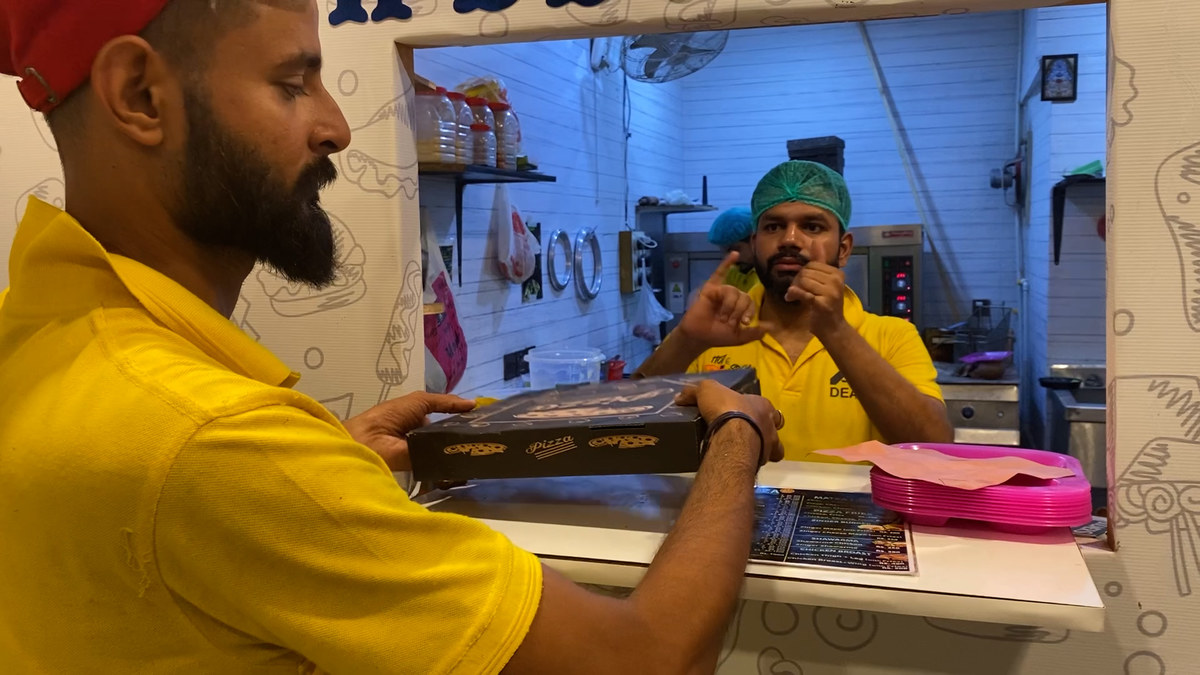
Employees of 'The Hot’s or Spicy Pizza' in Karachi, Pakistan, communicate via sign language with one another on August 13, 2023. (AN Photo)
“Eventually, I initiated this endeavor because food was my passion,” the younger brother told Arab News. “We are enthusiasts of flavors and have explored various places to find good food.”
Yasir recalled an incident about how a person doubted their ability to prepare savory pizzas simply because the brothers and the staff were deaf and mute.
“We suggested he try them [pizzas] first and then form an opinion,” Yasir said. “He initially ordered a small pizza, but after savoring it, was so impressed that he ordered a large one.
“Since then, he has become a regular customer of ours.”
There was also a method to the madness in hiring staffers who were deaf and mute, Noman said.
“It is quite easy to communicate with fellow disabled individuals like us,” he explained. “We are adept at understanding their sign language, and they, in turn, comprehend ours.”
Noman said empathy also drove his decision to hire such staffers, adding he knew first-hand the challenges they faced working elsewhere.
“Primarily, they face salary-related issues, and they also struggle with a lack of connection due to their challenges in understanding and being understood by others,” the 33-year-old said.
Yasir, meanwhile, said they wanted to send a positive message by venturing into a business.
“Some individuals use their disabilities as an excuse,” he said. “Disabilities are a decree from Allah, but they should not be used as an excuse.”


