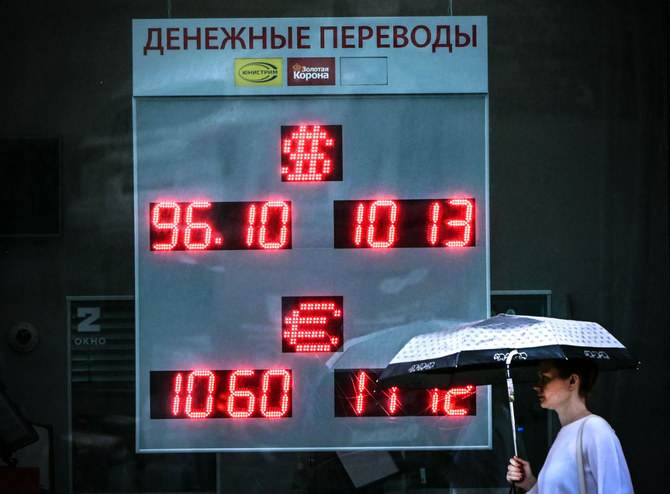
LONDON: The Russian ruble on Monday reached its lowest value since the early weeks of the war in Ukraine as Moscow increases military spending and Western sanctions weigh on its energy exports.
It led Russia’s central bank to announce an emergency meeting for Tuesday to review its key interest rate, raising the likelihood of an increase in borrowing costs that would support the flagging ruble.
The Russian currency had passed 101 rubles to the dollar, continuing a more than one-third decline in its value since the beginning of the year and hitting the lowest level in almost 17 months. The ruble recovered slightly after the central bank’s announcement.
The meeting was set after President Vladimir Putin’s economic adviser, Maksim Oreshkin, blamed the weak ruble on “loose monetary policy” in an op-ed Monday for state news agency Tass. He said a strong ruble is in the interest of the Russian economy and that a weak currency “complicates economic restructuring and negatively affects people’s real incomes.”
Oreshkin said Russia’s central bank has “all the tools necessary” to stabilize the situation and said he expected normalization shortly.
Bank deputy director Alexei Zabotkin told reporters Friday that it is adhering to a floating exchange rate because “it allows the economy to effectively adapt to changing external conditions.”
Analysts say the weakening of the ruble is being driven by increased defense spending — leading imports to rise — and falling exports, particularly in the oil and natural gas sector. Importing more and exporting less means a smaller trade surplus, which typically weighs on a country’s currency.
The Russian economy is now “working on different types of state orders related to the war, such as textile enterprises, pharmaceuticals and the food industry,” said Alexandra Prokopenko, nonresident scholar at the Carnegie Russia Eurasia Center and a former Russian central bank official.
Pivoting the entire economy to a war footing not only drives up imports but also raises the prospect of worsening inflation, she said.
To help lessen that prospect, the central bank said last week that it would stop buying foreign currency on the domestic market until the end of the year to try to prop up the ruble and reduce volatility.
Russia typically sells foreign currency to counter any shortfall in revenue from oil and natural gas exports and buys currency if it has a surplus.
The central bank also enacted a big increase of 1 percent to its key interest rate last month, saying inflation is expected to keep rising and the fall in the ruble is adding to the risk. The next meeting to discuss Russia’s key interest rate was planned for 15 September.
On Monday, some Russians in Moscow appeared concerned about the weakening currency.
“Prices will rise, which means that the standard of living will fall. It has already fallen, and it will fall even more — there are definitely more poor people,” said Vladimir Bessosedny, 63, a retired teacher.
Others hoped the fall of the ruble was temporary and that it would stabilize.
In January, the ruble traded at about 66 to the dollar but lost about a third of its value in subsequent months.
After Western countries imposed sanctions after the invasion of Ukraine in February 2022, the ruble plunged as low as 130 to the dollar, but the central bank enacted capital controls that stabilized its value. By last summer, it was in the 50-60 range to the dollar.
Zabotkin on Friday dismissed speculation that capital flight from Russia also was to blame for the ruble’s fall, saying the idea was “not substantiated.”


![]()

Russian central bank plans to intervene as ruble hits its lowest level since early in the war
Short Url
https://arab.news/pzvs7
Russian central bank plans to intervene as ruble hits its lowest level since early in the war
- The Russian currency had passed 101 rubles to the dollar, continuing a more than one-third decline in its value since the beginning of the year and hitting the lowest level in almost 17 months
- After Western countries imposed sanctions after the invasion of Ukraine in February 2022, the ruble plunged as low as 130 to the dollar


Latest updates


Recommended


© 2026 SAUDI RESEARCH & PUBLISHING COMPANY, All Rights Reserved And subject to Terms of Use Agreement.