

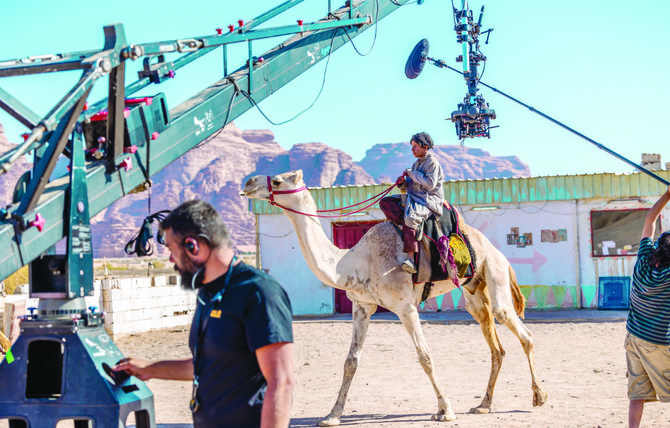


DHAHRAN: Ithra, the King Abdulaziz Center for World Culture, will debut the world premiere of its most recent feature film, “Hajjan" at the 48th Toronto International Film Festival next month.
The coming-of-age film follows a young Saudi orphan, Matar, who embarks on an epic journey across the Kingdom’s vast desert with his beloved camel, Hofira. Once tragedy strikes, the two find themselves on a journey racing other camels in a quest to help restore the past and save the future.
“Hajjan” which translates to cameleer or camel jockey, is scheduled for wider release in 2024, the year designated as the UN’s “International Year of Camelids.”

Actress Alshaima’a Tayeb and various members of the cast and crew during filming. (Supplied)
Arab News sat down with three of the key people who created the film, director Abu Bakr Shawky, Film Clinic founder and producer Mohamed Hefzy, and Majed Z. Samman, producer at Ithra Film Production, before the film makes its international debut next month, as part of TIFF’s Discovery program.
Samman said, “We are thrilled to present this universal story from a unique Saudi perspective to the world through Ithra Film Production. Our mission is to support Saudi Arabia’s growing film industry by nurturing home-grown talent and promoting cinematic content creation.”
Ithra collaborated with Film Clinic, one of the top indie film producers in the Arab region, to make the feature. It was shot during the last two months of 2022 in locations in northwestern Saudi Arabia as well as in neighboring Jordan.
HIGHLIGHTS
• Ithra collaborated with Film Clinic, one of the top indie film producers in the Arab region, to make ‘Hajjan.’
• ‘Hajjan’ is scheduled for wider release in 2024.
• 15-year-old newcomer Omar Alatawi will soon also be seen in the yet-to-be- released feature ‘Desert Warrior’ opposite Sir Ben Kingsley.
“Hajjan” is Egyptian Austrian writer and director Shawky’s second feature film. His debut, “Yomeddine,” was screened to critical acclaim at the 2018 Cannes Film Festival.
Egyptian producer and screenwriter Hefzy is one of the leading producers in the Middle East and North Africa region, with a filmography of more than 40 titles to date. Saudi Arabia’s own Samman, the resident Ithra “film guy,” has several titles already under his belt, including “Valley Road,” which is currently playing in Saudi cinemas.
It all began around three years ago.

Actress Alshaima’a Tayeb and various members of the cast and crew during filming. (Supplied)
Samman told Arab News: “It started in December 2020, I got an email (from Abdullah Al-Rashid, director of Ithra) saying, ‘We need a world-class film about camels.’ I laughed. I asked him if he was serious. He said, ‘Yes.’”
That weekend, he worked on the idea and brainstormed with his team in-person at the Ithra office, and a short time after, they had something written up. Management looked at it and gave them the green light. Then the real fun began.
“We went out looking for people who can make this movie with us. But from the beginning, I wanted to approach either Saudis or pan-Arab filmmakers: One, because of the subject matter — camels and Saudi culture — two, we have the talent pool in the region, why go abroad?” Samman explained.
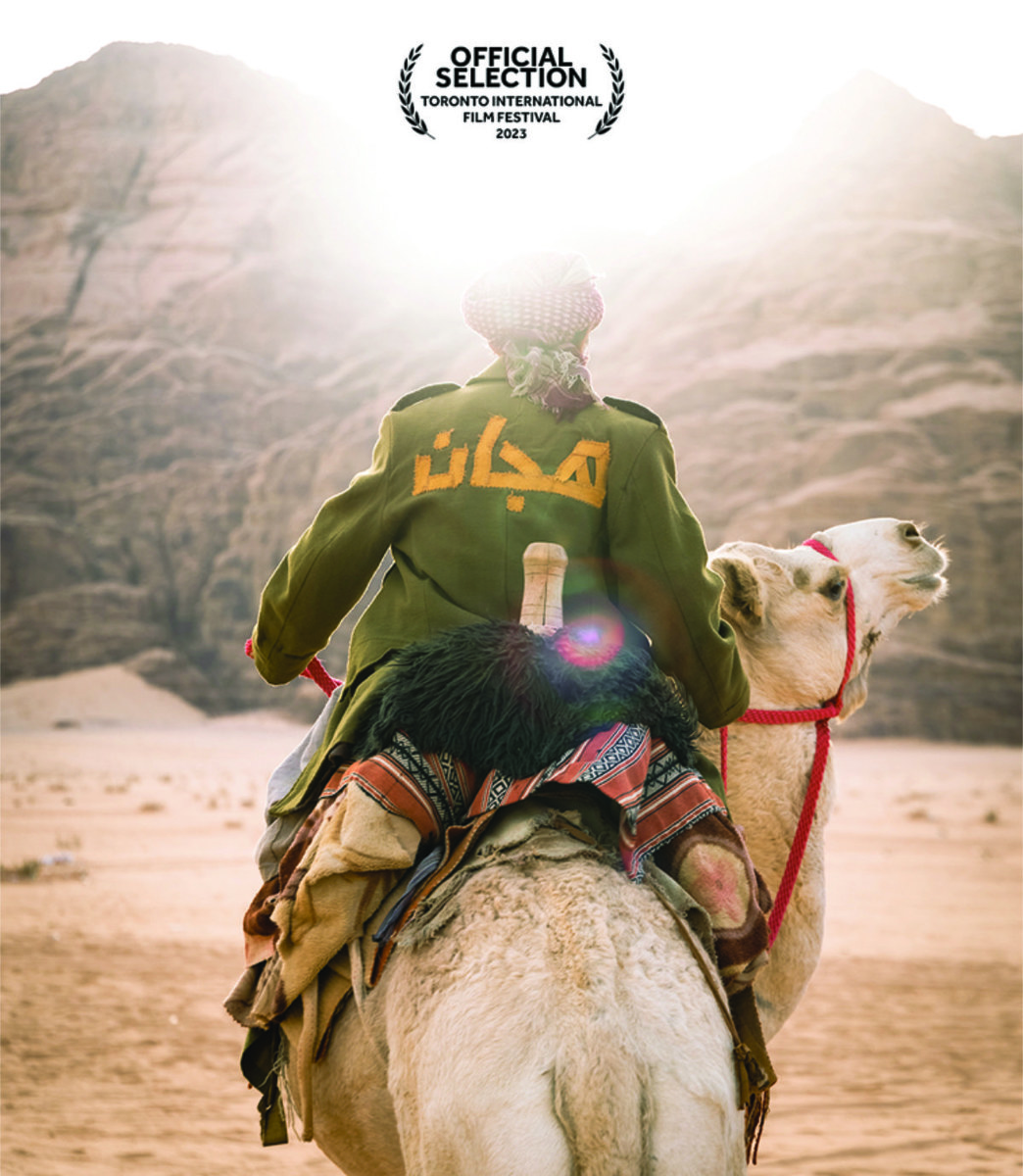
“Hajjan” is Egyptian Austrian writer and director Shawky’s second feature film. (Supplied)
That was when Shawky came into the picture. He had grown up watching John Wayne and Clint Eastwood Westerns and always longed for a regional version of it.
Speaking about what drew him to the project, Shawky said: “I thought it was a really interesting proposition because I don’t think there’s been movies about camel racing at all. There was this lure of going to Saudi Arabia and shooting a desert epic—which I’ve always wanted to do. A big desert epic that talks about Arabic folklore and the stories of the desert, sandstorms and things like that.”
We are thrilled to present this universal story from a unique Saudi perspective to the world through Ithra Film Production. Our mission is to support Saudi Arabia’s growing film industry by nurturing home-grown talent and promoting cinematic content creation.
Majed Z. Samman, Producer, Ithra Film Production
The film was written by Mufarij Almijfil and Omar Shama, featuring visual effects by Chadi Abo and a score by Amine Bouhafa. It was co-produced by Rula Nasser, and the cast was made of a mix of veterans and emerging talents. “Hajjan” stars legendary actor Abdulmohsen Al-Nimr and actress Alshaima’a Tayeb, and introduces 15-year-old newcomer Omar Alatawi as Matar, who will soon also be seen in the yet-to-be-released feature “Desert Warrior” opposite Sir Ben Kingsley.
The filmmakers went through the standard casting process for the professional actors.
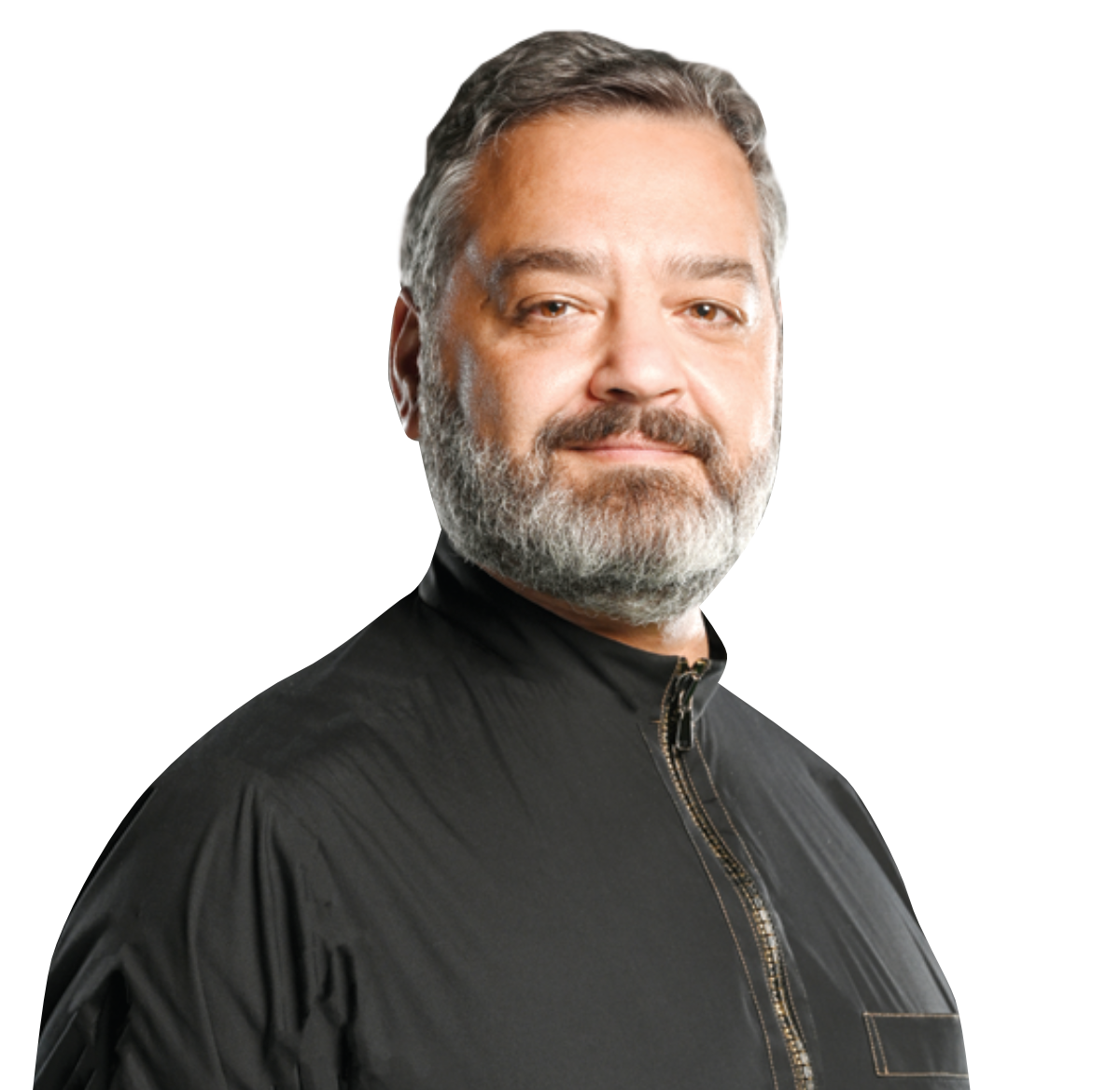
Majed Z. Samman, Producer, Ithra Film Production
Shawky explained: “For the role of Matar, which is the little boy, we went though a pretty rigorous kind of casting process where we knew we were looking for a 15-year-old kid that drives camels — which is not something that you find very often as a professional actor.
“So, we had to go the route of looking for non-actors and went through dozens of children and eventually found one who is a great talent, with a great cinematic face and just a great presence.”
According to Shawky, it was a bit difficult for the young actors to learn their lines but Alatawi, who had more speaking parts than his previous acting experience, was the epitome of professionalism and did not waste much time on set. During their 12-hour shoots, which sometimes went up to 14-hour days, the young actor was a trooper.
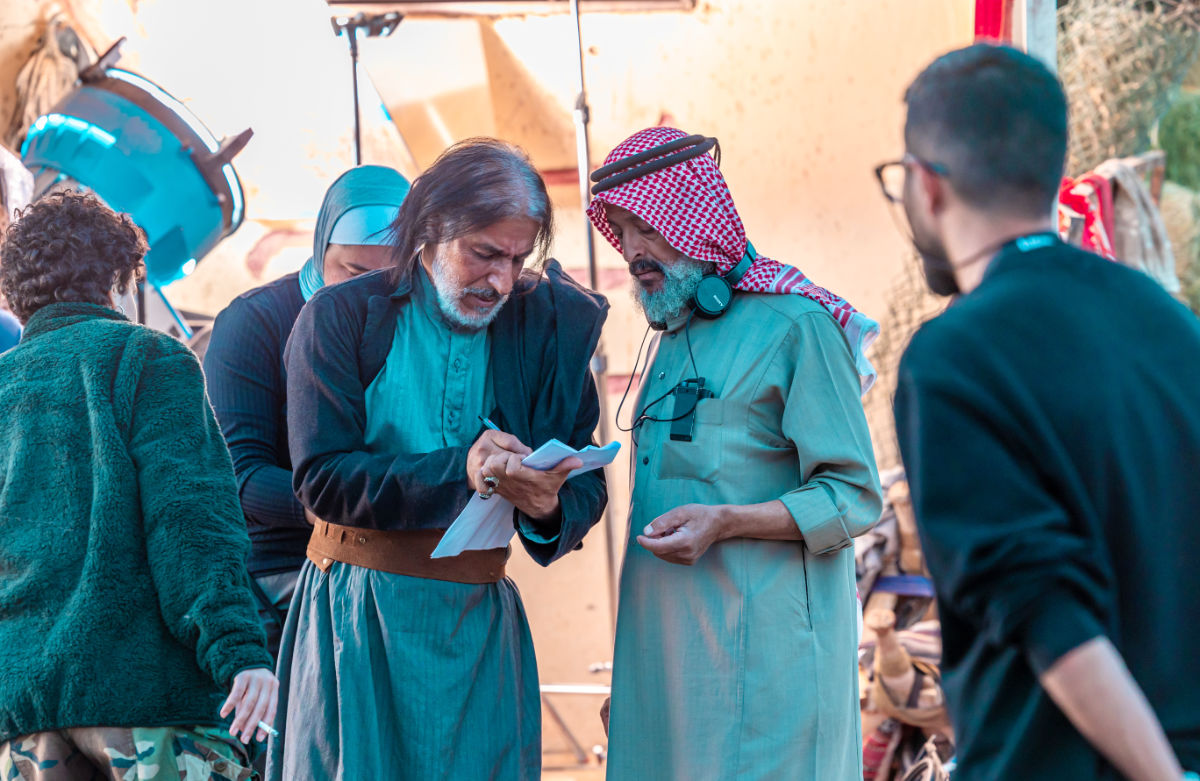
Ithra offers numerous workshops for aspiring filmmakers to master the art of storytelling for the big screen. (Supplied)
Alatawi had an arrangement with his family and school so he could be on set all day and still keep up with his education during the grueling two-month shoot schedule. Since they shot in November and December, the weather was fairly cool but the temperatures dropped significantly at night and made for an interesting bonding experience for many of the crew members who had long stretches to talk about life and contemplate things.
Their collective goal was to “show and not just tell” to the Western — and even Eastern — world what a camel symbolizes and how important this creature is to the Arabian Peninsula and to Saudis.
Speaking about the cultural oneness of the wider region the film was shot in, namely Saudi Arabia and Jordan, Hefzy said: “It was a long but fun journey in which I really discovered a lot about this country, the people. I realized that the people that live in Sinai, and the people that live near Petra, Jordan, and people that live in the north of Saudi Arabia may have more in common in their way of life or the love of camel breeding and camel racing, than me and that person in Egypt would have in common, even though we’re both Egyptian.”
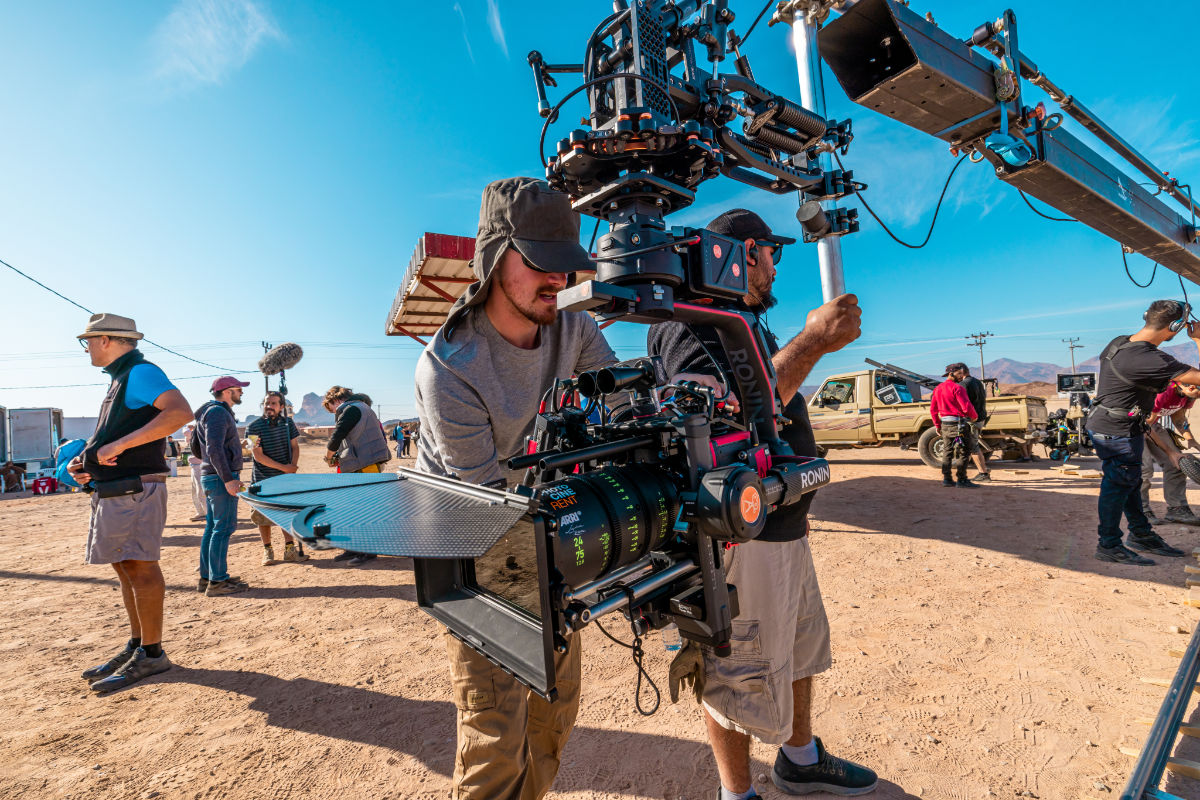
The filmmakers went through the standard casting process for the professional actors. (Supplied)
However, he emphasized that many values and traditions injected into the film could be easily understood, no matter where one comes from. “Those values are very relatable to an international audience, even though the culture itself is very specific. It was really interesting for me to learn about this world and to try to find a way to tell the story that's universal, and to make the film at a production value and with the right technical skills and artistic quality that can speak and translate to an international audience,” he said.
One of the biggest challenges to Hefzy was that the writers were not always writing from the same place — both physically and figuratively. They had to merge drafts and decide what to keep what to throw out. The writing process was a collaborative team effort.
“The development took maybe nine months, pre-production took another six months (and it took) a few months just to get the contracts out of the way and all that. But I think it was necessary to take that time in writing and pre-production to be able to produce the film at the level that it is now,” he explained.

Ithra offers numerous workshops for aspiring filmmakers to master the art of storytelling for the big screen. (Supplied)
Throughout the shoot, some unexpected things came up.
“They always say: ‘Don’t work with kids, don’t work with animals, don’t work with moving vehicles.’ We did all of the above,” he said. The team estimates that they used between 100 and 200 camels on the film at the various locations in Saudi Arabia and Jordan.
One unlikely hurdle stood in the way of the film finishing up was the recent riots in France. Various aspects of technical production like sound affects and the sound mixing were done in Paris, so things were delayed, but it will be ready for screening at the TIFF.

Ithra offers numerous workshops for aspiring filmmakers to master the art of storytelling for the big screen. (Supplied)
Samman was adamant about not “spoon-feeding” the audience and pushing any agenda. He wanted to organically depict the closeness of the camels with their human companions and how the land and the community all merge within the larger narrative.
“It’s a big, huge responsibility to make this film. And especially because the subject matter is something that was unknown for me — or even the other filmmakers. But when we did this movie, we said, we don’t understand anything about it but we’ll learn; we’re good at filmmaking,” Samman added. “So we’ll make it as cinematic as possible, even if you don’t understand the subject, which is fine. As a producer, I need to say that what we did was good. So when I did watch it, I was relieved and happy and proud.”
Ithra has produced more than 23 films, of which 15 have received local, regional and international awards. To date, Ithra productions have been screened at 17 festivals around the world.

The UN has designated 2024 as the ‘International Year of Camelids.’ (Supplied)
“When people ask us: ‘What is your mission and vision here?’ It is to elevate our talent and to elevate our understanding of the culture here in the country,” Samman said. “We haven’t had movies for the past 30 plus years, and all the Saudi filmmakers or ‘content creators,’ what did they do? They filmed using their phones, and edited and put it on YouTube, which is beautiful — but it’s not cinema. So what we’re trying to do is elevate that and make it into cinema.”
Ithra is providing ample opportunities for aspiring filmmakers to take workshops to understand how to be storytellers and tell those narratives for the big screen.
“We have endless stories and we’re amazing storytellers; orally but not visually. So this is what we’re trying to do. We’re pivoting to the next level, visually telling our story. And we have a lot of stories. Hollywood is not doing very well lately,” Samman concluded.
It is now time, according to them, for Saudi cinema to take over.


