

Echoes of history: International news headlines welcoming Pakistan’s freedom in 1947

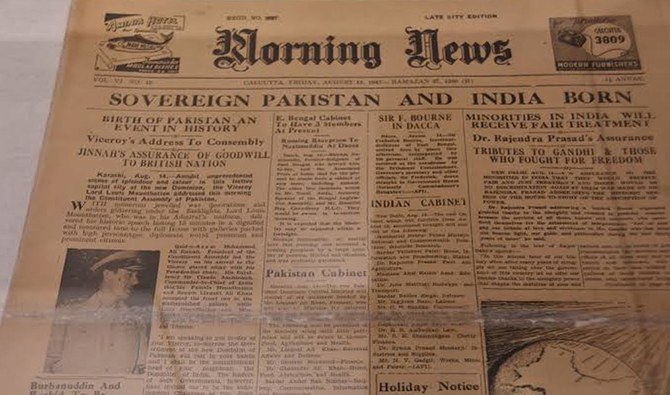
Frontpage view of the Morning News newspaper's August 15, 1947 edition announcing birth of India and Pakistan. (Photo courtesy: South Asian Voices)
Short Url
Updated 14 August 2023
Follow

Echoes of history: International news headlines welcoming Pakistan’s freedom in 1947

  • Freedom of one-fifth of humanity and the beginning of decolonization process grabbed headlines around the world
  • “Birth of Pakistan an Event in History,” said Dawn newspaper as it chronicled one of the biggest events of the 20th century

ISLAMABAD: As Pakistan celebrates its 77th Independence Day, most of its citizens may not be aware of how the news of their freedom from the British empire after about 200 years of colonial rule was received by the rest of the world where the international press prominently splashed it on the front page of their publications.

For over a century, Pakistan, which was part of the Indian subcontinent, played a significant role as one of the crown jewels in the British Empire’s colonial dominion. This strategic region was seen as a prized possession due to its valuable resources, diverse cultures, and geostrategic importance.

Pakistan’s fertile lands, rich natural resources, and vital trade routes made it a focal point for British economic interests. The empire exploited these resources for its gain, leading to the establishment of industries, railways, and infrastructure that primarily served Britain’s colonial ambitions.

“Birth of Pakistan an Event in History,” said the headline of the country’s Dawn newspaper as it chronicled one of the biggest events of the 20th century, when about one-fifth of humanity secured its freedom and set the decolonization process rolling.


Frontpage view of Dawn newspaper's August 15, 1947 edition reporting the creation of Pakistan. (Photo courtesy: Zahra/Pinterest)

Another front-page news item said: “Lord Mountbatten’s Address to Pakistan Constituent Assembly; Colorful Scenes of Splendor at the Secretariat Hall.”

The Statesman, a renowned Indian publication from Kolkata, announced the birth of the new countries with the following headline: “Inauguration of Two Dominions.”

The Morning News said, “Sovereign Pakistan and India Born” and Lahore-based The Tribune announced in its headline: “India Wakes to Life & Freedom.”

Leading newspapers in the United Kingdom also prominently displayed the story.

The Guardian conveyed a poignant message: “Farewell and Hail, End of the Indian Empire: Birth of Two Dominions.”

The Mail concisely stated, “Birth of Two Nations.”

Across the Atlantic, the United States press also contributed its perspectives to the historic event.

The Washington Post’s front page exclaimed, “India Achieves Sovereignty Amid Scenes of Wild Rejoicing,” capturing the ecstatic mood of the time.


Frontpage view of the Mail newspaper's August 15, 1947 edition announcing the birth of India and Pakistan. (Photo courtesy: Alamy)

The New York Times reported, “India and Pakistan Become Nations, Clashes Continue,” reflecting the mixed emotions that accompanied the birth of these nations and the violence that came with the mass migration.

Meanwhile, the New York World-Telegram announced, “Two New Nations Born as British End 200 Years’ Rule,” encapsulating the end of a long colonial era.


Pakistan to promote mineral sector at Saudi forum this month with 13 companies

Updated 02 January 2026
Follow

Pakistan to promote mineral sector at Saudi forum this month with 13 companies

  • Delegation will take part in the Future Minerals Forum in Riyadh from Jan. 13-15
  • Petroleum minister will lead Pakistan, participate in a 90-minute country session

ISLAMABAD: Around 13 Pakistani state-owned and private companies will attend the Future Minerals Forum (FMF) in Saudi Arabia from Jan. 13 to 15, an official statement said on Friday, as the country seeks to ramp up global engagement to develop its mineral resources.

The FMF is an international conference and investment platform for the mining sector, hosted by mineral-rich countries to attract global investors, companies and governments.

Petroleum Minister Ali Pervaiz Malik confirmed Pakistan’s participation in a meeting with the Saudi envoy, Nawaf bin Said Al-Malki.

Pakistan hosts one of the world’s largest copper-gold zones. The Reko Diq mine in southwestern Balochistan, with an estimated 5.9 billion tons of ore, is partly owned by Barrick Gold, which calls it one of the world’s largest underdeveloped copper-gold deposits. Its development is expected to boost Pakistan’s struggling economy.

“Upon an invitation of the Government of the Kingdom of Saudi Arabia, the Federal Minister informed the Ambassador that Pakistan will fully participate in the upcoming Future Minerals Forum (FMF), scheduled to be held in Riyadh later this month,” Pakistan’s Press Information Department (PID) said in an official statement.

The Pakistani minister will lead his country’s delegation at the FMF and take part in a 90-minute country showcase session titled “Unleashing Potential: Accelerating Pakistan’s Mineral Revolution” along with local and foreign investors.

Pakistan will also establish a dedicated pavilion to highlight the vast potential of its rich geological landscape to the global mineral community.

The Saudi envoy welcomed Pakistan’s decision to participate in the forum and discussed enhancing bilateral cooperation in the minerals and energy sectors during the meeting.

According to the statement, he highlighted the potential for cooperation between Saudi Arabia and Pakistan in the minerals and energy sectors, expressing confidence that the FMF would provide a platform to expand collaboration.
Pakistan’s mineral sector, despite its rich reserves of salt, copper, gold and coal, contributes only 3.2 percent to the country’s GDP and just 0.1 percent to global mineral exports.

However, many countries, including the United States, have shown interest in Pakistan’s underdeveloped mineral sector, particularly in copper, gold and other critical resources.

In October, Pakistan dispatched its first-ever shipment of rare earth and critical minerals to the United States, according to a Chicago-based US public relations firm’s report.