

Echoes of history: International news headlines welcoming Pakistan’s freedom in 1947

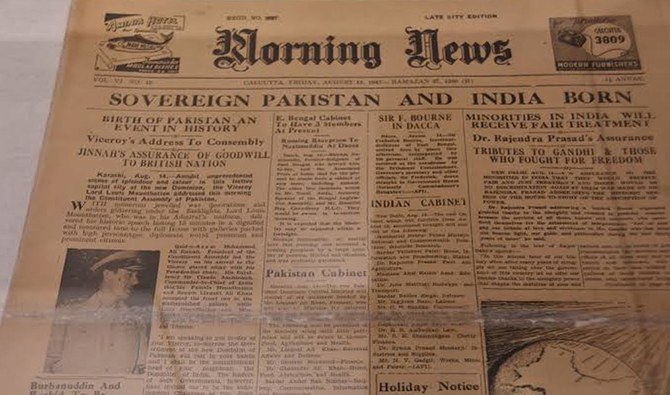
Frontpage view of the Morning News newspaper's August 15, 1947 edition announcing birth of India and Pakistan. (Photo courtesy: South Asian Voices)
Short Url
Updated 14 August 2023
Follow

Echoes of history: International news headlines welcoming Pakistan’s freedom in 1947

  • Freedom of one-fifth of humanity and the beginning of decolonization process grabbed headlines around the world
  • “Birth of Pakistan an Event in History,” said Dawn newspaper as it chronicled one of the biggest events of the 20th century

ISLAMABAD: As Pakistan celebrates its 77th Independence Day, most of its citizens may not be aware of how the news of their freedom from the British empire after about 200 years of colonial rule was received by the rest of the world where the international press prominently splashed it on the front page of their publications.

For over a century, Pakistan, which was part of the Indian subcontinent, played a significant role as one of the crown jewels in the British Empire’s colonial dominion. This strategic region was seen as a prized possession due to its valuable resources, diverse cultures, and geostrategic importance.

Pakistan’s fertile lands, rich natural resources, and vital trade routes made it a focal point for British economic interests. The empire exploited these resources for its gain, leading to the establishment of industries, railways, and infrastructure that primarily served Britain’s colonial ambitions.

“Birth of Pakistan an Event in History,” said the headline of the country’s Dawn newspaper as it chronicled one of the biggest events of the 20th century, when about one-fifth of humanity secured its freedom and set the decolonization process rolling.


Frontpage view of Dawn newspaper's August 15, 1947 edition reporting the creation of Pakistan. (Photo courtesy: Zahra/Pinterest)

Another front-page news item said: “Lord Mountbatten’s Address to Pakistan Constituent Assembly; Colorful Scenes of Splendor at the Secretariat Hall.”

The Statesman, a renowned Indian publication from Kolkata, announced the birth of the new countries with the following headline: “Inauguration of Two Dominions.”

The Morning News said, “Sovereign Pakistan and India Born” and Lahore-based The Tribune announced in its headline: “India Wakes to Life & Freedom.”

Leading newspapers in the United Kingdom also prominently displayed the story.

The Guardian conveyed a poignant message: “Farewell and Hail, End of the Indian Empire: Birth of Two Dominions.”

The Mail concisely stated, “Birth of Two Nations.”

Across the Atlantic, the United States press also contributed its perspectives to the historic event.

The Washington Post’s front page exclaimed, “India Achieves Sovereignty Amid Scenes of Wild Rejoicing,” capturing the ecstatic mood of the time.


Frontpage view of the Mail newspaper's August 15, 1947 edition announcing the birth of India and Pakistan. (Photo courtesy: Alamy)

The New York Times reported, “India and Pakistan Become Nations, Clashes Continue,” reflecting the mixed emotions that accompanied the birth of these nations and the violence that came with the mass migration.

Meanwhile, the New York World-Telegram announced, “Two New Nations Born as British End 200 Years’ Rule,” encapsulating the end of a long colonial era.


Pakistan welcomes Afghan scholars’ reported resolution against use of soil for cross-border attacks

Updated 5 sec ago
Follow

Pakistan welcomes Afghan scholars’ reported resolution against use of soil for cross-border attacks

  • Around 1,000 Afghan scholars passed a resolution this week prohibiting use of Afghan soil for cross-border attacks against another country, Afghan media reported
  • Development takes place as tensions persist between Pakistan and Afghanistan amid Islamabad’s allegations of Taliban supporting cross-border attacks against it 

ISLAMABAD: Pakistan’s foreign office spokesperson on Thursday welcomed a resolution reportedly passed by Afghan scholars against allowing the use of Afghan soil for attacks against any other country, but still demanded written assurances of the same from the Afghan leadership. 

According to a report published by Afghan news channel Tolo News, around 1,000 Afghan scholars gathered in Kabul on Wednesday to pass a resolution that, among other things, said no one will be allowed to use Afghanistan’s soil against other countries for attacks. The resolution also said that if anyone fails to comply with this decision, the Afghan government has the right to take action against them.

The development takes place as tensions persist between Afghanistan and Pakistan. Both countries have engaged in border clashes since October, with Islamabad accusing Kabul of harboring militants that launch attacks on Pakistan.

Afghanistan denies the allegation and says it cannot be held responsible for Pakistan’s security. 

Speaking to reporters during a weekly press briefing, Foreign Office spokesperson Tahir Andrabi said he had not seen the full text of the resolution. 

“Any developments with regards to the fact that Afghan leadership, the segment of Afghan society, realized the gravity of the situation that their soil is being used by not just TTP, but also by their own nationals to perpetrate terrorism in Pakistan — any realization to this effect is positive and one would certainly welcome it,” Andrabi said.

However, he said similar commitments by Kabul on preventing cross-border attacks have been made in the past but were not honored. 

Pakistan and Kabul engaged in a series of peace talks in Istanbul and Doha recently after their deadly border clashes in October. Andrabi pointed out that Islamabad had insisted on getting written assurances from the Afghan leadership that they would prevent Afghan soil from being used by the Pakistani Taliban and other militant groups. However, he said Islamabad had not received any. 

He said the resolution by Afghan scholars does not qualify as a proper written assurance from Kabul as it does not explicitly mention Pakistan or the Pakistani Taliban.

’NO FORMAL EXTRADITION TREATY’

Commenting on media reports of Islamabad seeking extradition of certain individuals from the UK, Andrabi confirmed that there exists no formal extradition treaty between Pakistan and the UK. However, he said cases can still be processed individually.

“In the absence of a formal treaty, the extradition cases can be processed on a case-to-case basis,” the FO spokesperson said. “And certain cases were submitted to the British High Commission in Islamabad for their consideration.”

Pakistan last week asked the UK to extradite two prominent pro-Imran Khan figures, former accountability aide Shehzad Akbar and YouTuber-commentator Adil Raja, saying they were wanted on charges of anti-state propaganda.

The issue had been brought up during Pakistan Interior Minister Mohsin Naqvi’s meeting with British High Commissioner Jane Marriott in Islamabad. The Interior Ministry said Naqvi had formally handed over Pakistan’s extradition documents, requesting that Raja and Akbar be returned to Pakistan without delay.