

Two militants killed in attack on Chinese engineers in Pakistan’s Gwadar — official

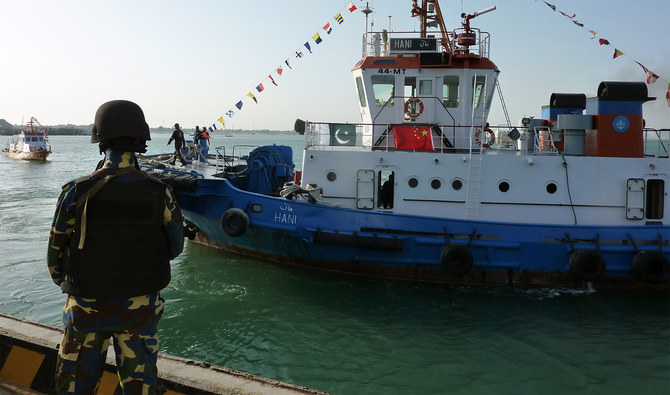
This file photograph taken on April 11, 2016, shows Pakistan Naval soldiers as they stand guard at the port of Gwadar, some 700kms west of Karachi. (AFP/File)
Short Url
Updated 13 August 2023
Follow

Two militants killed in attack on Chinese engineers in Pakistan’s Gwadar — official

  • Balochistan information secretary says Chinese escaped attack unhurt, situation under control
  • Beijing advises Chinese citizens in Pakistan to take ‘preventive measures’ against security risks

KARACHI: Two militants were killed in an attack on a convoy carrying Chinese engineers in the southwestern Pakistani port city of Gwadar, a government official said on Sunday, amid a surge in militant violence in the insurgency-hit Balochistan province.

The Gwadar port city lies at the heart of the China-Pakistan Economic Corridor (CPEC), a $65 billion network of roads, railways, pipelines, and ports in Pakistan that will connect China to the Arabian Sea and help Islamabad expand and modernize its economy.

Balochistan Information Secretary Hamza Shafqat said the Chinese nationals remained unhurt in the wake of the attack, which has been claimed by the outlawed Balochistan Liberation Army (BLA).

“The situation is under control. Two terrorists [have been] killed,” Shafqaat told Arab News over the phone. “Chinese are safe. Law enforcement agencies are combing the area.”

A source told Arab News the attack took place near Faqir Colony on Gwadar’s Airport Road.

Pakistan’s army confirmed militants had attacked a military convoy at 10:00 a.m. in Gwadar.

“Terrorists used small arms and hand grenades during the activity, however, due to efficient and swift response, two terrorists were sent to hell with no harm to any military or civil persons,” a statement from the army’s media wing, the Inter-Services Public Relations (ISPR) said.

Following the attack, China strongly condemned the incident and urged Pakistan to conduct a thorough probe into it. 

“The Embassy and the Consulate General in Karachi launched emergency response immediately, requesting the Pakistani authorities to conduct a thorough investigation on the attack, severely punish the perpetrators, take practical and effective measures to prevent similar incidents from happening again,” the Chinese embassy in Islamabad issued a statement.

The embassy reminded Chinese citizens in Pakistan “to be vigilant and take preventive measures against security risks” given the current security situation in Pakistan.

Balochistan, which shares a porous border with Iran and Afghanistan, has been the scene of a low-level insurgency by Baloch nationalists for around two decades. The separatists say they are fighting what they see as the unfair exploitation of the province’s wealth by the federation. The Pakistani state denies it.

The attack comes days after Pakistani forces killed two militants in an intelligence-based operation in Balochistan’s Kech district, according to the Inter-Services Public Relations (ISPR), the military’s media wing.

Pakistan has long accused neighboring countries and hostile agencies for harboring Baloch separatist fighters and other armed groups that operate in the Balochistan province.

Separately, the Pakistani military said on Sunday it had killed four militants in an intelligence-based operation in the Bajaur tribal district in the country’s northwest that borders Afghanistan.

A Pakistani soldier was also killed in the intense exchange of fire, while a militant was apprehended, according to the ISPR.

“Weapons, ammunition and explosives including a suicide vest was also recovered from the terrorists, who remained actively involved in numerous terrorist activities against security forces and killing of innocent citizens, especially suicide blasts,” the ISPR added.

The Pakistani government in July expressed serious concerns over militant “save havens” in Afghanistan after nine Pakistani soldiers were killed in an attack on a garrison in Balochistan.


Pakistan to promote mineral sector at Saudi forum this month with 13 companies

Updated 02 January 2026
Follow

Pakistan to promote mineral sector at Saudi forum this month with 13 companies

  • Delegation will take part in the Future Minerals Forum in Riyadh from Jan. 13-15
  • Petroleum minister will lead Pakistan, participate in a 90-minute country session

ISLAMABAD: Around 13 Pakistani state-owned and private companies will attend the Future Minerals Forum (FMF) in Saudi Arabia from Jan. 13 to 15, an official statement said on Friday, as the country seeks to ramp up global engagement to develop its mineral resources.

The FMF is an international conference and investment platform for the mining sector, hosted by mineral-rich countries to attract global investors, companies and governments.

Petroleum Minister Ali Pervaiz Malik confirmed Pakistan’s participation in a meeting with the Saudi envoy, Nawaf bin Said Al-Malki.

Pakistan hosts one of the world’s largest copper-gold zones. The Reko Diq mine in southwestern Balochistan, with an estimated 5.9 billion tons of ore, is partly owned by Barrick Gold, which calls it one of the world’s largest underdeveloped copper-gold deposits. Its development is expected to boost Pakistan’s struggling economy.

“Upon an invitation of the Government of the Kingdom of Saudi Arabia, the Federal Minister informed the Ambassador that Pakistan will fully participate in the upcoming Future Minerals Forum (FMF), scheduled to be held in Riyadh later this month,” Pakistan’s Press Information Department (PID) said in an official statement.

The Pakistani minister will lead his country’s delegation at the FMF and take part in a 90-minute country showcase session titled “Unleashing Potential: Accelerating Pakistan’s Mineral Revolution” along with local and foreign investors.

Pakistan will also establish a dedicated pavilion to highlight the vast potential of its rich geological landscape to the global mineral community.

The Saudi envoy welcomed Pakistan’s decision to participate in the forum and discussed enhancing bilateral cooperation in the minerals and energy sectors during the meeting.

According to the statement, he highlighted the potential for cooperation between Saudi Arabia and Pakistan in the minerals and energy sectors, expressing confidence that the FMF would provide a platform to expand collaboration.
Pakistan’s mineral sector, despite its rich reserves of salt, copper, gold and coal, contributes only 3.2 percent to the country’s GDP and just 0.1 percent to global mineral exports.

However, many countries, including the United States, have shown interest in Pakistan’s underdeveloped mineral sector, particularly in copper, gold and other critical resources.

In October, Pakistan dispatched its first-ever shipment of rare earth and critical minerals to the United States, according to a Chicago-based US public relations firm’s report.