Shippers warned to stay away from Iranian waters over seizure threat as US-Iran tensions high

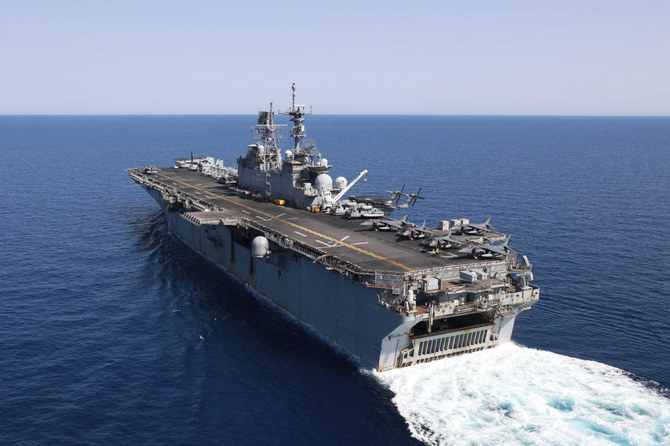
In this photo released by the US Navy, the amphibious assault ship USS Bataan travels through the Red Sea on Aug. 8, 2023. (AP file photo)
Short Url
Updated 13 August 2023
Follow

Shippers warned to stay away from Iranian waters over seizure threat as US-Iran tensions high

  • US exploring plans to put armed troops on commercial ships to deter Iranian military buildup

DUBAI: Western-backed maritime forces in the Middle East on Saturday warned shippers traveling through the strategic Strait of Hormuz to stay as far away from Iranian territorial waters as possible to avoid being seized, a stark advisory amid heightened tensions between Iran and the US
A similar warning went out to shippers earlier this year ahead of Iran seizing two tankers traveling near the strait, the narrow mouth of the Arabian Gulf through which 20 percent of the world’s oil passes.
While Iran and the US now near an apparent deal that would see billions of Iranian assets held in South Korea unfrozen in exchange for the release of five Iranian-Americans detained in Tehran, the warning shows that the tensions remain high at sea. Already, the US is exploring plans to put armed troops on commercial ships in the strait to deter Iran amid a buildup of troops, ships and aircraft in the region.
US Navy Cmdr. Timothy Hawkins, a spokesman for the Mideast-based 5th Fleet, acknowledged the warning had been given, but declined to discuss specifics about it.
A US-backed maritime group called the International Maritime Security Construct “is notifying regional mariners of appropriate precautions to minimize the risk of seizure based on current regional tensions, which we seek to de-escalate,” Hawkins said. “Vessels are being advised to transit as far away from Iranian territorial waters as possible.”
Separately, a European Union-led maritime organization watching shipping in the strait has “warned of a possibility of an attack on a merchant vessel of unknown flag in the Strait of Hormuz in the next 12 to 72 hours,” said private intelligence firm Ambrey.
“Previously, after a similar warning was issued, a merchant vessel was seized by Iranian authorities under a false pretext,” the firm warned.
The EU-led mission, called the European Maritime Awareness in the Strait of Hormuz, did not immediately respond to a request for comment.
Iran through its state media did not acknowledge any new plans to interdict vessels in the strait. Iran’s mission to the United Nations did not immediately respond to a request for comment.
The Strait of Hormuz is in the territorial waters of Iran and Oman, which at its narrowest point is just 33 kilometers (21 miles) wide. The width of the shipping lane in either direction is only 3 kilometers (2 miles). Anything affecting it ripples through global energy markets, potentially raising the price of crude oil. That then trickles down to consumers through what they pay for gasoline and other oil products.
There has been a wave of attacks on ships attributed to Iran since 2019, following the Trump administration unilaterally withdrawing America from the 2015 Iran nuclear deal and re-imposing crushing sanctions on Tehran.
Those assaults resumed in late April, when Iran seized a ship carrying oil for Chevron Corp. and another tanker called the Niovi in May.
The taking of the two tankers in under a week comes as the Marshall Island-flagged Suez Rajan sits off Houston, likely waiting to offload sanctioned Iranian oil apparently seized by the US
Those seizures led the US military to launch a major deployment in the region, including thousands of Marines and sailors on both the amphibious assault ship USS Bataan and the USS Carter Hall, a landing ship. Images released by the Navy showed the Bataan and Carter Hall in the Red Sea on Tuesday.


UN alarm at escalating drone attacks, worsening humanitarian crisis in Sudan’s North Kordofan and Darfur

Updated 8 sec ago
Follow

UN alarm at escalating drone attacks, worsening humanitarian crisis in Sudan’s North Kordofan and Darfur

  • El-Obeid, a strategically vital hub linking Khartoum with Darfur region, remains under siege as Rapid Support Forces seeks to consolidate control over critical corridor
  • Number of displaced people sheltering near town of Tawila has grown to 715,000 since RSF attacks on El-Fasher began to intensify last year, says UN spokesperson

NEW YORK CITY: The UN on Tuesday expressed alarm over continuing drone attacks in North Kordofan state, warning that the violence and worsening humanitarian conditions are compounding civilian suffering across Sudan.

El-Obeid, the capital of the state, has experienced a series of intense attacks by the paramilitary Rapid Support Forces, marked by frequent drone strikes targeting key infrastructure across the city.

Government and other public buildings, including the headquarters of the Legislative Council, a police facility, a telecommunications company and a hospital, have sustained significant damage. Last month, drone attacks targeted the city’s power supply and residential neighborhoods, resulting in civilian casualties, including children.

El-Obeid, a strategically vital hub linking Khartoum with Darfur region, remains under siege as the Rapid Support Forces, which has been engaged in a civil war with the Sudanese Armed Forces since April 2023, seeks to consolidate its control over this critical corridor. Since beginning of this month there have been near-daily drone assaults on the city and surrounding areas, including parts of North Kordofan State.

“We continue to be very concerned by the deteriorating humanitarian situation, notably in North Darfur state, and by reports of continuing drone attacks in North Kordofan state,” UN spokesperson Stephane Dujarric told reporters in New York.

Drone attacks targeted El-Obeid for at least three consecutive days beginning on Feb. 20. One strike hit the University of Kordofan’s campus in the city on Monday, causing significant structural damage.

In North Darfur, escalating violence in the area around the border town of Tine has forced civilians to flee into neighboring Chad, Dujarric said, and is constraining humanitarian access.

Humanitarian movements through the Adre border crossing nevertheless are continuing and UN aid officials are maintaining close contact with the governments of Chad and Sudan to ensure the safe and efficient passage of supplies and personnel, as the Adre crossing remains indispensable for humanitarian operations in Darfur, the UN said.

Elsewhere in North Darfur, the area around the town of Tawila has become one of the region’s largest and fastest-growing displacement hubs, Dujarric said. It is hosting more than 715,000 people displaced by attacks last year on El-Fasher and nearby camps. Prior to this mass influx, Tawila’s population was estimated at about 40,000. Now more than half a million displaced people are sheltering at four major sites just outside the town.

The UN’s Children’s Fund has found that more than half of the people in North Darfur are not receiving the minimum daily water requirement for survival, which is set by the World Health Organization at 7.5 liters per person per day. More than 40 percent of latrines are non-functional, more than 80 percent of families lack soap, and only 8 percent of women and girls reported having access to sufficient menstrual hygiene supplies.

Humanitarian agencies are calling for rapid funding, as well as safe and unhindered access for the delivery of aid and the scaling up water and sanitation services in Tawila to prevent further deterioration of the public health conditions there.

The UN’s 2026 Humanitarian Response Plan for Sudan is seeking $2.9 billion in funding to assist more than 20 million people nationwide.