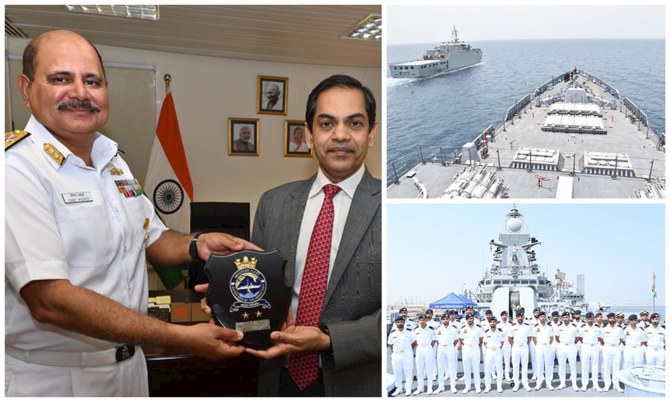
NEW DELHI: India and the UAE have concluded a joint naval drill aimed at enhancing joint operating capabilities between the two navies, the Indian Navy said on Saturday.
The drill, codenamed Zayed Talwar, took place off the coast of the UAE from Aug. 8-11.
Indian naval ships INS Visakhapatnam and INS Trikand, which took part in the exercise, reached Port Rashid in Dubai on Tuesday.
The two-day exercise came a week after the Indian Navy’s largest, indigenously designed missile destroyer INS Chennai was deployed for a mission on the Red Sea, including a port call to Jeddah and an exercise with the Royal Saudi Naval ship HMS Al-Jubail.
Both countries have agreed to increase interaction between their navies to “jointly tackle the common challenges of piracy, smuggling, human trafficking, enhance maritime security and undertake joint humanitarian assistance and disaster relief operations, should the need arise,” a statement by the Indian Navy said on Saturday.
INS Visakhapatnam, commanded by Capt. Ashok Rao, one of the largest operational destroyers in the Indian Navy, was made by the Mazagaon Docks Limited. INS Trikand, commanded by Capt. Pramod G. Thomas, is an advanced stealth frigate commissioned in 2013.
“I am confident that participation of the ship in the exercise not only allows us to have good professional interactions but also enables understanding with each other so that we can jointly secure the area,” Rao told Prasar Bharati, India’s official broadcaster, on Friday.
Thomas also expressed optimism that the exercise would be tactically important for the Indian Navy.
“I’m sanguine that the upcoming exercise will allow the crew to cross train on tactics, techniques and procedures, while developing stronger professional bonds between our navies,” he said.
Growing military cooperation between India and the Middle East will deepen economic and strategic relations, experts believe.
“Traditionally, India’s interactions with the west Asian region were primarily focused on energy and expatriates, but defense and security cooperation have emerged as a major driver of deeper economic and strategic relations,” Ranjit Kumar, a strategic affairs expert based in New Delhi, told Arab News.
“India considers the Gulf region as its immediate neighborhood, and in the fast-changing geopolitical ecology, both India and the Gulf considers it in their national interest to deepen mutual trust, cooperation and partnership in the defense arena,” he said.
India’s growing economic heft is also attracting west Asian countries.
Mohammed Soliman, director at the Washington-based Middle East Institute, said that growing defense ties with the Middle East indicates how significant the region is for India’s geopolitical interests.
“The Middle East is vital for India’s defense and geopolitical strategy due to its role in energy security, trade routes, expanding geopolitical influence, and projecting naval power to safeguard maritime interests,” he told Arab News.
“The naval exercises significantly enhance bilateral relations, improve maritime security, promote regional stability, increase interoperability, and send diplomatic signals,” Soliman said.


![]()

India, UAE conclude joint Arabian Gulf naval exercise
Short Url
https://arab.news/6duvn
India, UAE conclude joint Arabian Gulf naval exercise
- Two-day drill comes a week after Indian Navy missile destroyer INS Chennai deployed for Red Sea mission
- Growing military cooperation between India, Middle East will deepen economic and strategic relations, experts say


Latest updates




© 2026 SAUDI RESEARCH & PUBLISHING COMPANY, All Rights Reserved And subject to Terms of Use Agreement.