

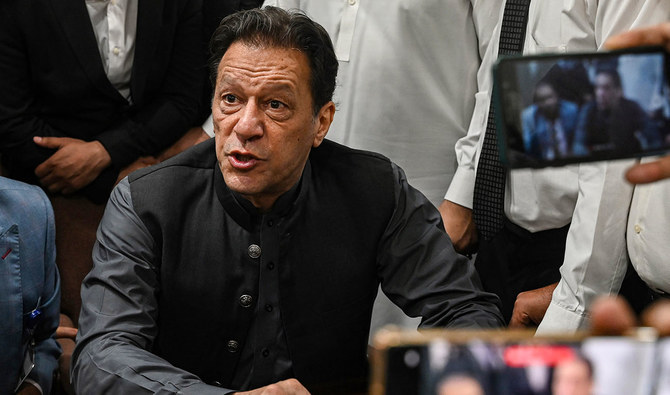

ISLAMABAD: A Pakistani high court on Saturday instructed the authorities at Attock Jail, where former prime minister Imran Khan is imprisoned after his recent graft conviction, to allow visits by his family and aides and to provide him with “appropriate medical facilities.”
Khan began serving a three-year sentence last week for unlawfully selling state gifts during his tenure, which also resulted in a five-year ban on holding public office. The cricketer-turned-politician, who maintains his innocence, was apprehended at his Lahore residence and subsequently transferred to Attock Jail, located near Islamabad.
Following his incarceration, Khan’s legal team filed a petition at the Islamabad High Court (IHC) challenging his conviction. They sought explanations from the outgoing federal and Punjab governments regarding the former PM’s placement in a facility designed for hardened criminals, lacking the amenities entitled to political prisoners.
“The jail authorities shall provide reasonable opportunity to the relatives/friends/legal advisors of the petitioner to seek interview in accordance with the rules and jail manual subject, of course, to the permission of the superintendent [at] Attock Jail,” the IHC said in its order, a copy of which is available with Arab News.
The court heard Khan’s case a day ago and reserved its decision on his transfer plea, but it issued the written order earlier today, directing the jail management to facilitate the ex-premier in a better way during his stay in prison.
“He may also be provided a prayer mat, an English version of the Qur’an, and appropriate medical facilities to cater his health and wellbeing,” the IHC order continued.
Khan’s lawyers maintained in their petition that owing to his “education, habits, and social and political status,” the former prime minister should be transferred to the better-equipped Adiala Jail in Rawalpindi where he could receive A-class facilities.
They noted that their client had been kept under “distressing conditions” in Attock with “C-class jail facilities.” Khan’s lawyers also claimed that the ex-PM was facing “serious threats to life” in the Attock prison.
Khan, 70, was ousted from power in a parliamentary no-confidence vote in April last year. Shortly after that, he began criticizing the government that replaced his administration, along with the country’s powerful establishment, for allowing his removal under an “international conspiracy.”


