West African countries suspend key military meeting on Niger as coup supporters protest foreign intervention

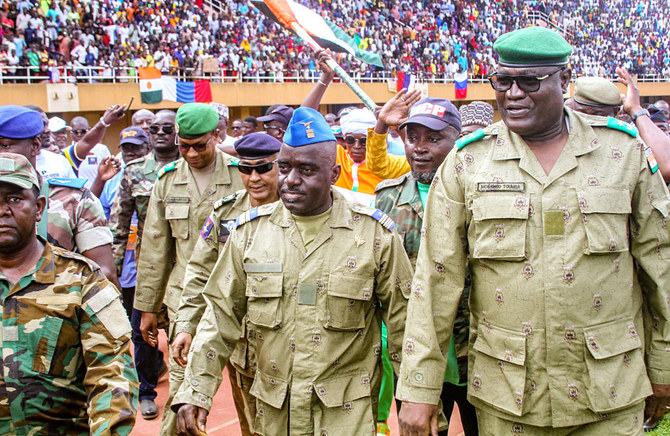
Members of a military council that staged a coup in Niger attend a rally in Niamey. Russia has warned against any foreign military intervention in Niger. (Reuters)
Short Url
Updated 12 August 2023
Follow

West African countries suspend key military meeting on Niger as coup supporters protest foreign intervention

  • On Thursday, the ECOWAS bloc said it had decided to deploy a “standby force” aimed at restoring Niger's elected president Mohamed Bazoum to power
  • US laments that Niger’s military leaders have refused to release the family of the detained president in a proposed goodwill gesture

NIAMEY, Niger: West African nations on Friday suspended a key military meeting on the crisis in Niger, a day after saying they would muster a “standby” force in their bid to reinstate the country’s deposed leader.
Fears also mounted for elected President Mohamed Bazoum, who was ousted by members of his guard on July 26, with reports saying his detention conditions were deteriorating.
Chiefs of staff from West African ECOWAS bloc countries were set to attend a meeting on Saturday in Ghana’s capital Accra, regional military sources had said on Friday.
But they later said that it had been suspended indefinitely for “technical reasons.”
The sources said the meeting was originally set up to inform the organization’s leaders about “the best options” for activating and deploying the standby force.
ECOWAS has yet to provide details on the force or a timetable for action, and the leaders have emphasised they still want a peaceful solution.
The last-minute cancelation came as thousands of coup supporters rallied near a French military base in Niger on Friday.
Meanwhile, US Secretary of State Antony Blinken lamented that Niger’s military leaders have refused to release the family of the detained president in a proposed goodwill gesture.
In a phone call with Niger’s former president Mahamadou Issoufou, a fellow Western ally whom Bazoum served, Blinken “expressed his grave concern at the continued unlawful detention under deteriorating conditions of President Bazoum and his family.”
Blinken “shared that he is particularly dismayed by the refusal of those who seized power in Niger to release Bazoum’s family members as a demonstration of goodwill,” a State Department statement said.
During Friday's rally, protesters near the base on the outskirts of the capital Niamey shouted “down with France, down with ECOWAS.”
Niger’s new leaders have accused ex-colonial power France, a close Bazoum ally, of being behind the hard-line ECOWAS stance against the coup.
Many brandished Russian and Niger flags and shouted their support for the country’s new strongman, General Abdourahamane Tiani.
“We are going to make the French leave! ECOWAS isn’t independent, it’s being manipulated by France,” said one demonstrator, Aziz Rabeh Ali, a member of a students’ union.
France has around 1,500 personnel in Niger as part of a force battling an eight-year jihadist insurgency.
It is facing growing hostility across the Sahel, withdrawing its anti-jihadist forces from neighboring Mali and Burkina Faso last year after falling out with military governments that ousted elected leaders.
Niger’s new leaders scrapped defense agreements with France last week, while a hostile protest outside the French embassy in Niamey on July 30 prompted Paris to evacuate its citizens.

EU, AU sound alarm
The European Union and African Union (AU) joined others in sounding the alarm for Bazoum on Friday.
“Bazoum and his family, according to the latest information, have been deprived of food, electricity and medical care for several days,” said EU foreign policy chief Josep Borrell.
UN rights chief Volker Turk said Bazoum’s reported detention conditions “could amount to inhuman and degrading treatment, in violation of international human rights law.”
The AU said “such treatment of a democratically elected president” was “unacceptable.”
German Foreign Minister Annalena Baerbock warned that the “coup plotters must face harsh consequences should anything happen” to Bazoum or his family.
A source close to Bazoum said “he’s OK, but the conditions are very difficult.” The coup leaders had threatened to assault him in the event of military intervention, the source added.
Human Rights Watch said it had spoken to Bazoum earlier this week. The 63-year-old described the treatment of himself, his wife and their 20-year-old son as “inhuman and cruel,” HRW said.
“I’m not allowed to receive my family members (or) my friends who have been bringing food and other supplies to us,” the group quoted him as saying.
“My son is sick, has a serious heart condition, and needs to see a doctor,” he was quoted as saying. “They’ve refused to let him get medical treatment.”
Under pressure to stem a cascade of coups among its members, ECOWAS had previously issued a seven-day ultimatum to the coup leaders to return Bazoum to power.
But they defied the deadline, which expired on Sunday without any action being taken.
The coup leaders have since named a new government, which met for the first time on Friday.

Fifth coup in 63 years
Since 1990, the 15-country bloc has intervened among six of its members at times of civil war, insurrection or political turmoil.
But the possibility of intervention in deeply fragile Niger has sparked debate within its ranks and warnings from neighboring Algeria as well as from Russia.
Moscow, whose influence in the region has grown, said a military solution “could lead to a protracted confrontation” in Niger and “a sharp destabilization” across the Sahel.
The president of ECOWAS member Cape Verde, Jose Maria Neves, spoke out against a military intervention on Friday and said his country was unlikely to participate in such a campaign.
Military-ruled ECOWAS nations Mali and Burkina Faso have warned an intervention would be a “declaration of war” on their countries.
General Salifou Mody, Niger’s new defense minister, made a brief visit to Mali on Friday, according to a Malian presidential adviser speaking on condition of anonymity.
The coup is Niger’s fifth since the landlocked country gained independence from France in 1960.
Like Mali and Burkina Faso, the country is struggling with a brutal jihadist insurgency that has claimed thousands of lives, forced many people from their homes and undermined faith in government.


Court records raise doubts that ICE is detaining the ‘worst of the worst’ in Maine

Updated 4 sec ago
Follow

Court records raise doubts that ICE is detaining the ‘worst of the worst’ in Maine

  • Federal officials say more than 100 people have been detained statewide enforcement ‘Operation Catch of the Day’
  • ICE has said the operation is targeting about 1,400 immigrants in a state of about 1.4 million people
PORTLAND, Maine: Immigration and Customs Enforcement has highlighted the detention of people whom it called some of Maine’s most dangerous criminals during operations this past week, but court records paint a more complicated picture.
Federal officials say more than 100 people have been detained statewide in what ICE dubbed “Operation Catch of the Day,” a reference to the fishing industry. ICE said in a statement that it was arresting the “worst of the worst,” including “child abusers and hostage takers.”
Court records show some were violent felons. But they also show other detainees with unresolved immigration proceedings or who were arrested but never convicted of a crime.
Immigration attorneys and local officials say similar concerns have surfaced in other cities where ICE has conducted enforcement surges and many of those targeted lacked criminal records.
One case highlighted by ICE that involves serious felony offenses and criminal convictions is that of Sudan native Dominic Ali. ICE said Ali was convicted of false imprisonment, aggravated assault, assault, obstructing justice and violating a protective order.
Court records show Ali was convicted in 2004 of violating a protective order and in 2008 of second-degree assault, false imprisonment and obstructing the reporting of a crime. In the latter case, prosecutors said he threw his girlfriend to the floor of her New Hampshire apartment, kicked her and broke her collarbone.
“His conduct amounted to nothing less than torture,” Judge James Barry said in 2009 before sentencing Ali to five to 10 years in prison.
Ali was later paroled to ICE custody, and in 2013 an immigration judge ordered his removal. No further information was available from the Executive Office for Immigration Review, and it remains unclear what happened after that order.
Other cases were more nuanced, like that of Elmara Correia, an Angola native whom ICE highlighted in its public promotion of the operation, saying she was “arrested previously for endangering the welfare of a child.”
Maine court records show someone with that name was charged in 2023 with violating a law related to learner’s permits for new drivers, a case that was later dismissed.
Correia filed a petition Wednesday challenging her detention, and a judge issued a temporary emergency order barring authorities from transferring her from Massachusetts, where she is being held. Her attorney said she entered the United States legally on a student visa about eight years ago and has never been subject to expedited removal proceedings.
“Was she found not guilty, or are we just going to be satisfied that she was arrested?” Portland Mayor Mark Dion said during a news conference in which he raised concerns that ICE failed to distinguish between arrests and convictions or explain whether sentences were served.
Dion also pointed to another person named in the release: Dany Lopez-Cortez, whom ICE said is a “criminal illegal alien” from Guatemala who was convicted of operating under the influence.
ICE highlighted Lopez-Cortez’s case among a small group of examples it said reflected the types of arrests made during the operation. Dion questioned whether an operating-under-the-influence conviction, a serious offense but one commonly seen in Maine, should rise to the level of ICE’s “worst of the worst” public narrative.
Boston immigration attorney Caitlyn Burgess said her office filed habeas petitions Thursday on behalf of four clients who were detained in Maine and transferred to Massachusetts.
The most serious charge any of them faced was driving without a license, Burgess said, and all had pending immigration court cases or applications.
“Habeas petitions are often the only tool available to stop rapid transfers that sever access to counsel and disrupt pending immigration proceedings,” she said.
Attorney Samantha McHugh said she filed five habeas petitions on behalf of Maine detainees Thursday and expected to file three more soon.
“None of these individuals have any criminal record,” said McHugh, who is representing a total of eight detainees. “They were simply at work, eating lunch, when unmarked vehicles arrived and immigration agents trespassed on private property to detain them.”
Federal court records show that immigration cases involving criminal convictions can remain unresolved or be revisited years later.
Another whose mug shot was included in materials on “the worst of the worst” of those detained in Maine is Ambessa Berhe.
Berhe was convicted of cocaine possession and assaulting a police officer in 1996 and cocaine possession in 2003.
In 2006 a federal appeals court in Boston vacated a removal order for him and sent the case back to the Board of Immigration Appeals for further consideration.
According to the ruling, Berhe was born in Ethiopia and later taken to Sudan by his adoptive parents. The family was admitted to the United States as refugees in 1987, when he was about 9.
ICE has said the operation is targeting about 1,400 immigrants in a state of about 1.4 million people, roughly four percent of whom are foreign-born.