

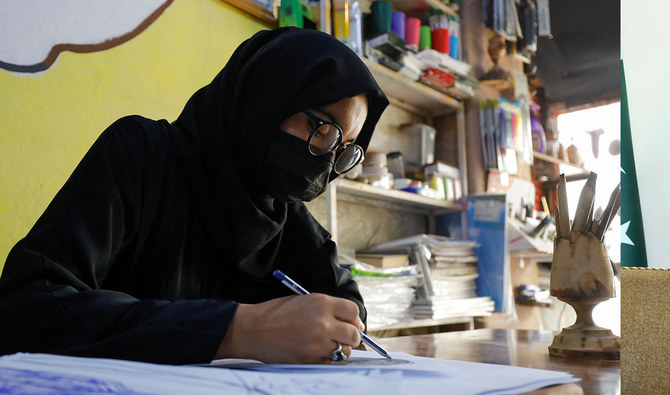

MAZAR-I-SHARIF, Afghanistan: At home in northern Afghanistan, 19-year old Khushi draws a self-portrait — a figure enveloped by a blue burqa inside a cage.
The former university student once attended classes in law and political science at northern Balkh province’s main university. But she sank into depression since the Taliban closed tertiary institutions to women in December, requiring psychiatric treatment where she was recommended art therapy classes.
“When I realized that I am not mentally well, I got sad ... I was not happy at all, I was always depressed, I felt like a bird being stuck in a cage, one who has lost all her happiness,” said Khushi, who is only being identified by only one name for security reasons.
“After the Taliban banned girls from universities and announced that girls can no longer continue our education, I felt so upset, day by day my mental health deteriorated, I ... finally decided to see a psychiatrist in order to get better.”
The Taliban closed universities to women in December 2022, sparking rare public protests. The decision came in the wake of the closure of most girls’ high schools and was followed by Taliban authorities ordering most Afghan female humanitarian workers not to work.
The orders restricting women from public life have drawn heavy international criticism and Western governments have said it is a key hurdle to moving toward any formal recognition of the Taliban’s government, which took over as foreign forces left two years ago.
Advertisement · Scroll to continue
The Taliban say they respect women’s rights in line with their interpretation of Islamic law and Afghan culture.
But many women, particularly in urban areas, who gained opportunities in education and work during the 20-year presence of foreign troops and a Western-backed government are now struggling with a deep sense of despair and mental health challenges, Afghan women and mental health experts say.
“Since the Islamic Emirate (Taliban administration) started ruling the country, they have imposed so many restrictions on women, they banned them from universities, amusement parks, beauty salons and so on, they have left nothing for women,” said
Khushi’s psychiatrist, who also cannot be named for security reasons. “Art studios are the only avenue we have left to help our patients... they have become the only place where girls can clear their minds, catch up with old friends, make new friends, and apart from that, they can learn art too.”
Khushi sees her psychiatrist twice a month. He used to see four to five patients a day but says the number of his patients has now increased to 10 to 15 daily, most of them women. The increase became even more noticeable after the Taliban banned female students from attending universities, he said.
Health organizations estimate half of Afghanistan’s 40 million people have suffered from psychological distress after decades of war and instability. There are few reliable figures on mental health trends but anecdotally doctors and aid workers say more women are struggling with mental health in the wake of the orders restricting women’s work and education.
In a small, colorful art studio in Balkh’s capital Mazar-i-Sharif, paintings adorn the walls and several young women, including Khushi, gather for a pencil drawing class. Many of them have been sent here at the recommendation of a mental health expert to ease their isolation and learn a new skill, alongside talk therapy and medication.
“When I felt depressed, the doctor prescribed me to go to a place where I can calm my mind. I chose the art studio. Not only did I make good friends here, I also receive art therapy,” said a former university student at the class.
Khushi said the art therapy gave her a respite from home and a little hope for the future.
“It gives me a sense of accomplishment for having made something, over all, drawing empowers me with confidence,” she said. “I’m disappointed in my life, but I am not giving up, I will fight. I hope things will get better in the future.”


