BEIJING: The death toll from record-breaking rains across northern China rose to at least 78 on Friday, as authorities warned of more flooding and another storm approached the country.
Deaths from flooding in Hebei province rose to 29, state media reported Friday, after Storm Doksuri, which hit mainland China as a typhoon two weeks ago, brought on the most severe rainfall since records began 140 years ago.
Rescuers have continued to search for people swept away by the floods, as another storm, Khanun, approaches over the weekend.
The deluge followed weeks of historic heat, with scientists saying such extreme weather events are being exacerbated by climate change.
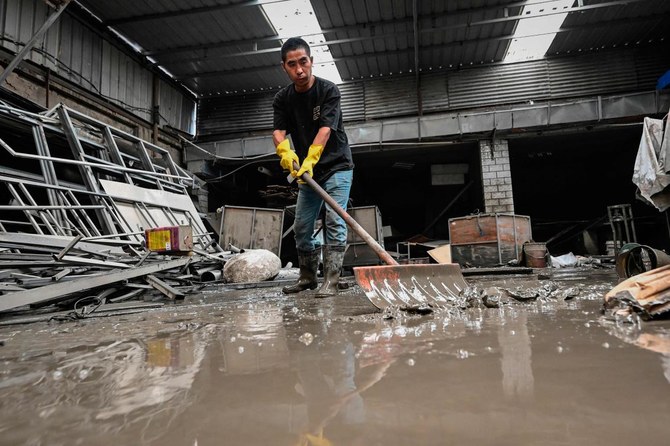
Streets in parts of Hebei, which borders the capital, were still caked in mud when AFP visited on Wednesday.
Residents were scrambling to recover waterlogged belongings and clean up damaged homes.
During a visit to affected communities last week, Hebei province party chief Ni Yuefeng said that the area could “reduce the pressure on Beijing’s flood control” and serve as a “moat” for the capital.
As of Thursday, 29 people had been killed by the rains across the province, six of whom had been previously listed as missing, state broadcaster CCTV said Friday.
Sixteen are still missing.
In Beijing, at least 33 people have died, including two rescue workers, authorities said this week.
And more than a dozen people were killed in northeastern Jilin province after torrential rain last week.
In neighboring Liaoning province, two deaths were reported after the first few days of intense rain in late July.
On Friday, state news agency Xinhua said that another flood control team had been sent to the province, where “the local flooding situation remains severe.”
Heavy rains are expected again over the weekend as tropical depression Khanun — formerly a typhoon — approaches China.
Emergency alert levels are being held in place across northern China, Xinhua said, with key riverways being closely monitored.
China’s state media has hailed the government’s efforts to mitigate damage from the inundations, with coverage focused on tales of mutual aid and selfless officials working tirelessly on rescue efforts.
But a week after the waters first swelled, some villagers in Hebei told AFP they did not receive adequate warning from the authorities about when the floods would come.
The Chinese government on Wednesday said it would allocate one billion yuan ($139 million) to compensate residents in areas that had been inundated to control flood levels in downstream areas.
The fund would pay for “damage to crops, animal and poultry farms, commercial forests, houses and agricultural machinery,” according to the official Xinhua news agency.
In Hebei alone, officials said almost four million people had been affected by the flooding, with 40,900 houses having collapsed, according to local media.
Hundreds of thousands of hectares of crops have been damaged in the province.
Insurance providers in Beijing are paying out at least 380 million yuan in claims for losses caused by the recent rains, according to Xinhua.
The bad weather is not limited to northern China.
On Friday, the State Flood Control and Drought Relief Headquarters said heavy rain was also likely over the weekend in the southwestern provinces of Sichuan and Yunnan, and the northwestern provinces of Gansu and Qinghai, according to Xinhua.
At least seven people died in a flash flood southwest of Sichuan’s capital Chengdu this week, after an unexpected tide of water washed away a number of tourists on the Longxi River.
And in Gansu, five people were killed when they were swept away by mountain torrents after a rainstorm alert on Thursday, Xinhua said.


![]()

China rains death toll rises to 78 as new storm approaches
Short Url
https://arab.news/pa3yk
China rains death toll rises to 78 as new storm approaches
- Rescuers continue search for people swept away by the floods, as another storm, Khanun, approaches over the weekend


Latest updates





Recommended


© 2026 SAUDI RESEARCH & PUBLISHING COMPANY, All Rights Reserved And subject to Terms of Use Agreement.