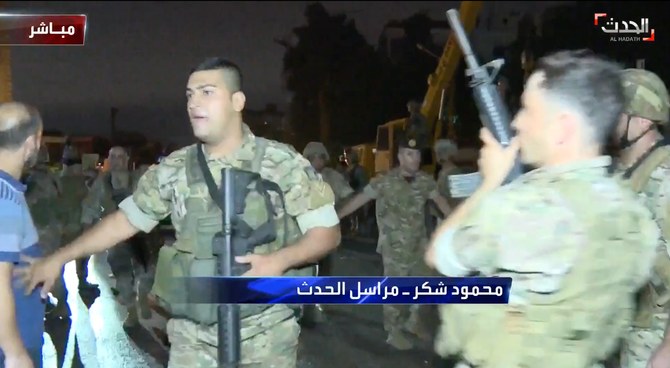
Lebanese Army soldiers ‘assault’ Al-Hadath reporter during live broadcast in Kahala

Journalists and activists in Lebanon are increasingly under attack by state and non-state actors, the HRW said. (Screenshot)
Short Url
Updated 10 August 2023
Follow

Lebanese Army soldiers ‘assault’ Al-Hadath reporter during live broadcast in Kahala

  • Mahmoud Shukr was covering accident on Beirut-Damascus Road
  • Overturned truck belongs to Hezbollah, according to media reports

DUBAI: Several Lebanese Army soldiers attacked Al-Hadath reporter Mahmoud Shukr during a live broadcast Wednesday while he was covering an accident involving a truck in the Kahala area on the Beirut-Damascus Road, the news outlet has alleged in a tweet.

In a video of the incident posted on Twitter on Wednesday, what appears to be members of the Lebanese Army are seen pushing Shukr and covering the camera with their hands as some of the equipment falls to the ground.

The accident involved an overturned truck, which reportedly belongs to Hezbollah. Several local militants armed with guns had gathered at the accident site, according to media reports. There was reportedly gunfire exchanged between the militants and people traveling in the truck, resulting in the intervention of the Lebanese Army.

Journalists have regularly been targeted by factions as tensions rise in Lebanon.

Just last month, MTV journalist Dima Sadek was sentenced to a year in prison as the result of a lawsuit filed by the head of the Free Patriotic Movement, Gebran Bassil, who accused her of defamation and slander three years ago.

Radwan Mortada, a journalist at Al-Akhbar newspaper, was sentenced to a 13-month prison sentence, in absentia, on charges of defaming the Lebanese Army, in November 2021.

Nada Homsi, a US-based journalist, was also detained in 2021, allegedly arbitrarily, leading to appeals from Human Rights Watch and Amnesty International.

Journalists and activists in Lebanon are increasingly under attack by state and non-state actors, the HRW said.

More than 100 media workers have been attacked by non-state actors between the start of the social protests in October 2019  and November 2021, according to the Samir Kassir Eyes Center for Media and Cultural Freedom, a press-freedom watchdog in Beirut.

SKeyes said that they documented 80 assaults by government agents on media workers doing their jobs, primarily covering protests, between October 2019 and March 2021.


UAE outlines approach to AI governance amid regulation debate at World Economic Forum

Updated 22 January 2026
Follow

UAE outlines approach to AI governance amid regulation debate at World Economic Forum

  • Minister of State Maryam Al-Hammadi highlights importance of a robust regulatory framework to complement implementation of AI technology
  • Other experts in panel discussion say regulators should address problems as they arise, rather than trying to solve problems that do not yet exist

DUBAI: The UAE has made changes to 90 percent of its laws in the past four years, Maryam Al-Hammadi, minister of state and the secretary-general of the Emirati Cabinet, told the World Economic Forum in Davos on Wednesday.

Speaking during a panel discussion titled “Regulating at the Speed of Code,” she highlighted the importance of having a robust regulatory framework in place to complement the implementation of artificial intelligence technology in the public and private sectors.

The process of this updating and repealing of laws has driven the UAE’s efforts to develop an AI model that can assist in the drafting of legislation, along with collecting feedback from stakeholders on proposed laws and suggesting improvements, she said.

Although AI might be more agile at shaping regulation, “there are some principles that we put in the model that we are developing that we cannot compromise,” Al-Hammadi added. These include rules for human accountability, transparency, privacy and data protection, along with constitutional safeguards and a thorough understanding of the law.

At this stage, “we believe AI can advise but still (the) human is in command,” she said.

Authorities in the UAE are aiming to develop, within a two-year timeline, a shareable model to help other nations learn and benefit from its experiences, Al-Hammadi added.

Argentina’s minister of deregulation and state transformation, Federico Sturzenegger, warned against overregulation at the cost of innovation.

Politicians often react to a “salient event” by overreacting, he said, describing most regulators as “very imaginative of all the terrible things that will happen to people if they’re free.”

He said that “we have to take more risk,” and regulators should wait to address problems as they arise rather than trying to create solutions for problems that do not yet exist.

This sentiment was echoed by Joel Kaplan, Meta’s chief global affairs officer, who said “imaginative policymakers” often focus more on risks and potential harms than on the economic and growth benefits of innovation.

He pointed to Europe as an example of this, arguing that an excessive focus on “all the possible harms” of new technologies has, over time, reduced competitiveness and risks leaving the region behind in what he described as a “new technological revolution.”