
DUBAI: Two years ago, Dubai’s skyscraper-studded skyline welcomed a Ferris wheel touted as the world’s largest, but it mysteriously stopped turning just months after opening.
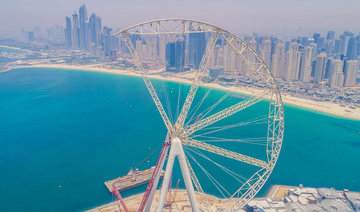
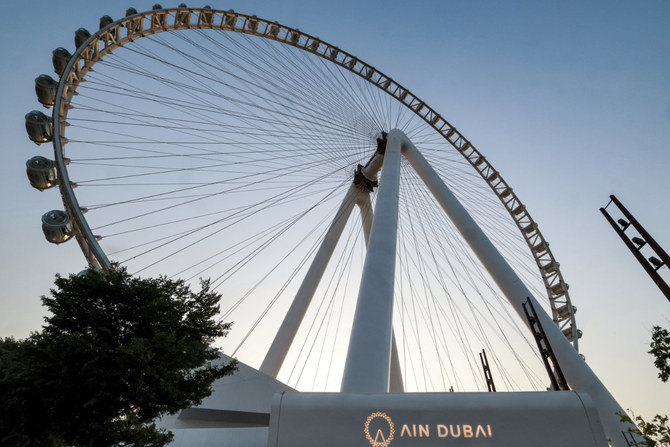
The much-touted Ain Dubai (Dubai Eye) was designed as a tourist-luring landmark in the United Arab Emirates’ glam-hub, which is home to the world’s tallest building.
But now it stands idle for undisclosed reasons, its extravagant light fixtures the only parts seemingly still working.
“Ain Dubai remains closed until further notice,” says an official website for the attraction.
“We continue to rigorously work on completing the enhancement works that have been taking place over the past months.”
The wheel was supposed to close for just a month but its reopening has since been postponed indefinitely.
Those behind the project inaugurated in 2021 have failed to reply to enquiries.
At restaurants, shops and cafes built around the attraction, employees remain skeptical that the structure, which took around six years to build, will ever turn again.
“Last year they promised us that in winter it will be open, even now, they are saying that in (the coming) winter it will be open again,” said one employee at a nearby shop.
“But we’re not sure... it will,” said the man who asked to remain anonymous due to fear of reprisal.
The Dubai Eye, built by a consortium of international companies, is located in Bluewaters — a man-made island designed as a retail, residential and entertainment hub.
For more than a year, the main entrance to the attraction has remained closed and ticket booths abandoned. Only a slow trickle of tourists visit the site, snapping pictures of LED lights mounted on its exterior.
“I asked a security guard here about it and he told me that it doesn’t work,” said Marwan Mohammad, an Egyptian tourist.
“I asked him for the reason but he did not give me an answer,” said the 33-year-old business consultant.
In a city filled with record-breaking landmarks, the Dubai Eye stands at a height of 250 meters (825 feet), each of its legs the length of 15 London buses, according to Dubai’s tourism department.
Nearly twice as tall as the London Eye, it is the largest of its kind in the world.
Its 48 passenger cabins, all of them air-conditioned, can carry around 1,750 passengers on a single ride.
Ticket prices range between 100 dirhams (about $27) and 4,700 dirhams (about $1,280), with luxury passes and private cabins on offer.
“The view was very beautiful from above,” said Mohammad who experienced the 38-minute ride before it closed, adding however, that it moved “too slowly.”
With no official explanation, rumors are rife on the Ferris wheel’s apparent technical issues, especially among employees at Bluewaters.
They all spoke on condition of anonymity, fearing repercussions from authorities or their employers.
“This is a man-made island. I heard that (the wheel) is heavier than the island itself, that’s why it is very dangerous,” said a waiter at a nearby restaurant, adding that it had been noisy during its few months of operation.
“Now... it’s only for show, just for the lighting and that’s it.”
The giant wheel, made of more steel than the Eiffel Tower, features prominently on the list of Dubai’s top tourist attractions.
They include the Dubai Frame monument and Burj Khalifa, the world’s tallest building.
Patrick Clawson, research director at the Washington Institute for Near East Policy, said official silence on the Ferris wheel suggested a complicated problem.
UAE authorities are generally “quick to provide information if they” have a solution, he said.
But with the Dubai Eye, “whatever the problem, the authorities are not confident they have a solution,” he told AFP.