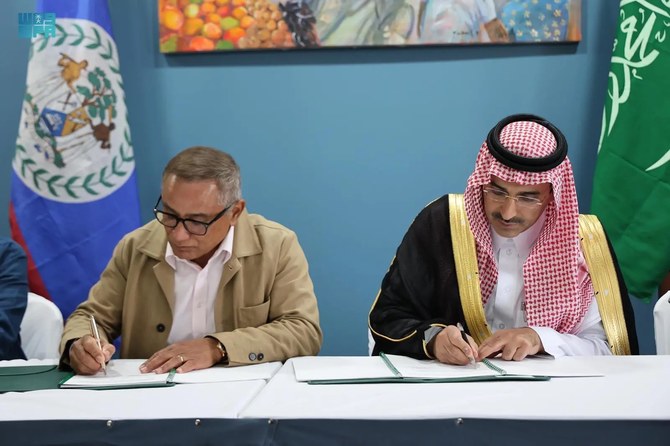
Saudi Fund for Development signs $77m loan agreement to set up solar energy plant in Belize

Short Url
Updated 06 August 2023
Follow

Saudi Fund for Development signs $77m loan agreement to set up solar energy plant in Belize

  • The project is expected to have a significant impact on stimulating social growth and creating direct and indirect job opportunities

RIYADH: CEO of the Saudi Fund for Development Sultan Al-Marshad has signed a development loan agreement with the Prime Minister of Belize John Briceno.

The agreement, worth $77 million, aims to finance the construction of a solar power plant in the Central American nation, the Saudi government authority said.

The signing ceremony was attended by Belizean Minister of Finance, Economic Development and Investment Christopher Coy, along with several officials from both sides.

The agreement reflects the fund’s commitment to supporting sustainable development in developing countries and small island states globally. Since its establishment in 1975, the SFD has successfully implemented more than 700 projects and development programs in 90 countries.

It is the second deal signed between the Kingdom, via SFD, and Belize since the start of its development activities in 2023.

The project’s primary objective is to build a 60-megawatt solar power plant, complete with the supply and equipment of solar panels, to reduce emissions in the energy sector by an estimated 60,000 tons of carbon dioxide annually through system efficiency and consumption.

The project is expected to have a significant impact on stimulating social growth and creating direct and indirect job opportunities.

It will also enhance the quality of electricity and promote environmental sustainability by addressing climate change through the reduction of greenhouse gas emissions, as well as advancing Belize’s efforts toward mitigating climate change and transitioning to clean energy.

Briceno said: “The solar power plant project comes at the right time, as Belize deems it necessary to increase its production of solar energy due to economic inflation, and most importantly, the project is in line with our country’s policy to focus on supporting renewable energy,” the Saudi Press Agency reported.

He added that the project would “bring many benefits to Belize, including cost savings, energy independence, environmental sustainability, job creation, and improved access to electricity for rural communities.”

Al-Marshad said: “The agreement represents an important step toward strengthening the existing development cooperation between the fund and Belize to contribute to the development of the clean energy sector in Belize, and to meet the basic needs of the population in enhancing access to electricity, and limiting the effects of global climate change, as well as promoting Belize’s economic and social growth.”



First EU–Saudi roundtable on critical raw materials reflects shared policy commitment

Updated 16 January 2026
Follow

First EU–Saudi roundtable on critical raw materials reflects shared policy commitment

RIYADH: The EU–Saudi Arabia Business and Investment Dialogue on Advancing Critical Raw Materials Value Chains, held in Riyadh as part of the Future Minerals Forum, brought together senior policymakers, industry leaders, and investors to advance strategic cooperation across critical raw materials value chains.

Organized under a Team Europe approach by the EU–GCC Cooperation on Green Transition Project, in coordination with the EU Delegation to Saudi Arabia, the European Chamber of Commerce in the Kingdom and in close cooperation with FMF, the dialogue provided a high-level platform to explore European actions under the EU Critical Raw Materials Act and ResourceEU alongside the Kingdom’s aspirations for minerals, industrial, and investment priorities.

This is in line with Saudi Vision 2030 and broader regional ambitions across the GCC, MENA, and Africa.

ResourceEU is the EU’s new strategic action plan, launched in late 2025, to secure a reliable supply of critical raw materials like lithium, rare earths, and cobalt, reducing dependency on single suppliers, such as China, by boosting domestic extraction, processing, recycling, stockpiling, and strategic partnerships with resource-rich nations.

The first ever EU–Saudi roundtable on critical raw materials was opened by the bloc’s Ambassador to the Kingdom, Christophe Farnaud, together with Saudi Deputy Minister for Mining Development Turki Al-Babtain, turning policy alignment into concrete cooperation.

Farnaud underlined the central role of international cooperation in the implementation of the EU’s critical raw materials policy framework.

“As the European Union advances the implementation of its Critical Raw Materials policy, international cooperation is indispensable to building secure, diversified, and sustainable value chains. Saudi Arabia is a key partner in this effort. This dialogue reflects our shared commitment to translate policy alignment into concrete business and investment cooperation that supports the green and digital transitions,” said the ambassador.

Discussions focused on strengthening resilient, diversified, and responsible CRM supply chains that are essential to the green and digital transitions.

Participants explored concrete opportunities for EU–Saudi cooperation across the full value chain, including exploration, mining, and processing and refining, as well as recycling, downstream manufacturing, and the mobilization of private investment and sustainable finance, underpinned by high environmental, social, and governance standards.

From the Saudi side, the dialogue was framed as a key contribution to the Kingdom’s industrial transformation and long-term economic diversification agenda under Vision 2030, with a strong focus on responsible resource development and global market integration.

“Developing globally competitive mineral hubs and sustainable value chains is a central pillar of Saudi Vision 2030 and the Kingdom’s industrial transformation. Our engagement with the European Union through this dialogue to strengthen upstream and downstream integration, attract high-quality investment, and advance responsible mining and processing. Enhanced cooperation with the EU, capitalizing on the demand dynamics of the EU Critical Raw Materials Act, will be key to delivering long-term value for both sides,” said Al-Babtain.

Valere Moutarlier, deputy director-general for European industry decarbonization, and directorate-general for the internal market, industry, entrepreneurship and SMEs at European Commission, said the EU Critical Raw Materials Act and ResourceEU provided a clear framework to strengthen Europe’s resilience while deepening its cooperation with international partners.

“Cooperation with Saudi Arabia is essential to advancing secure, sustainable, and diversified critical raw materials value chains. Dialogues such as this play a key role in translating policy ambitions into concrete industrial and investment cooperation,” she added.