

Syrian baby born under earthquake rubble turns 6 months, happily surrounded by her adopted family

Khalil al-Sawadi plays with his adopted daughter Afraa in Jinderis, Syria, on August 5, 2023. (AP)
Short Url
Updated 06 August 2023
Follow

Syrian baby born under earthquake rubble turns 6 months, happily surrounded by her adopted family

  • Afraa survived 10 hours under rubble after Feb 6 quake crushed her parents, siblings to death
  • Her story captivated the world at the time, and people from all over offered to adopt her

JINDERIS, Syria: A baby girl who was born under the rubble of her family home destroyed by the deadly earthquake that hit Turkiye and Syria six months ago is in good health, loves her adopted family and likes to smile even to strangers.

The dark-haired baby Afraa survived 10 hours under the rubble after the Feb. 6 earthquake crushed to death her parents and four siblings in the northern Syrian town of Jinderis. When she was found, her umbilical cord was still connected to her mother.

Her story captivated the world at the time, and people from all over offered to adopt her.
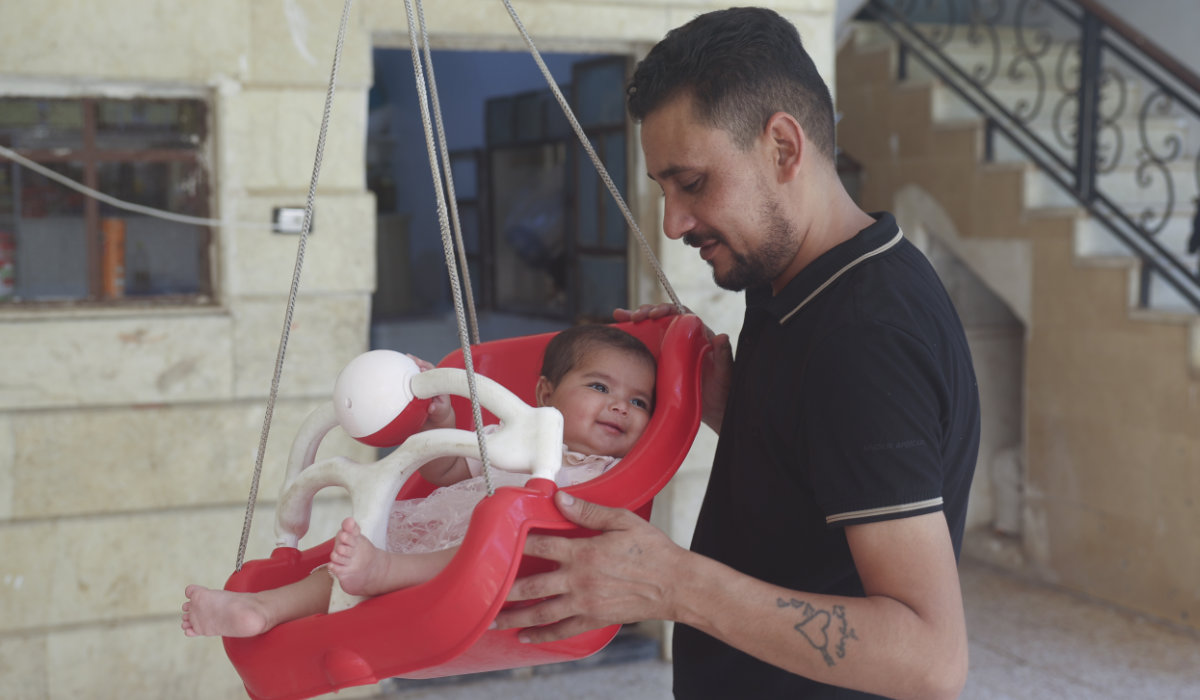


Khalil al-Sawadi plays with his adopted daughter Afraa in Jinderis, Syria, on Saturday, Aug. 5, 2023. (AP)

After spending days at a hospital in north Syria, Afraa was released and handed over to her paternal aunt and her husband, who adopted her and are raising her along with their five daughters and two sons. Afraa was handed over to her aunt’s family days after a DNA test was conducted to make sure the girl and her aunt are biologically related, her adopted father, Khalil Al-Sawadi, said.

On Saturday, baby Afraa was enjoying herself, swinging on a red swing hanging from the ceiling while Al-Sawadi pushed her back and forth.

“This girl is my daughter. She is exactly the same as my children,” said Al-Sawadi, sitting cross-legged with Afraa on his lap.

Al-Sawadi said he spends the day at an apartment he rented but at night the family goes to a tent settlement to spend the night, as his children are still traumatized by the earthquake which killed more than 50,000 people in southern Turkiye and northern Syria.

According to the UN Office for the Coordination of Humanitarian Affairs, more than 4,500 deaths and 10,400 injuries were reported in northwest Syria due to the earthquakes. It estimated that 43 percent of the injured are women and girls while 20 percent of the injured are children aged five to 14 years old.

The devastating 7.8 magnitude earthquake struck in the early hours of Feb. 6, followed by multiple aftershocks. Among the hardest hit areas was rebel-held northwestern Syria that is home to some 4.5 million people, many of whom have been displaced by the country’s 12-year conflict that has killed half a million.

When Afraa grows up, Al-Sawadi says, he will tell her the story of how she was rescued and how her parents and siblings were killed in the devastating earthquake. He said that if he doesn’t tell her, his wife or children will.

A day after the baby arrived at the hospital, officials there named her Aya — Arabic for “a sign from God.” After her aunt’s family adopted her, she was given a new name, Afraa, after her late mother.

Days after Afraa was born, her adopted mother gave birth to a daughter, Attaa. Since then she has been breast-feeding both babies, Al-Sawadi said.

“Afraa drinks milk and sleeps most of the day,” Al-Sawadi said.

Al-Sawadi said he has received several offers to live abroad, but he said he refused because he wants to stay in Syria, where Afraa’s parents lived and were killed.

Afraa’s biological father, Abdullah Turki Mleihan, was originally from Khsham, a village in eastern Deir Ezzor province, but left in 2014 after the Daesh group captured the village, Saleh Al-Badran, an uncle of Afraa’s father, said earlier this month.

“We are very happy with her, because she reminds us of her parents and siblings,” Al-Sawadi said. “She looks very much like her father and her sister Nawara.”


Rubio says technical talks with Denmark, Greenland officials over Arctic security have begun

Updated 29 January 2026
Follow

Rubio says technical talks with Denmark, Greenland officials over Arctic security have begun

  • US Secretary of State on Wednesday appeared eager to downplay Trump’s rift with Europe over Greenland

WASHINGTON: Technical talks between the US, Denmark and Greenland over hatching an Arctic security deal are now underway, Secretary of State Marco Rubio said on Wednesday.
The foreign ministers of Denmark and Greenland agreed to create a working group aimed at addressing differences with the US during a Washington meeting earlier this month with Vice President JD Vance and Rubio.
The group was created after President Donald Trump’s repeated calls for the US to take over Greenland, a Danish territory, in the name of countering threats from Russia and China — calls that Greenland, Denmark and European allies forcefully rejected.
“It begins today and it will be a regular process,” Rubio said of the working group, as he testified before the Senate Foreign Relations Committee. “We’re going to try to do it in a way that isn’t like a media circus every time these conversations happen, because we think that creates more flexibility on both sides to arrive at a positive outcome.”
The Danish Foreign Ministry said Wednesday’s talks focused on “how we can address US concerns about security in the Arctic while respecting the red lines of the Kingdom.” Red lines refers to the sovereignty of Greenland.
Trump’s renewed threats in recent weeks to annex Greenland, which is a semiautonomous territory of a NATO ally, has roiled US-European relations.
Trump this month announced he would slap new tariffs on Denmark and seven other European countries that opposed his takeover calls, only to abruptly drop his threats after a “framework” for a deal over access to the mineral-rich island was reached, with NATO Secretary-General Mark Rutte’s help. Few details of the agreement have emerged.
After stiff pushback from European allies to his Greenland rhetoric, Trump also announced at the World Economic Forum in Davos, Switzerland, last week that he would take off the table the possibility of using American military force to acquire Greenland.
The president backed off his tariff threats and softened his language after Wall Street suffered its biggest losses in months over concerns that Trump’s Greenland ambitions could spur a trade war and fundamentally rupture NATO, a 32-member transatlantic military alliance that’s been a linchpin of post-World War II security.
Rubio on Wednesday appeared eager to downplay Trump’s rift with Europe over Greenland.
“We’ve got a little bit of work to do, but I think we’re going to wind up in a good place, and I think you’ll hear the same from our colleagues in Europe very shortly,” Rubio said.
Rubio during Wednesday’s hearing also had a pointed exchange with Sen. Tim Kaine, D-Virginia, about Trump repeatedly referring to Greenland as Iceland while at Davos.
“Yeah, he meant to say Greenland, but I think we’re all familiar with presidents that have verbal stumbles,” Rubio said in responding to Kaine’s questions about Trump’s flub — taking a veiled dig at former President Joe Biden. “We’ve had presidents like that before. Some made a lot more than this one.”