

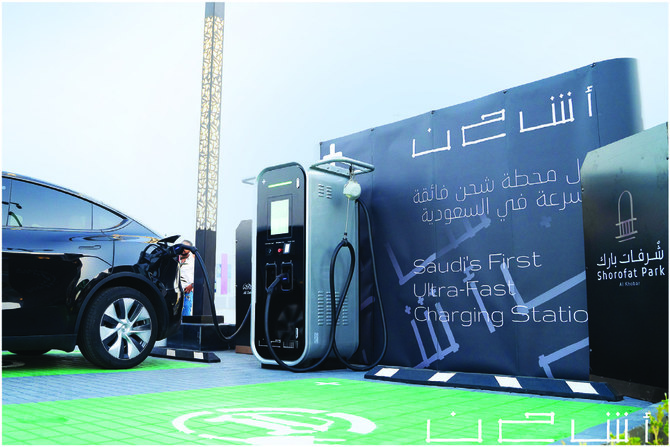
Ultra-fast charging for electric vehicles comes to Alkhobar

1 / 2
Something that also sets the 22-year-old Alhareth Al-Hisan apart from his giant competitors is that he is focused solely on the charging of electric vehicles. (Supplied)
2 / 2
The major players in the area have local car charging stations — but they often do not work since they have not been able to secure the permits to operate and thus, cars will arrive but the charger will not charge. (Supplied)
Short Url
Updated 06 August 2023
Follow

Ultra-fast charging for electric vehicles comes to Alkhobar

  • Ishan startup secures necessary permits to help electric cars juice up

ALKHOBAR: Saudi Arabia is entering a new era in the electric cars market — and at the helm is Alhareth Al-Hisan, the lively 22-year-old who just inaugurated the Kingdom’s first ever ultra-fast charging station, which handles 200 kilowatts.

Arab News spoke to Al-Hisan during the event to collect his thoughts on the launch of his startup, Ishan, which is the Arabic word for “charge.”

During the last two years, he worked tirelessly to secure the necessary permits to help cars juice up.

At Shorofat Park in Alkhobar this week, vehicles lined up to get a taste of what is to come.

Having lived the majority of his life in the UK, Saudi national Al-Hisan is offering the country a European sensibility to elevate the lives of drivers in his home country. Choosing Alkhobar as the launch of the charging station was deliberate — it’s the cradle of oil and gas, and liquid gold has  been pumped into the economy and the car-dependent country since the start.


The major players in the area have local car charging stations — but they often do not work since they have not been able to secure the permits to operate and thus, cars will arrive but the charger will not charge. (Supplied)

As an architecture student, he was always adamant at utilizing urban spaces efficiently and  admits that cars have never been a passion of his but he saw a need in the market and decided  to step in.“I decided to go on an entrepreneurial path. My project is basically three things; first of 
all, I get experience so that I can build a bigger project … (second) to gain money — because I will not be able to do my project without having money. The third one is to have a good impact. And this will enable me to check all three,” he told Arab News.

He believes that the environment, people’s quality of life and their safety will all benefit — and their wallets will also thank them.

“If I were to help in the spread of electric vehicles in Saudi Arabia, people would be more safe, we’ll have better cars, people will have a better environment, people will have more money in their pockets,” he told us.

The biggest hurdle is securing permits. The Kingdom does have a system for it currently, but it is rigorous and cumbersome with a stack of seemingly never-ending regulations. Normally, Al-Hisan would say that the paperwork was “too much” but he felt like in this instance, it was wise of the country to be so strict so that they do not repeat the mistakes the US made.

“It is positive to have these strict guidelines because they  are mindful that they want to have an almost universal  charging station,” he said.

The major reason why electric cars have not become dominant in the Kingdom is because the country does not have adequate working charging stations yet.


Diversifying beyond petrol is not only practical but is the only way  to secure a sustainable economy and environment, says yoing Saudi entrepreneur Alhareth Al-Hisan. (Supplied)

The major players in the area have local car charging stations — but they often do not work since they have not been able to secure the permits to operate and thus, cars will arrive but the charger will not charge.

Defying all odds, Al-Hisan has a working station and hopes people will come to try it.

While it is easier to create the roadmap since nothing is set in stone yet, it is always a hard road to enter an emerging market.

“We have to do the same as what has happened in the Netherlands because we don’t want to get into the same issue that the US because the US now, they are in a whole mess with the infrastructure for electric vehicles,” he said.

“They have given the support to buy electric vehicles in the US, they get a discount and tax  breaks, but the main issue they face is the distribution, so  they had to deal with Tesla because they have the most spread and diverse network of electric vehicles. If we follow the US example it will be a mess. We have to do it the European way,”  added Al-Hisan.

Something that also sets him apart from his giant competitors is that he is focused solely on the charging of electric vehicles.

“We are immersed and we know exactly what to do because we own electric vehicles. (Others) do several other things. They do  petrol construction, they do importing of devices. We are specialized in electric vehicle chargers. This is the only thing we do. This is why I can say that we are very good at it. Why?Because we don’t know how to do anything else,” he said.

Changing car-dependent user habits is not on his mind as he trusts that Saudi residents are intelligent enough to recognize that this is the future, and diversifying beyond petrol is not only practical but is the only way  to secure a sustainable economy and environment.

“You have to add a positive impact – that is the purpose of us as human beings. Because if my ancestors didn’t attempt improving their minds and our lives, we wouldn’t be in what we are in today. So I only have  to try,” he said.


PIF-backed EV maker Lucid hits 16k 2025 deliveries, sets sights on robotaxi deployment

Updated 8 sec ago
Follow

PIF-backed EV maker Lucid hits 16k 2025 deliveries, sets sights on robotaxi deployment

RIYADH: Electric vehicle manufacturer Lucid Group, majority-owned by Saudi Arabia’s Public Investment Fund, announced a surge in deliveries in 2025 with volumes reaching 15,841 units, a 55 percent increase year-on-year.

According to a statement, the EV maker also provided an optimistic production outlook for 2026, signaling confidence in its operational turnaround and strategic shift toward autonomy.

In September 2023, the group opened its first-ever international car manufacturing facility in the Kingdom. The hub serves as the company’s second Advanced Manufacturing Plant and its first outside of the US.

According to the earnings report, the company delivered 5,345 vehicles in the fourth quarter of 2025, up 72 percent from the same period in the previous year, marking its eighth consecutive quarter of record deliveries.

Interim CEO Marc Winterhoff said that 2025 “was all about execution and strategy adjustment to set Lucid up for long-term success. Against a challenging macro backdrop, we nearly doubled production, gained market share, reduced unit costs, and strengthened our financial position.”

This commercial momentum translated directly into financial gains. Lucid’s fourth-quarter revenue soared 123 percent to $522.7 million, while full-year 2025 earnings climbed 68 percent to $1.35 billion. The company ended the quarter with a robust liquidity position of approximately $4.6 billion.

A key driver of the improved performance was the ramp-up of production, including the launch of the Lucid Gravity SUV. Despite facing supply chain and tariff headwinds, Lucid nearly doubled its total production for the year.

The company clarified its final production figures for 2025, reporting a total of 17,840 vehicles. This aligns with its previous guidance of approximately 18,000 units.

Lucid explained that a preliminary estimate of 18,378 units, announced in early January, was revised after 538 vehicles were found not to have completed the final internal validation procedures required to be classified as “produced.”

These vehicles are expected to be finalized in 2026, and the company stressed the revision does not impact previously reported financial results.

The manufacturer expects to produce between 25,000 and 27,000 vehicles in 2026, representing growth of up to 51 percent compared with 2025.

Chief Financial Officer Taoufiq Boussaid said: “Q4 marked a clear step-change in production and unit economics. The progress we made is structural, creating a more repeatable and stable operating cadence heading into 2026.”

Beyond the production numbers, Lucid outlined a pivot toward software and autonomy. Winterhoff highlighted the company’s ambition to become an “early mover in the emerging robotaxi market” by leveraging its industry-leading EV technology and strategic partnerships.

To fund these future growth platforms while maintaining financial discipline, the company is making targeted adjustments to its workforce.

“As we prepare for the next stage of our product and volume expansion, we are making targeted adjustments to our US-based, non-manufacturing workforce to reallocate resources to support the next stage of our growth and margin progression,” Boussaid added.

He reiterated the company’s commitment to “financial rigor, operational efficiency, and thoughtful capital allocation.”

In January 2025, the EV maker became the first global automotive company to join the Kingdom’s “Made in Saudi” program, granting it the right to use the “Saudi Made” label on its products, symbolizing the nation’s focus on quality and innovation.

Lucid’s facility, located in King Abdullah Economic City, can currently assemble 5,000 vehicles annually during its first phase. Once fully operational, the complete manufacturing plant, including the assembly line, is expected to produce up to 155,000 electric cars per year. 

This comes as the Kingdom is promoting the adoption of electric vehicles as part of its Vision 2030 strategy, which aims to achieve net-zero carbon emissions by 2060.
A critical target of the initiative is for 30 percent of all vehicles in Riyadh to be electric by 2030, contributing to a broader goal of reducing emissions in the capital by 50 percent.