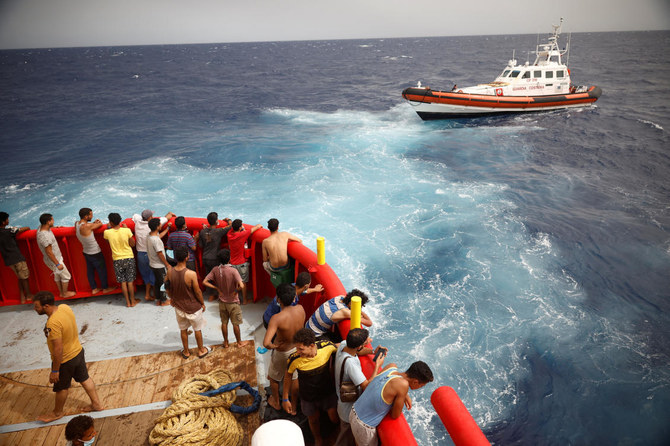
Two dead, 57 rescued from migrant shipwrecks off Italy’s Lampedusa

Italy’s coast guard on Saturday found one person dead following a migrant shipwreck off the southern Italian island of Lampedusa, as searches were still ongoing for two people said to be missing. (Reuters/File)
Short Url
Updated 06 August 2023
Follow

Two dead, 57 rescued from migrant shipwrecks off Italy’s Lampedusa

  • Ansa said the coastguard rescued 43 people and recovered the body of what appeared to be a minor following the accident
  • Survivors told authorities a total of 46 people had embarked in the journey

ROME: Italy’s coast guard said on Sunday it had recovered two bodies and rescued 57 people off the southern island of Lampedusa, amid reports that more than 30 people were missing following two shipwrecks.
The Ansa news agency, citing survivors’ accounts, reported that two migrant boats that had set off from the port of Sfax, a hotspot for Tunisia’s migration crisis, had sunk on Saturday on their way to Europe.
One was carrying 48 people, the second 42, Ansa said, adding that the coast guard found the survivors about 23 nautical miles (46 km) south-west of Lampedusa, as well as the two victims — a woman from Ivory Coast and her one-year-old child.
A coast guard spokesperson said he could only confirm the number of survivors and the recovery of two bodies.
More than 2,000 people have arrived in Lampedusa in the last few days after being rescued at sea by Italian patrol boats and NGO groups, as strong winds further complicate the situation around the island.
About 20 migrants have been stuck since Friday on a cliff after their boat crashed against rocks upon arrival in Lampedusa, with the coast guard unable to reach them via sea or helicopter, local media said.
On Sunday, NGO group Open Arms wrote on social media X that it had finally begun disembarking 195 rescued sea migrants in the southern Italian port of Brindisi after more than two days of sailing in rough seas.
Italy’s right-wing government has adopted a policy of assigning far-away ports to charity ships, rather than letting them disembark rescued migrants in nearer Lampedusa or Sicily, with the aim of spreading arrivals across the country.
NGOs complain that this increases their navigation costs, prolongs the misery of survivors, and reduces the amount of time charity ships can patrol the areas of the Mediterranean where shipwrecks are more common.
Italy is experiencing a sharp surge in sea migration, with almost 92,000 arrivals recorded far this year, according to interior ministry data last updated on Friday, compared to more than 42,600 in the same period in 2022. 


New Zealand restricts the spread of a reviled killer’s views by hampering his attempts to gain fame

Updated 4 sec ago
Follow

New Zealand restricts the spread of a reviled killer’s views by hampering his attempts to gain fame

  • The 35-year-old told the court this week he didn’t want to plead guilty and made the “irrational” admissions during a “nervous breakdown” induced by his solitary and austere prison conditions

WELLINGTON, New Zealand: In a near-empty courthouse, in front of almost no one, the appeal by New Zealand’s most reviled killer was heard in muted fashion with little mention of the details of the country’s deadliest mass shooting.
Such is New Zealand’s desire to smother the racist motivations of Brenton Tarrant, who murdered 51 Muslims praying at two mosques in the city of Christchurch in 2019. Tarrant, a self-professed white supremacist, referred to other perpetrators of hate-fueled massacres when he committed his attack and other mass shooters have cited his actions since.
Yet it’s rare to encounter the Australian man’s words in New Zealand, the country where he migrated with a plan to amass semiautomatic guns and carry out the slaughter.
Officials have sought to curb the spread of his views, including through a legal ban on his racist manifesto and a video he livestreamed of the shooting. The effort to prevent public exposure to Tarrant is perhaps most apparent in New Zealand’s courts, where he sought this week to recant his guilty pleas.
A three-judge panel in the Court of Appeal in Wellington heard final arguments Friday by Crown lawyers opposing Tarrant’s application to have his admissions in 2020 to charges of terrorism, murder and attempted murder discarded. He is serving life in prison without a chance of parole, but the case would return to court for a full trial if he is allowed to revoke his guilty pleas.
Opposing lawyers say his appeal has no merit
The 35-year-old told the court this week he didn’t want to plead guilty and made the “irrational” admissions during a “nervous breakdown” induced by his solitary and austere prison conditions. But Crown lawyers opposing his appeal bid said in their response Friday there was no evidence for the claims that he was seriously mentally ill.
Experts had ruled Tarrant was fit to enter pleas, and his former lawyers and prison staff didn’t raise concerns either.
“It’s difficult to see what more could’ve been done,” Crown lawyer Barnaby Hawes told the court. Tarrant, he added, “is an unreliable witness and his narrative should be treated with caution.”
The evidence against Tarrant — including his own livestream of the massacre, in which he filmed his face — was so overwhelming that a guilty verdict was assured if he had fought the charges in a trial, the lawyers said.
“Pleading guilty to charges where his guilt is certain can’t be seen to be irrational,” Hawes said.
The subdued hearing defies the tension over the case
One topic nearly absent from the weeklong hearing was any mention of the hateful motivations Tarrant cited for committing the crimes. Lawyers both supporting and opposing Tarrant’s bid avoided reference to his white supremacist views, and proceedings unfolded in the quiet and stolid way New Zealand court cases usually do.
But there were signs the court sought to limit the public’s exposure to Tarrant, as New Zealand’s justice system has done before. Almost nobody was permitted to view the gunman’s evidence and the appeal bid unfolded in front of nine reporters, nine lawyers, a few court staff, and an empty public gallery.
Tarrant was permitted to watch the proceedings by video conference from Auckland Prison, but his image was not visible in the courtroom except when he gave evidence. Apart from in Christchurch, where the bereaved and wounded survivors watched a livestream of the hearing at the local courthouse, the shooter was invisible.
The approach New Zealand has enacted — in which even news outlets name the shooter as few times as possible in each article — stands at odds with the publicity given to trials for racist mass killers before, including widely covered proceedings for the Norwegian murderer Anders Breivik, whom Tarrant years later cited as an inspiration. Crown lawyers urged the appeal judges Friday to thwart the prospect of the matter returning to court in a lengthy public trial, which would happen if the Australian’s bid to recant his guilt was successful.
“Keeping this case alive is a source of immense distress” to the shooter’s victims, Crown lawyer Madeleine Laracy said. “It doesn’t allow them to heal.”
A swift ruling isn’t expected
The judges’ decision will be released later. New Zealand’s appeals court delivers 90 percent of its judgments within three months of a hearing’s end, according to the Court’s website.
If his bid to revoke his guilty pleas is unsuccessful, Tarrant’s case will return to the appeals court for a later hearing where he will seek a review of his life sentence.