Atlas Lionesses secure their legacy in Moroccan football’s golden era

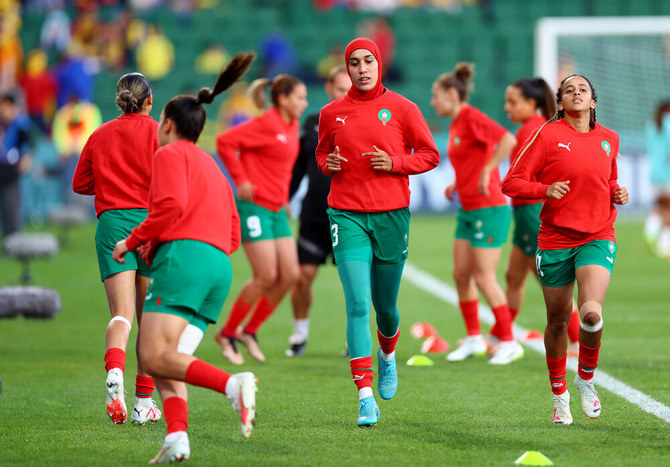
Morocco’s Nouhaila Benzina during the warmup before their FIFA Women’s World Cup 2023 Group H match against Morocco at the Perth Rectangular Stadium, Perth, Australia on Aug. 3, 2023. (Reuters)
Short Url
Updated 04 August 2023
Follow

Atlas Lionesses secure their legacy in Moroccan football’s golden era

  • Qualification to knockout stages of Women’s World Cup compares with men’s semifinal appearance at Qatar 2022
  • Morocco’s 1-0 win over Colombia on Thursday means they now face France in Round of 16

They all went in different directions. Some hugged those nearest, some fell to their knees in prayer and disbelief, and some just ran around not knowing what to do with themselves.
The reaction of the Moroccan players as it all ended was surely matched by fans back home after the stunning 1-0 win over Colombia in Perth, Australia, on Thursday.
Less than eight months after the men reached the semifinals of Qatar 2022, the women’s team, unbelievably, reached the knockout stages of their first ever Women’s World Cup.
This is truly a golden era for Moroccan football.
It could be argued that this latest achievement matches the first, but either way, this is simply stunning.
When the Atlas Lionesses lost their first ever World Cup game 6-0 to Germany on July 24 in Melbourne, the reaction was that the team needed time and experience to compete at this level. After all, this was a game between the two-time world champions, a team ranked second in the world, and a North African debutant, a full 70 places lower.
As the full-time whistle sounded in that game, nobody would have imagined that just a few days later Morocco would be going through to the last 16 and that the mighty Germans would be going home.
Nobody could have conceived that, on Thursday, it would be the Europeans wandering around tearful and shell-shocked in Brisbane at the end of their 1-1 draw with South Korea while the Moroccans would be running around the Perth pitch, thousands of kilometers to the west, celebrating after beating the Group H leaders to take second place and become not just the first Arab team to appear at the competition, but also to progress past the group stage.
Here is what happened in between. After the first game thrashing, Morocco bounced back by beating South Korea 1-0. That gave Reynald Pedros’ team a little hope. Germany lost their second game to Colombia. That meant that the last win over the South Americans was enough to progress, as Germany just could not find the all-important second goal to defeat the Koreans.
For those watching back home in Rabat, Fez, Marrakesh and everywhere else in the Arab world, there was much more to it than that. It was a double agony. First they had to wait for the final whistle to ensure that the three points came against Colombia. The lead had been taken just before the break due to what was a fairly soft penalty as Ibtissam Jraidi was brought down in the area. The legendary Ghizlane Chebbak stepped up only to see her kick saved, before Anissa Lahmani came in to shoot home the rebound.
Of course, there was plenty of Colombian pressure in the second half and while Morocco defended resolutely and Khadija Er-Rmichi made some top-class saves, this was no mere backs-to-the-wall performance full of desperate defending, but one of a team that looked to get forward whenever possible, and it was only in the final few minutes that they started to look tired.
When the whistle came, there were celebrations from the players, but the atmosphere soon went quiet as the realization set it that the group’s other game had yet to finish. Indeed, there were 16 minutes of injury time in Brisbane.
So, then came the second agonizing wait, to see if Korea — by this time aware that they were heading home and out of the competition — could hold on in the face of serious pressure from Germany, the team that reached the final of the European Championships last year. This time, the Moroccan players shared the pain, helplessness but growing excitement with those back home and gathered in a huddle on the pitch, along with coaching staff, to watch the game on their phones. Then the second whistle sounded, the impossible had happened and women’s football in Morocco will never be the same again.
Now they go on to face France in Adelaide on Aug. 8 in a chance to avenge the men’s defeat in the last four last December.
Whatever happens, this has already been a success and it could be argued that it ranks alongside what the men managed in Qatar. Morocco had already appeared at five World Cups before 2022, reaching the knockout stage in 1986 and performing well in a very tough group in 2018. With the likes of Achraf Hakimi and Hakim Ziyech playing at the top levels of European football, they won a tough group, finishing above Croatia and Belgium, and going on to eliminate Spain and then Portugal before coming up against the defending world champions and giving France a tough game.
That was truly heroic, and the side became the darlings of the tournament, but the women have come a long way in such a short period of time. Before 2022, they had only ever appeared at two Women’s Africa Cup of Nations, winning just a single game in total. It could have in no way been said that this side was a powerhouse of the continental football scene. Reaching the continental final on home soil last year electrified the nation, but it was the first taste of international success that the team had ever managed.
Coming into the World Cup, they were ranked 31 out of the 32 participants with only Zambia placed lower. Then came that 6-0 loss. After that, it would have been easy to just focus on not losing face and avoiding embarrassment, but the players picked themselves up and conjured up two very famous wins against teams with more pedigree.
Now, just as when players went off in every direction when the big moment came on Thursday, nobody knows where or how far this Moroccan team can go.


UAE golden boy Yahya Alghassani hoping to pay it forward for country’s young footballers

Updated 30 December 2025
Follow

UAE golden boy Yahya Alghassani hoping to pay it forward for country’s young footballers

  • The Shabab Al-Ahli forward spoke to Arab News about captaining his country at the Arab Cup, childhood inspirations, challenges ahead and helping young Emirati talent blossom

DUBAI: On Nov. 6 this year, Omar Abdulrahman, the golden boy of Emirati football during the 2010s, announced his retirement at the age of 34, to little fanfare.

It was a somewhat sad end for one of the UAE’s great talents, one whose last five years as professional were ruined by injuries.

It may have taken a few years for the Whites to have a new hero on the pitch, but in Yahya Alghassani, 27, the UAE finally have one of their own to take the national team forward.

The Shabab Al-Ahli star recently captained the UAE in two matches at the 2025 FIFA Arab Cup in Qatar and is looking increasingly at ease as the face of Emirati football — on and off the pitch.

Alghassani has in recent years stepped up from being one of the UAE national team’s great hopes to being one of the senior players. With several nationalized foreign superstars vying for places in the squad, that is no mean feat.

Now he is paying it forward. In December, after the Arab Cup, Alghassani hosted a youth tournament to encourage more youngsters to take up a career in football, and indeed to find the country’s newest gem.

“When I was young we used to get a lot of opportunities to show off our talents,” he said at the launch of the Talent Cup at Dubai Police Club Stadium.

“But as the years went by, these opportunities decreased. The avenues to show off our talents decreased. Of course, there should be someone to help them show off (and) display their skills.”

“These kids need outlets for their energy, so instead of wasting it in the wrong places, they could release it via football,” Alghassani added.

“I know football, and I was raised in that environment, so I know what it means to them and what it means to get the same competitions to play in, to in the same way have someone discover their talents.

“All of what we’re doing is for the sake of the kids. In the end we need to give back everything to the society.”

For the more outstanding players present, Alghassani sees real opportunities to find a pathway into the professional game.

“In this competition, I insisted that there be scouts present, both from the local clubs and international ones, especial from the UK. Maybe in the summer they will have special trials for some of these best players, they will get opportunities to play there.”

“And the local coaches will be able to scout freely, I don’t interfere in these matters,” he said. “From my side, if I see a good player, a player who deserves to be in a local team, I will help him. All of us are here to help the local players.”

With the help of several entities, Alghassani’s work extends beyond the training pitch. “One of the things I like to be involved in is charity work.” he said.

“I now work with Al-Jalila Foundation, who provide me with a lot of support. I am also an ambassador for Dubai Sports Council, and I am proud to work with such government organizations.”

“There are companies like Red Bull and Whoop that support me personally, as well as Nike. They all help me and I in turn provide all my resources to help the kids so that they receive the highest level of training and get the best chance of being discovered.”

Alghassani remembers those who helped him become the player he is today. “I used to train at Al-Furjan before joining Al-Ahli (now Shabab Al-Ahli). I was 14 years old.

“To be honest, progress wasn’t easy, but there were a lot of opportunities to show your talent. Al-Furjan has somewhat disappeared now, so we are trying to bring it back. This is a positive thing for the community.”

He also credits his brothers for being an inspiration and regrets that they did not become professional footballers. “But I was lucky that God helped me to make it, so in the end I have to give back to the community. This is the most important thing for me.”

As Alghassani took his first steps in club football, his inspirations where two of the UAE’s most prominent members of the Golden Generation that blossomed under Emirati Mahdi Ali.

“Ali Mabkhout and Amoory (Omar Abdulrahman),” he said without hesitation.

“They were very passionate about their way of playing, their way of thinking, their way of being in the field. I was fortunate to play with them for a while, and I hope to play with them again. Especially Omar Abdulrahman.”

The former Al-Ain, Al-Jazira, Shabab Al-Ahli and Al-Wasl superstar may have officially retired, but Alghassani believes there could still be one final twist in his tale.

“Amoory is one of the talents you can’t deny, he is a very positive person on the team, and he likes to help the players around him,” he said. “I don’t think he is retired completely.

“There could still be a return on the cards, and I think he will be back soon, God willing.”

After his youth team stint at Al-Ahli, Alghassani signed with Abu Dhabi’s Al-Wahda Club in 2018, before moving back in January 2021 to current club Shabab Al-Ahli in Dubai, where his career overlapped with Abdulrahman’s. His international debut came a year later.

“You can’t describe the feeling of being in the national team,” Alghassani said. “Nothing else you do can compare to it, to represent your country and have all your people supporting you.

“I have been with the national team for a long time now. Honestly, the pressure is very high, it is not easy. But we have to embrace this pressure with pride because we are representing our nation.”

Alghassani is delighted to have the extra pressure of captaining the UAE national team. “If you are a professional football player and you don’t welcome the pressure with a smile, you won’t be able to continue.

“I always say that I have to welcome the stress and the pressure, because they are what keeps the player focused and calm at the same time.”

In the absence of goalkeeper Khalid Eissa, Alghassani assumed national captain duties for the Arab Cup matches against Algeria and Morocco. Emirati fans must have been proud to witness him give last-minute team talks as players went into a huddle seconds before kick-off.

“It is one of my duties,” he said.

“If I am the captain, I have to give these instructions. Of course these players have helped me a lot. They give me this platform to give them advice, and they accept my advice. We are all equal, there is no one leader on the pitch. We are all captains and everyone helps each other.”

After the UAE’s progress ended in the Arab Cup following a 1-0 loss to Morocco, the third-place play-off against Saudi Arabia was abandoned due to bad weather.

“We are thankful to God that we were awarded (joint) third place with the Saudi team,” Alghassani said.

“Honestly, I expected to do even better. It’s true no one expected us to reach this level, but personally I felt that we could reach a higher level. We have to see the Arab Cup as an experience. It will help us in the future.”

Despite not qualifying for the 2026 World Cup, Alghassani is already looking to some major challenges ahead. “We will now focus on this championship (AFC Asian Cup 2027 in Saudi Arabia),” he said.

“This is our sole focus now. Unfortunately, the World Cup is gone. It is a very important tournament for us, and I hope we will produce positive results.”

Alghassani has already scored in that competition — against Hong Kong in 2023. And if he needs any inspiration, he could cast his mind back to the 2015 AFC Asian Cup and the heroics his childhood heroes performed in Australia.

“I remember the penalty kick by Ismail Ahmed,” he said, recalling the winning spot-kick against Japan in a memorable semifinal in Sydney.

“His was the decisive penalty. I also remember Amoor’s ‘Panenka’ kick, I remember all of them. But when Ismail Ahmed scored I ran out of the house. I was happy. It was an indescribable feeling as a fan.”

A Panenka kick refers to a technique where the player chips the ball softly down the center of the goal, relying on the goalkeeper diving to one side, named after Czechoslovakia player Antonin Panenka who first used it to win the 1976 European Championship final.

After that 2015 Asian tournament, in which the UAE finished third, there was genuine interest in Abdulrahman and Mabkhout from European clubs, though a move never materialized for either.

Would Alghassani be willing to take that step? “Of course, I always welcome the idea of a professional career abroad,” he said confidently.

“It is always in my mind. I welcome any idea, but I have to respect my contract with Shabab Al-Ahli. If they need me, I will be there. And if they support a move abroad for me, I will go, why not. This is the dream of every professional player.”