

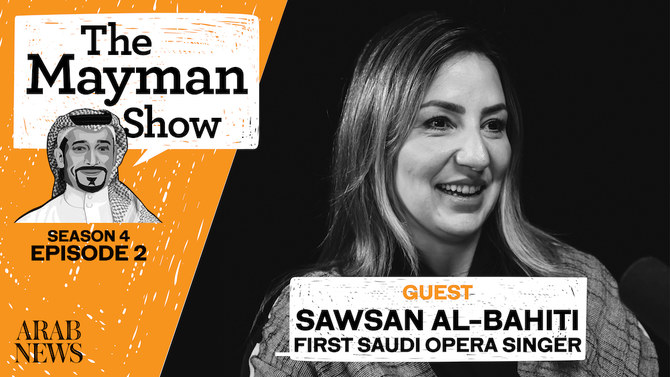

RIYADH: It all started with a love for singing and playing rock ’n’ roll music, and now Sawsan Al-Bahiti is Saudi Arabia’s first opera singer, and in 2019 became the first woman to perform the national anthem in public.
Speaking on The Mayman Show recently, Al-Bahiti said opera was gaining more fans because Saudis are drawn to the quality and poetic elements of much of the genre.
Al-Bahiti lauded the Ministry of Culture and the Music Commission for laying the groundwork for musicians to flourish in the Kingdom, including the announcement that the Saudi Opera House is scheduled to open in 2026. This made it “the right time to be an artist and a singer.”
Al-Bahiti said she wants to help grow opera’s fanbase. “I chose it because I want to pioneer and lead (the way by) introducing opera to this part of the world.”
She chose music because her work in marketing left her unfulfilled. Her family provided support, which made her understand that “when your dream is something of big value, it provides you with lifelong energy.”
“My family always tells me how happy I am now versus how I was before and how different I became as a personality. This tells me constantly that I’m on the right track and it’s like my compass,” she said.
Al-Bahiti is also passionate about teaching. She founded the Soulful Voice Studio in Jeddah, where she focuses on coaching aspiring singers. She is also a project manager with the Saudi National Orchestra and Choir.
It was in 2019 that Al-Bahiti made the decision to pursue a career in opera. An unforgettable moment was her debut at the King Fahd Cultural Center in Riyadh, where she became the first woman to perform the Saudi national anthem. This was to mark the opening performance of the prestigious La Scala di Milano Orchestra.
“I was literally above the stars, it was out of this world. The excitement, the happiness, the pride, the seeing of the audience’s reactions as well, was overwhelming.”
Another highlight of her career was meeting Andrea Bocelli and his family in AlUla. “I was privileged enough to be invited to meet him before his concerts.”
Looking ahead, Al-Bahiti said she is scheduled to perform at the Natural History Museum in London.
Al-Bahiti outlined some of the techniques involved in singing opera, which is “more relying on the breath and the strength of the singer’s breath rather than the voice itself. So, if you have a strong breath and you know how to use it in the right technique, you’ll be able to sing nicely.”
She encourages people to “follow their dreams,” adding “it’s not unrealistic if you put (in place) a plan, a vision. And if you’re supported with good values to drive your dream and get the right advice from the right people, you will be able to achieve things that you never thought you could.”


