

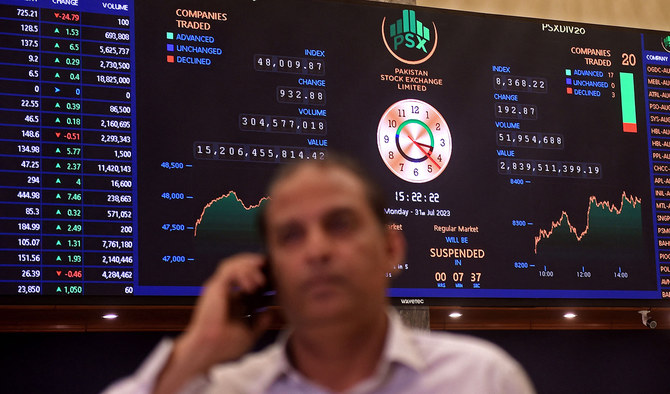

KARACHI: Pakistan Stock Exchange’s (PSX) key index on Wednesday closed at 48,765 points, the highest level it has crossed in six years, with analysts attributing bullish sentiments to factors such as Islamabad's deal with the International Monetary Fund (IMF) for a bailout program and much-needed financial support from Saudi Arabia and the UAE.
Pakistan received critical financial support from Saudi Arabia and the UAE in June, with the two countries depositing $2 billion and $1 billion respectively in Pakistan's central bank before the IMF's Executive Board approved a $3 billion standby agreement (SBA) with Islamabad.
The benchmark KSE100 index surged by 534 points to close at 48,765 points on Wednesday. Previously, the market closed at 49,527 points on June 09, 2017, according to data shared by the PSX and leading Pakistani securities and research firm, Arif Habib Limited (AHL).
“A number of factors have played a key role in keeping bullish trends up at the capital market and closing the index at the higher side after six years,” Shahid Ali Habib, CEO of AHL, told Arab News.
Habib said major developments at the political and economic fronts continue to promote positive sentiments among investors at the PSX, particularly after Islamabad successfully secured the $3 billion short-term bailout program from the IMF.
“The Saudi and UAE support with payments even before the formal signing of the SBA agreement and disbursement played a key role in boosting sentiments at Pakistan’s stock market,” Habib explained.
The key stock index, KSE100 index, has gained 7,312 points or 17.6% since Pakistan signed the staff-level agreement with the IMF.
On Tuesday, Pakistan organized its first minerals summit in the capital, aiming to tap into an estimated $6 trillion worth of mineral deposits in the country.
Habib said investors received positive signals when they saw Arab investors attending the summit.
“Previously, developments were taking place at larger political and economic fronts but now, developments are taking place at the sectoral front too,” Habib said adding that these factors have "eased off economic uncertainties to some extent."
Pakistan has been facing a dollar liquidity crunch but investors are now downplaying dollar-related risks, Habib said.
“Investors now saying the dollar risk is no more,” he added.
Market heavyweights, including Oil and Gas Development Company (OGDC), Habib Bank Limited (HBL), Engro, and Muslim Commercial Bank (MCB) lifted the index higher during the trading session, equity dealers said.
The blue-chip HBL said it was informed by the Agha Khan Fund for Economic Development of its intention to acquire HBL's additional shares amounting to Rs3.5 billion from the open market.
Analysts said stock bullish sentiments were also fueled by improvement in key economic indicators.
“Stocks closed bullish as investors weighed falling CPI (Consumer Price Index) inflation to 28.3 percent in July 2023 and the State Bank of Pakistan (SBP) status quo in the key policy rate announcement,” Ahsan Mehanti, a senior equity analyst, told Arab News.
“$1.6 billion trade deficit for July 2023, surging global crude oil prices and the government's likely resolve to record SOEs (state-owned enterprises) gas circular debt crises played a catalyst role in the bullish close.”
However, Pakistan's national currency continues to depreciate amid rising demand for the greenback for import payment. The Pakistani rupee lost its value by 0.64 percent to close at Rs289.38 against the US dollar in the interbank market on Wednesday.


