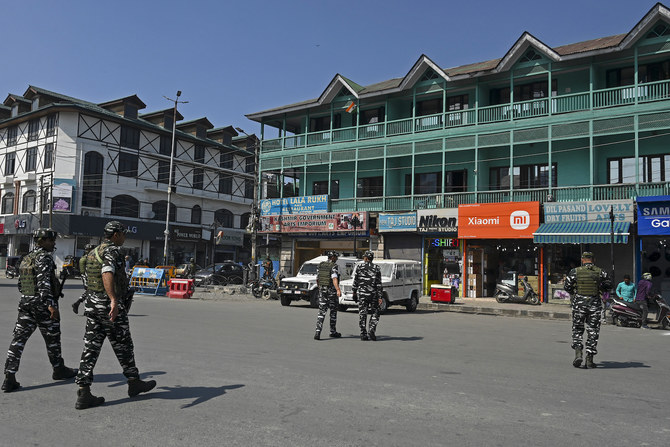

NEW DELHI: India’s top court began on Wednesday hearing a challenge to the 2019 government decision that stripped the Muslim-majority region of Kashmir of its statehood and special autonomous status.
The semi-autonomy of Jammu and Kashmir was granted by India’s constitution until Aug. 5, 2019, when the Indian government unilaterally revoked the relevant provisions and scrapped its flag, legislature, protections on land ownership, and fundamental rights.
The hearings that the Supreme Court’s constitutional bench started on Wednesday are of petitions filed over the past four years to challenge that move.
“We have approached the Supreme Court with this belief that whatever the Indian government has done is unconstitutional, not taking into consultation stakeholders of the people of Jammu and Kashmir (is) violating the constitutional order itself,” said Mohammed Yousuf Tarigami, a Kashmiri politician and one of the petitioners.
“We hope that the court will deliver justice and put the constitution in order and whatever constitutional rights have been decimated, abrogated will be restored ... we are expecting that the honorable court would restore the constitution and democracy itself to that part of the world which has been delinked from the democratic spirit of the country.”
Indian-controlled Jammu and Kashmir is part of the larger Kashmiri territory, which has been the subject of international dispute since the 1947 partition of the Indian subcontinent into Hindu-majority India and Muslim-majority Pakistan.
Both countries claim Kashmir in full, and rule in part.
Indian-controlled Kashmir has for decades witnessed outbreaks of separatist insurgency to resist control from the government in New Delhi.
With the constitutional change, Jammu and Kashmir was split into two federally-governed union territories, in a move that was followed by a total communications blackout, severe restrictions on freedom of movement, and detention of local leaders — some of whom remain in jail.
Administrative measures introduced after the abrogation of the special status and statehood have allowed non-locals to settle and vote in the region, raising fears of attempts to engineer demographic change.
Some of the petitioners who appealed to the Supreme Court, like Air Vice Marshal Kapil Kak, a retired officer of the Indian Air Force, believe that the changes can still be voided by the country’s top-most constitutional bench.
“I have full faith in the objectivity, impartiality and sense of justice and fair play of the honorable Supreme Court of India and I do believe that petitioners have a very strong constitutional case,” Kak told Arab News.
“If it is looked at (in a) fair and just manner, we will receive our due in ensuring that the unconstitutional act which was promulgated under the Jammu and Kashmir Reorganization Act in August 2019 will be undone.”
But not everyone is optimistic.
For Subhash Chandra Gupta, an advocate in Jammu, it was a “futile exercise” by the apex court that was too late in hearing the petitions.
“The judiciary has its own limitations and it cannot restore what has been bulldozed. There was hope had the Supreme Court taken up the petitions within weeks after the changes were made,” he said.
“Now so much intervention has been made in that region by the government. Restoring the status quo ante would create a new problem.”