Iran’s Revolutionary Guard runs drill as US military presence in region grows

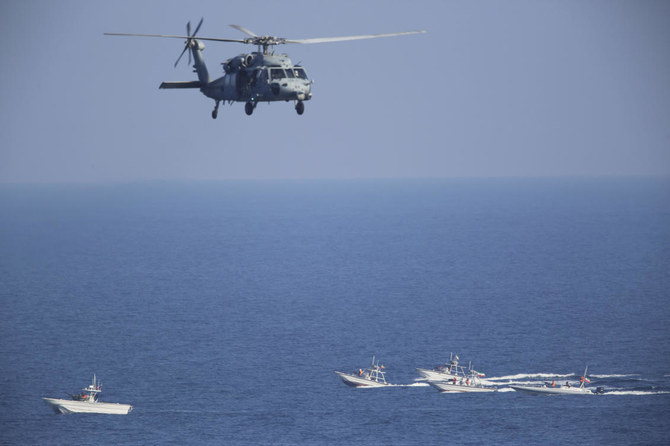
Ships, drones and missile units took part in Iran's latest drill. (File/AP)
Short Url
Updated 02 August 2023
Follow

Iran’s Revolutionary Guard runs drill as US military presence in region grows

  • Iran did not provide a reason for launching the drill

TEHRAN: Iran’s paramilitary Revolutionary Guard launched a surprise military drill Wednesday on islands in the Arabian Gulf, just as the US military increase its presence in the region over recent ship seizures by Tehran.
The drill focused primarily on Abu Musa Island, though the Guard also landed forces on the Greater Tunb Island as well, Iran’s state-run IRNA news agency reported. Ships, drones and missile units took part in the drill, the report said.
Iran did not provide a reason for launching the drill, though such snap exercises have happened in the past.
“We always try for security and tranquility; it is our way,” the Guard’s chief, Gen. Hossein Salami, said in a televised address during the drill. “Our nation is vigilant, and it gives harsh responses to all threats, complicated seditions and secret scenarios and hostilities,”
However, the drill comes as thousands of Marines and sailors on both the amphibious assault ship USS Bataan and the USS Carter Hall, a landing ship, are on their way to the Arabian Gulf. Already, the US has sent A-10 Thunderbolt II warplanes, F-16 and F-35 fighters, as well as the destroyer USS Thomas Hudner, to the region.
The Pentagon has said the deployment is “in response to recent attempts by Iran to threaten the free flow of commerce in the Strait of Hormuz and its surrounding waters.” Some 20 percent of the world’s oil passes through the narrow waterway connecting the Arabian Gulf to the wider world and the US views it as crucial to both its national security and keeping global energy prices stable.
Meanwhile, Iran now enriches uranium closer than ever to weapon-grade levels after the collapse of its 2015 nuclear deal with world powers.
Meanwhile, Iran has been trying to signal its displeasure over recent comments about the islands made by Russia, which Tehran has supplied with bomb-carrying drones for their war in Ukraine. Russia earlier this summer in a joint statement with the Gulf Cooperation Council called for “bilateral negotiations or the International Court of Justice” to decide who should control the islands. That prompted an outcry in Iran and Tehran summoned the Russian envoy over the remarks.


Sudan defense minister dismisses ‘intelligence document’ as fabrication after convoy strike

Updated 12 February 2026
Follow

Sudan defense minister dismisses ‘intelligence document’ as fabrication after convoy strike

  • Gen. Hassan Kabroun tells Arab News claims that army hid weapons in aid convoy are “completely false”

RIYADH: Sudan’s defense minister has firmly denied reports attributed to Sudanese intelligence alleging that a convoy targeted in North Kordofan was secretly transporting weapons under the cover of humanitarian aid.

Gen. Hassan Kabroun described the claims as “false” and an attempt to distract from what he called a militia crime.

The controversy erupted after news reports emerged that a document attributed to Sudan’s General Intelligence Service claimed the convoy struck in Al-Rahad on Friday was not a purely humanitarian mission, but was instead carrying “high-quality weapons and ammunition” destined for Sudanese Armed Forces units operating in the state.

The report further alleged that the convoy had been outwardly classified as humanitarian in order to secure safe passage through conflict zones, and that the Rapid Support Forces had destroyed it after gathering intelligence on its route and cargo.

Kabroun categorically rejected the narrative.

“First of all, we would like to stress the fact that this news is false,” he told Arab News. “Even the headline that talks about the security of the regions, such as Al-Dabbah, is not a headline the army would use.”

He described the document as fabricated and politically motivated, saying it was designed to “cover up the heinous crime they committed.”

The minister affirmed that the area targeted by drones is under full control of the Sudanese Armed Forces and does not require any covert military transport.

“Second, we confirm that the region that was targeted by drones is controlled by the army and very safe,” Kabroun said. “It does not require transporting any military equipment using aid convoys as decoys because it is a safe area controlled by the army, which has significant capabilities to transport humanitarian aid.”

According to the minister, the Sudanese military has both the logistical capacity and secure routes necessary to move equipment openly when needed.

“The army is professional and does not need to deliver anything to Kadugli or Dalang on board aid convoys,” he said. “The road between Dalang and Kadugli is open. The Sudanese forces used that road to enter and take control of the region. The road is open and whenever military trucks need to deliver anything, they can do so without resorting to any form of camouflage.”

Kabroun further rejected any suggestion that the military uses humanitarian operations as cover.

“Aid is transported by dedicated relief vehicles to the areas in need of this assistance,” he said. “Aid is not transported by the army. The army and security apparatus do not interfere with relief efforts at all, and do not even accompany the convoys.”

He stressed that the Sudanese Armed Forces maintains a clear institutional separation between military operations and humanitarian work, particularly amid the country’s crisis.

“These are false claims,” he said. “This fake news wanted to cover up the heinous crime they committed.”

Sudan has been gripped by conflict since April 2023, when fighting broke out between the Sudanese Armed Forces and the Rapid Support Forces, plunging the country into what the United Nations has described as one of the world’s worst humanitarian disasters.

The latest dispute over the convoy comes amid intensified fighting in South Kordofan, a strategically sensitive region linking central Sudan with the contested areas of Darfur and Blue Nile.

The false report suggested that intelligence monitoring had enabled the RSF to strike what it described as a military convoy disguised as humanitarian aid. But Kabroun dismissed that version outright.

“The intelligence agency is well aware of its duties,” he said. “The Sudanese Army has enough weapons and equipment to use in the areas of operations. These claims are completely false.”

He argued that the narrative being circulated seeks to shift blame for attacks on civilian infrastructure and humanitarian movements.

“This shows that they are trying to cover up the atrocities,” he added, referring to the militia.

Kabroun maintained that the army has regained momentum on multiple fronts and remains fully capable of sustaining its operations without resorting to deception.

“The region is secure, the roads are open, and the army does not need camouflage,” he said. “We are operating professionally and transparently.”

“These claims are completely false,” Kabroun said. “The Sudanese Army does not use humanitarian convoys for military purposes.”