

In Karachi, a savory and sweet stroll on the famed Hussainabad food street

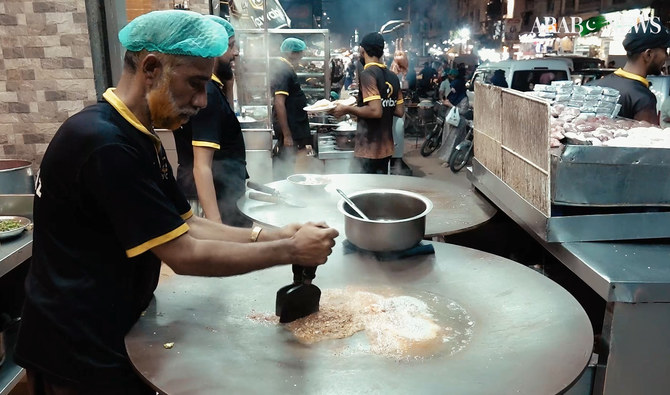
The screen grab taken from a video shows a man preparing food at Hussainabad food street in Karachi, Pakistan on July 31, 2023. (AN Photo)
Short Url
Updated 02 August 2023
Follow

In Karachi, a savory and sweet stroll on the famed Hussainabad food street

  • With kata-kat, chargha, Balochi tikka, expect an overload for your taste buds along food street in Federal B Area
  • Area has been a thriving food center since at least the 1980s but was formally converted into a food street in 2016

 KARACHI: When you enter the Hussainabad food street in Pakistan’s bustling commercial capital of Karachi, the first thing that hits you is the aroma of kata-kat stir-fried meat, crispy parathas, and a deep-fried whole chicken dish popularly known as chargha.

Located in the prominent Federal B Area, the locality has been a thriving food center since at least the 1980s, though it was formally converted into a food street in 2016 by then Karachi Mayor Waseem Akhtar.

The narrow street is sandwiched between a row of buildings on both sides and on most nights is jampacked with pedestrians on the lookout for their favorite foods. On the weekends, there is barely enough space for people to walk freely.

Today, there are over 50 stalls and restaurants on the two-kilometer-long stretch of street, selling a variety of dishes ranging from fast and street foods like chaat and samosas, barbecue, haleem and nihari stews, ice creams, shakes, and other desserts and specialties.

A customer favorite is kata-kat, a stir-fried dish prepared from beef and organ meats on a flat griddle known as a tawa. The dish’s name is an onomatopoeia from the sound of two sharp knives constantly hitting the tawa as the meat is cooked.

“Our kata-kat is delivered to Germany, China, Kenya, Canada, USA, Dubai, and Malaysia,” Mohammad Imran, the manager at the 42-year-old Bolan Restaurant, told Arab News. “We get orders, then we send [it in] tin packs. A lot of people come from Karachi [and] interior Sindh.”

Bolan Restaurant’s kata-kat is made of kidney, liver, brain, and heart cooked in mild spices and topped with green chilies.

“The food here is very delicious,” Imran said as he inspected platefuls of kata-kat being prepared for customers.

Speaking about the history of the street, Imran remembered it as a small market up until a few years ago.

“There wasn’t much [here] 15-20 years ago,” he said. “It used to be a small market but ever since the food street has been established, it has developed a lot.”

Tayyabi’z Restaurant, which opened in 1967, is another old eatery that for years only served boiled eggs and minced meat parathas, but expanded its menu as Hussainabad’s popularity as a hub of food grew, its owner told Arab News.

“Now we have gravy, karahi, kata-kat, brain masala, Balochi tikka, special barbeque platter, and much more,” Mohammad Moosa said.

Tayyabi’z Balochi tikka is a must-try, different from usual tikkas for being deep-fried after it is barbequed, and served with a thick gravy and topped with green and red chilies, and various spice mixes like garam and chaat masala.

Another customer favorite is the grilled chargha at Ghousia Fast Food, crispy on the edges and very soft inside, said Kamran Gul, who has been making the dish for the last 17 years.

“Grilled chargha is famous for its spices, you won’t get this taste anywhere [else] in Pakistan,” Gul told Arab News. “We ground whole spices ourselves instead of using ready-made spices from the market.”

Instructor Faizan Gaba, 30, testified to the unique taste and quality of food at Hussainabad.

“Ghousia Fast Food, they were the first ones to launch Grill Chargha which has been copied by many now. However, the taste and spice they offer is hard to find anywhere else in the city and the country,” Gaba told Arab News.

“People feel an attachment with the food offered here because it is tasteful yet affordable. There are numerous options at the food street, beyond the main meals, and a vibrant environment for a family outing.”


Pakistan’s president defends ongoing strikes in Afghanistan, urges Kabul to dismantle militants

Updated 02 March 2026
Follow

Pakistan’s president defends ongoing strikes in Afghanistan, urges Kabul to dismantle militants

  • Afghanistan on Thursday launched attacks in retaliation for Pakistani airstrikes the previous Sunday
  • Pakistan’s military says it is only targeting Afghan military installations to avoid civilian casualties

ISLAMABAD: Pakistan’s president on Monday defended his country’s ongoing military strikes in neighboring Afghanistan, saying Islamabad tried all forms of diplomacy before targeting militants operating from Afghan territory, and called on the Taliban government in Kabul to disarm groups responsible for attacks in Pakistan.

Pakistan earlier said it is in “open war” with Afghanistan, alarming the international community. The border area remains a stronghold for militant organizations including Al-Qaeda and the Daesh (Islamic State) group.

“(The Afghan Taliban) must choose to dismantle the terror groups that survive on conflict and its war economy,” Asif Ali Zardari said during a speech to lawmakers, adding that “no state accepts serial attacks on its soil.”

Afghanistan on Thursday launched attacks in retaliation for Pakistani airstrikes the previous Sunday. Since then, Pakistan has carried out operations along the border, with Information Minister Attaullah Tarar claiming the killing of 435 Afghan forces and the capture of 31 Afghan positions.

Kabul has denied such claims.

In Afghanistan, the deputy government spokesman Hamdullah Fitrat said Pakistan’s military fired mortar shells at a refugee camp in eastern Kunar province, killing three children and injuring three others.

Afghanistan’s defense ministry said Afghan forces carried out strikes targeting a Pakistani military facility near Paktia province, causing “substantial losses and heavy casualties.”

Pakistan’s military did not respond to questions. It has said Pakistan is only targeting Afghan military installations to avoid civilian casualties.

Pakistan has witnessed a surge of violence in recent months and blames it on the outlawed Pakistani Taliban, known as Tehreek-e-Taliban Pakistan or TTP. It operates both inside Pakistan and from Afghan territory.
Islamabad accuses Afghanistan’s Taliban government of providing safe havens for the TTP, which Kabul denies.

The latest cross-border fighting ended a ceasefire brokered by Qatar and Turkiye in October. The two sides failed to reach a permanent agreement during talks in Istanbul.

Zardari reiterated Pakistan’s call for talks, saying, “We have never walked away from dialogue.”

The Pakistani leader again accused Afghanistan of acting as a proxy for India by sheltering militant groups.

“Stop being used by another country as a battlefield for their ambitions,” he said.

Zardari cited a recent report from the United Nations Security Council’s monitoring team that described the presence of militant groups in Afghanistan as an extra-regional threat.