

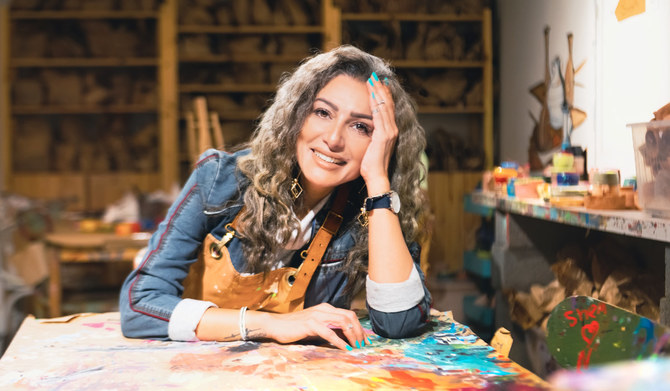

JEDDAH: Saudi artist Ghadeer Hafez has traveled the world to showcase her work and has established herself as an artistic ambassador of the Kingdom.
She is known for paintings that feature bold compositions and colors with an aesthetic and intellectual appeal. The Jeddah-based artist’s journey has spanned more than 23 years, during which she has been present at the forefront of the Saudi and international art scenes.
Hafez was the first Saudi woman artist to exhibit her work in a range of countries, including the US, Italy, Kosovo, Albania, Macedonia, Turkey, Austria, China and Egypt.
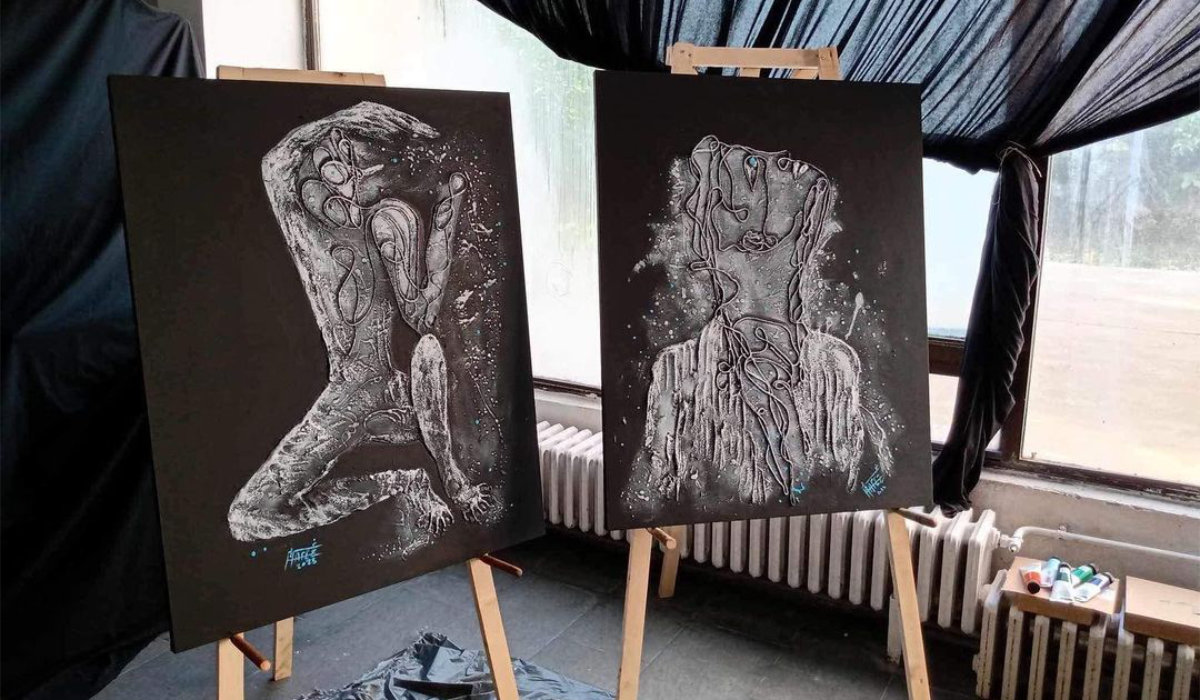
Two paintings that were showcased by Hafez in Macedonia last week.
She recently held a personal exhibition in the Egyptian Opera House that was attended by many art pioneers as well as Saudi Ambassador to Egypt Osama Nuqali.
To Hafez, art is a powerful medium of expression. Before she departed to Macedonia to represent Saudi Arabia in an international symposium for artists, she told Arab News: “Art is a message that the artist releases to the world through works of art.”
Speaking about the message in her own work, she added: “It is about everything related to humanity and the dealings that take place between us as human beings, male or female.”
Art is not for entertainment; it is for discussing minds and promoting society ... always care about what increases the culture of society and improves its behavior.
Ghadeer Hafez, Saudi artist
For this reason, social and humanitarian issues are at the heart of most of Hafez’s paintings. When she paints, she tries to express something to those who see it.
In her paintings, Hafez also derives inspiration from her surroundings to create unique and vibrant works. She said: “The life situations that we meet are the most beautiful, honest inspiration that conveys reality,” adding that she is also inspired by meeting people.
Hafez has represented Saudi Arabia on global art platforms. She said: “By the grace of God, I was invited by government agencies in Europe and America to represent the Kingdom in many art exhibitions, and the last of these participations was in the US in the largest art event that included 195 countries.
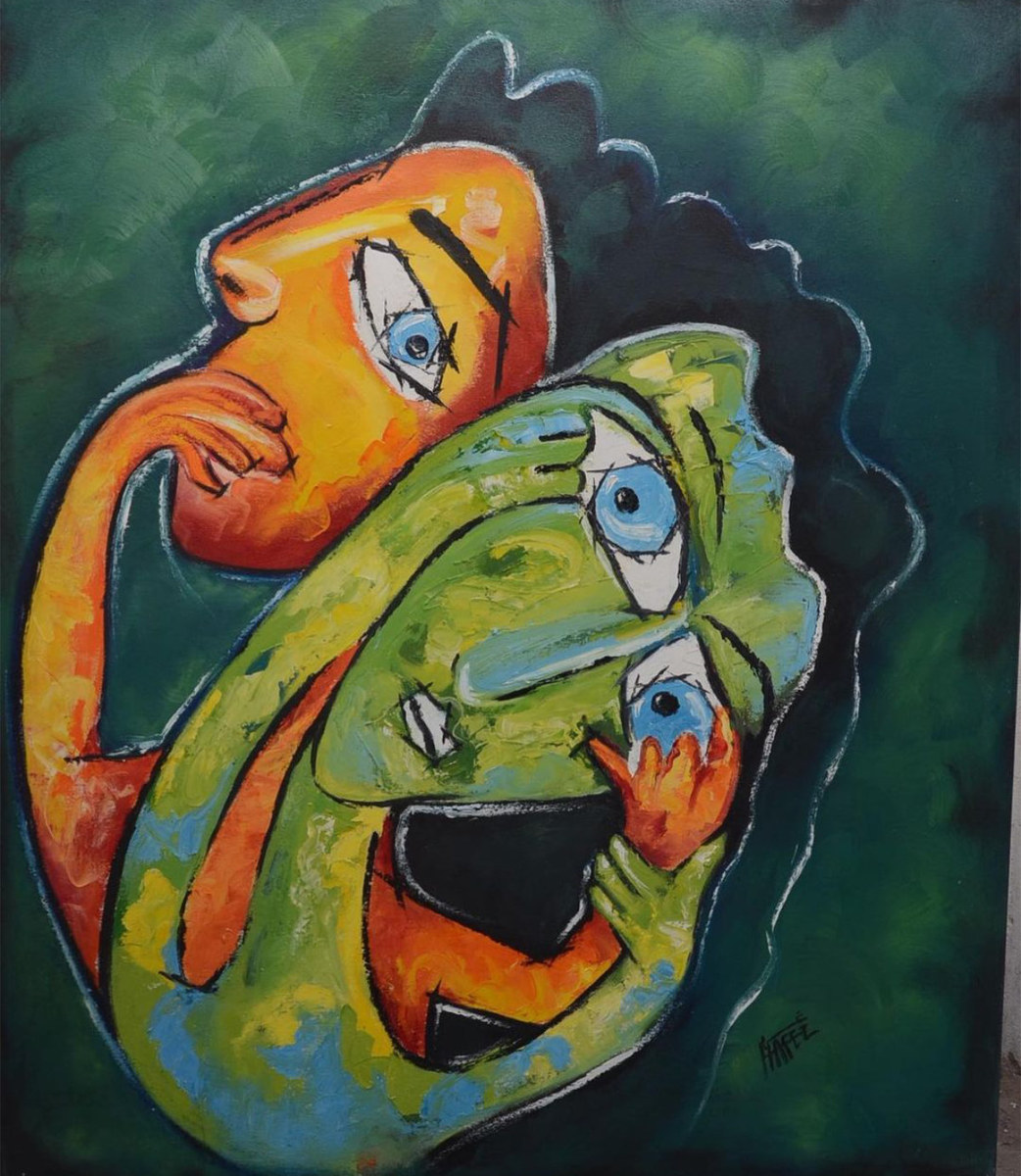
Two paintings that were showcased by Hafez in Macedonia last week.
“I was nominated to represent the Kingdom in this great event and also in Antalya in a global exhibition on peace. And the municipality of Pristina in the coming month of September.”
In 2008, as part of her initiatives to promote art in Saudi Arabia, Hafez established her own art center, known as Ebda Al-Ghadeer.
Commenting on what she has hoped to achieve through the initiative, she added: “My goal was to produce an educated generation that appreciates art and is aware of its dimensions in a correct, non-random way; to come out to the world with works that elevate human behavior.”
In 2008, Ghadeer Hafez founded her own art center Ebda Al-Ghadeer in Jeddah.
She said: “Every month I feel proud of the artistic output that I have achieved through my students, who now number more than 3,700 women and more than 2,600 children from inside and outside the Kingdom. My students participating in local exhibitions and my giving continues through them.”
For artists, a successful career does not happen overnight, and is usually a gradual process. Reflecting on the breadth of her experience in the art world, Hafez said: “I achieved everything I wanted in my artistic career, thanks to God. My paintings became treasured in museums and my international participation is in every country I visit.
“I leave my artistic mark in art exhibitions inside and outside the Kingdom.”
HIGHLIGHTS
• Ghadeer Hafez was the first Saudi woman artist to exhibit her work in a range of countries, including the US, Italy, Kosovo, Albania, and Macedonia.
• Social and humanitarian issues are at the heart of most of Hafez’s paintings.
Hafez added that she teaches art to students not only in Saudi Arabia, but in the rest of the Gulf region, too.
While she is now an accomplished artist, the journey has not been perfectly smooth, she said, adding: “The presence of women in Saudi society and in the artistic community was never easy, and the path of art was never paved.
“It was very difficult to convince people of the importance of art. In the past, the culture of art was not important in Saudi society, and the artistic movement did not activate until many years ago. These were the challenges I faced … to convince those around me of the importance of art in society and how art elevates human behavior.”
On her greatest accomplishments, Hafez said: “I established Ebda Al-Ghadeer in Jeddah. I was the first Saudi woman to be internationally accredited in the field of arts training from the Canadian International Center. In addition, I am an international arbitrator for the arts for more than 28 countries.”
She hopes to see great progress in the Kingdom’s art scene. “There is a state of momentum in the Saudi artistic movement, but I still find that the art scene is not studied and needs to set laws that select artists and works of art,” she said
Hafez, a pioneer of the feminist art movement in Saudi Arabia, concluded with sage words of advice to aspiring artists: “Art is not for entertainment; it is for discussing minds and promoting society. Empty works of art do not present content. Always care about what increases the culture of society and improves its behavior. Art is a double-edged sword. Practice art, but before you practice it, you must study it carefully.”


