Pakistan party targeted by deadly Daesh bombing questions state security services

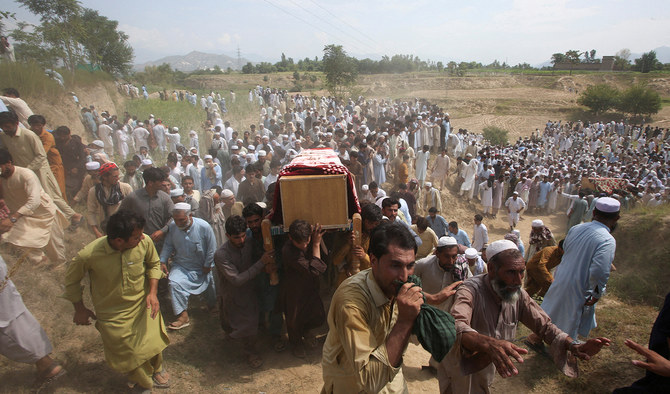
People carry the coffins of victims, who were killed in a blast, during funeral in Bajaur district of Khyber Pakhtunkhwa province, Pakistan on July 31, 2023. (REUTERS)
Short Url
Updated 01 August 2023
Follow

Pakistan party targeted by deadly Daesh bombing questions state security services

  • Maulana Fazlur Rehman says his party is peaceful but ‘even patience and endurance have their limits’
  • The suicide blast has raised concerns about a bloody election period following months of political chaos

PESHAWAR: The leader of an influential Pakistan political party called Tuesday for better state-provided security after a Daesh suicide bomber killed 54 people — almost half of them children — at an election gathering.

Around 400 members of the Jamiat Ulema-e-Islam-F (JUI-F) party — a key government coalition partner — were meeting Sunday when a bomber detonated a vest packed with explosives and ball bearings.

JUI-F’s leader, firebrand cleric Fazlur Rehman, questioned how such a “significant intelligence failure” could have occurred.

“The entire nation is turning to the state institutions responsible for its security,” he said in a statement posted to Twitter.

“Where are they? When will they listen to us? When will they heal our wounds? When will they establish a system that safeguards our future generations?”

Rehman said Jamiat Ulama-e-Islam was a peaceful party, “but even patience and endurance have their limits.”

“Nonetheless, I urge my supporters not to abandon patience and endurance,” he said.

Rehman started political life as a firebrand Islamist hard-liner, and while his party continues to advocate for socially conservative policies, he has more recently forged alliances with secular rivals.

In the past, he has also helped facilitate talks between the government and Tehreek-e-Taliban Pakistan (TTP), a Daesh rival that has since 2007 waged a bloody campaign of bombings and other attacks across the country.

Sunday’s attack occurred in the town of Khar, 45 kilometers (28 miles) from the Afghan border, in an area where militancy has been rising since the Afghan Taliban — who are allied with but distinct from the TTP — took control of Kabul in 2021.

The blast has raised fears Pakistan could be in for a bloody election period following months of political chaos prompted by the ousting of Imran Khan as prime minister in April last year.

Parliament is likely to be dissolved after it completes its term in the next two weeks, with national elections to be held by mid-November.

Last year, Daesh said it was behind attacks against religious scholars affiliated with JUI-F, which has a huge network of mosques and schools in the north and west of Pakistan.

Daesh accuses the JUI-F of hypocrisy for being a religious party while supporting secular governments and the military.

While Rehman’s party never musters more than a dozen or so seats in parliament, it can be crucial in any coalition and his ability to mobilize tens of thousands of religious school students grants him additional clout.

Violence has been rising across Pakistan in recent months.

In January, a suicide bomber linked to Pakistan’s Taliban blew himself up in a mosque inside a police compound in the northwestern city of Peshawar, killing more than 80 officers.

Militant assaults have focused on regions abutting Afghanistan, and Islamabad alleges some are being planned on Afghan soil — a charge Kabul denies.


Qatar, Pakistan resolve to boost strategic, economic cooperation at Doha talks

Updated 24 February 2026
Follow

Qatar, Pakistan resolve to boost strategic, economic cooperation at Doha talks

  • Both countries urge dialogue on Afghanistan amid renewed border tensions between Islamabad and Kabul
  • Discussions focus on bilateral trade and investment, energy, defense, manpower and labor and culture

ISLAMABAD: Pakistan and Qatar on Tuesday agreed to deepen their strategic and economic cooperation during high-level talks between Prime Minister Shehbaz Sharif and his Qatari counterpart Sheikh Mohammed bin Abdulrahman bin Jassim Al Thani, Sharif’s office said.

Sharif visited Qatar along with a high-level delegation on the invitation of Qatari emir Sheikh Tamim bin Hamad Al Thani. The Pakistani premier also held meetings with Qatar’s trade and defense ministers to discuss cooperation in various domains.

The visit came at a time when Pakistan is seeking closer economic engagement with Gulf partners amid its broader push to stabilize the economy and attract investment, while maintaining security and defense cooperation with key regional states.

During their meeting in Doha, PM Sharif and Qatar’s Sheikh Mohammed discussed bilateral relations and exchanged views on regional and international developments, according to the Pakistan prime minister’s office.

“They reaffirmed the strong brotherly relations between Pakistan and Qatar and expressed satisfaction at the growing momentum in political, economic and institutional ties,” Sharif’s office said.

“Discussions focused on enhancing cooperation in the fields of trade and investment, energy, defense, manpower and labor and culture, with both sides stressing the importance of their task force to accelerate cooperation in all these areas.”

Pakistan and Qatar maintain strong trade and investment ties. In 2022, the office of Qatar’s emir said the Qatar Investment Authority planned to invest $3 billion in Pakistan, targeting sectors including transport, aviation, education, health, media, technology and labor.

Nearly 300,000 Pakistanis live and work in Qatar, according to Pakistan’s foreign office, with many employed in health, education, engineering and public services, as well as construction and transport. The two countries engage through forums such as the Bilateral Political Consultations and the Joint Ministerial Commission.

Sharif said he had productive discussions with Qatar’s emir, Sheikh Tamim bin Hamad Al Thani, on how the two sides could transform their brotherly ties into mutually beneficial economic relationships. 

“We also took stock of the regional situation,” he said on X. “Pakistan and Qatar will continue to work together for peace and stability in the region and beyond.”

Prime Minister Shehbaz Sharif (second right) meets the Qatari Emir Qatar’s emir Sheikh Tamim bin Hamad Al Thani (left) in Doha, Qatar, on February 24, 2026. (PID)

DIALOGUE WITH AFGHANISTAN

Earlier, Sharif and Qatar’s Deputy PM Sheikh Saoud Al-Thani discussed the situation in Afghanistan and called for dialogue to support regional stability.

The meeting took place amid renewed tensions after Islamabad carried out airstrikes last week on what it described as Tehreek-e-Taliban Pakistan (TTP) targets inside Afghanistan. Kabul said the strikes killed civilians and vowed to respond to what it called a violation of its sovereignty.

“Regional developments were also discussed, in particular the situation in Iran and Afghanistan,” Sharif’s office said in a statement. “Both sides emphasized the importance of dialogue, de-escalation and collective efforts to promote peace and stability in the region.”

This was the second time in less than six months that Pakistan conducted airstrikes in Afghanistan. The last strikes triggered heavy, weeklong clashes between the neighbors along their border before Qatar and Turkiye mediated a ceasefire between them in Oct. last year.

Separately, Sharif held meetings with Qatar’s State Minister for Trade Dr. Ahmed bin Mohammed Al-Sayed and a delegation of the Qatar Businessmen Association (QBA), highlighting Pakistan’s investment-friendly reforms.

He invited QBA members to explore opportunities in infrastructure, logistics, energy, agriculture, technology and export-oriented manufacturing, his office said.