

Non-oil activities drive Saudi economy up by 1.1% in Q2: GASTAT 

The flash estimates by GASTAT showed that Saudi Arabia’s economic growth was driven by non-oil activities which increased by 5.5 percent annually in the second quarter.  (Shutterstock)
Short Url
Updated 31 July 2023
Follow

Non-oil activities drive Saudi economy up by 1.1% in Q2: GASTAT 

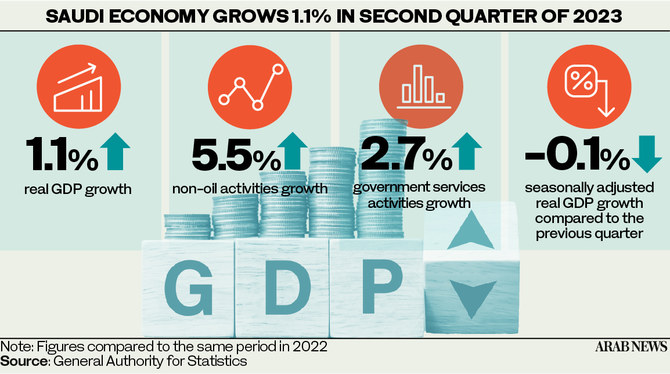
RIYADH: Affirming Saudi Arabia’s progress in its economic diversification journey, the Kingdom’s real gross domestic product grew by 1.1 percent in the second quarter of this year compared to the same period of 2022, according to the General Authority for Statistics.    

The flash estimates by GASTAT showed that Saudi Arabia’s economic growth was driven by non-oil activities which increased by 5.5 percent annually in the second quarter.    

Strengthening the non-oil sector is a crucial agenda of Saudi Arabia’s Vision 2030, as the Kingdom is steadily diversifying its economy which has been dependent on oil for several decades.  

According to the GASTAT report, government services activities increased by 2.7 percent in the second quarter, while oil activities dipped by 4.2 percent on an annual basis.  

The fall in oil activities was primarily due to the decision taken by the Organization of the Petroleum Exporting Countries and its allies, known as OPEC+, to reduce oil output by 1.2 million barrels per day. In those cuts, Saudi Arabia pledged to reduce output by 500,000 bpd.  

In June, the Kingdom also announced an additional cut of 1 million bpd for the month of July. 

The report added that Saudi Arabia’s seasonally adjusted real GDP decreased by 0.1 percent in the second quarter of this year compared to the previous quarter.  

“This effect was due to the decrease in oil activities by 1.4 percent. Non-oil activities increased by 1.8 percent and government services activities grew by 0.6 percent on a quarterly basis,” said GASTAT in the report.  

Earlier in June, the International Monetary Fund, citing prolonged oil output cuts, slashed its 2023 GDP growth projection for Saudi Arabia to 1.9 percent.  

In its World Economic Outlook update, the IMF revised its growth forecast for the Kingdom to 2.1 percent in June from its earlier prediction of 3.1 percent in May.  

“The downgrade for Saudi Arabia for 2023 reflects production cuts announced in April and June in line with an agreement through OPEC+, whereas private investment, including from giga-project implementation, continues to support strong non-oil GDP growth,” said the IMF in its report.  


Saudi stc, PIF’s Humain to launch a JV to develop AI data centers

Updated 8 sec ago
Follow

Saudi stc, PIF’s Humain to launch a JV to develop AI data centers

RIYADH: Saudi Telecom Co. has signed an agreement with Public Investment Fund-backed firm Future Artificial Intelligence Co., also known as Humain, to launch a joint venture to develop and operate data centers dedicated to artificial intelligence in the Kingdom.

According to a Tadawul statement, Humain will hold a 51 percent stake in the JV with stc responsible for the remaining 49 percent.

Under the newly sealed six-year memorandum of understanding, the data center, which will be established through stc’s subsidiary Digital Data and Communications Centers, also known as center3, will be built with advanced infrastructure and can handle up to 1 gigawatt of power, starting with an initial capacity of 250 megawatt, depending on customer contracts.

The move underscores stc’s commitment to advancing Saudi Arabia’s digital future and aligns with Vision 2030 by localizing advanced digital infrastructure, accelerating AI development, and strengthening the Kingdom’s position as a regional digital hub.

It also falls in line with the National Strategy for Data and AI goals to position the Kingdom among the top 10 countries in the open data index and among the top 20 countries in peer-reviewed data and AI publications by 2030. 

The bourse filing said: “The JV brings together center3’s scale, data-center leadership, and extensive regional connectivity with Humain’s strategic mandate to champion end-to-end capabilities — laying the groundwork for high-capacity, low-latency infrastructure critical to the AI era.”

It added: “The financial impact is expected to be positive; however, it cannot be determined at this stage, as it depends on the project plans and investment requirements.”

The Tadawul statement further revealed that Humain is considered a related party, as it is one of PIF's subsidiaries, which also holds an ownership stake in stc.

Earlier this month, the Saudi Press Agency reported, citing data from Global AI Index, that Saudi Arabia secured the fifth rank globally and first in the Arab region for growth in the AI sector.

According to the report at the time, this development underscores the Kingdom’s progress in AI, reflecting the success of Saudi Arabia’s development plans and its ability to achieve high international competitiveness under its economic diversification strategy, Vision 2030.