

Israelis protest after government pushes through key reform

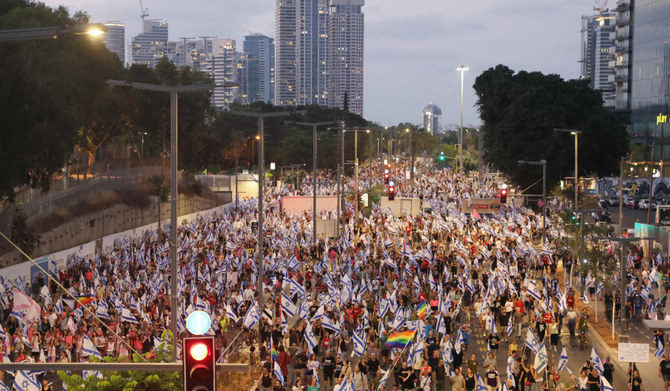
Demonstrators wave flags as they protest the Israeli government's judicial overhaul plan in Tel Aviv on July 29, 2023. (AFP)
Short Url
Updated 30 July 2023
Follow

Israelis protest after government pushes through key reform

  • Israeli medics responded with a brief walkout, while scores of military veterans have vowed to end their volunteer duties and trade unions are mulling further industrial action

TEL AVIV: Thousands of Israelis took to the streets Saturday to protest the government’s decision to forge ahead with its judicial reform package despite widespread opposition.
Demonstrators waving Israeli flags rallied in the country’s commercial hub Tel Aviv, keeping up the momentum of months of protests against Prime Minister Benjamin Netanyahu’s proposals.
“We still love this country and we’re trying to fix all the problems,” said film composer Itay Amram.
“We’re not accepting any of it,” the 27-year-old told AFP, railing against what he saw as the government’s “constitutional revolution.”
From the northern city of Haifa to Eilat on the Red Sea, protest organizers promoted rallies nationwide in the biggest test of public opinion since the government put a key plank of its reforms to a final vote in parliament on Monday.
The vote to scrap the “reasonableness” law, through which the Supreme Court can overturn government decisions such as ministerial appointments, was met with concern from Israel’s top allies including the United States.
Israeli medics responded with a brief walkout, while scores of military veterans have vowed to end their volunteer duties and trade unions are mulling further industrial action.
Netanyahu argues the reform package is necessary to rebalance the relationship between elected officials and the judiciary, but the premier’s opponents accuse him of a power grab.
“We refuse to serve a dictatorship,” warned a placard held by a demonstrator in Tel Aviv.
While an official turnout figure was not available, Israel’s Channel 13 estimated more than 170,000 people turned out in the city.

Wrapped in an Israeli flag in Jerusalem, near the prime minister’s home, Lotem Pinchover said she felt “heartbroken, helpless” after Monday’s vote.
“I’m very scared of what’s happening in Israel now and I’m very worried about the future of my daughter,” the 40-year-old academic said.
Months of protests since the judicial package was unveiled in January — including some in support of the government — have led to fears about widening fissures within Israeli society.
Stationed at a “psychological first aid” stand for protesters in Jerusalem, therapist Pnina Manes said the situation “tears families apart.”
“It’s started to feel like — and it’s very sad for me to say so — like two different groups” in Israeli society, the 59-year-old said.
There have been multiple petitions filed at the Supreme Court this week against Monday’s vote, with hearings set to be held in September.
The broader reform package includes ambitions to hand the government a greater say in the appointment of judges, as well as downgrading the status of legal advisers attached to ministers.
The legislative process is currently on hold due to parliament’s summer recess, with Netanyahu pledging openness in negotiations over future steps.
Opposition chiefs remain skeptical of talks with the government, a coalition which also includes far-right and ultra-Orthodox Jewish parties, after earlier dialogue broke down.


First responders enter devastated Aleppo neighborhood after days of deadly fighting

Updated 12 January 2026
Follow

First responders enter devastated Aleppo neighborhood after days of deadly fighting

  • The US-backed SDF, which have played a key role in combating the Daesh group in large swaths of eastern Syria, are the largest force yet to be absorbed into Syria’s national army

ALEPPO, Syria: First responders on Sunday entered a contested neighborhood in Syria’ s northern city of Aleppo after days of deadly clashes between government forces and Kurdish-led forces. Syrian state media said the military was deployed in large numbers.
The clashes broke out Tuesday in the predominantly Kurdish neighborhoods of Sheikh Maqsoud, Achrafieh and Bani Zaid after the government and the Syrian Democratic Forces, the main Kurdish-led force in the country, failed to make progress on how to merge the SDF into the national army. Security forces captured Achrafieh and Bani Zaid.
The fighting between the two sides was the most intense since the fall of then-President Bashar Assad to insurgents in December 2024. At least 23 people were killed in five days of clashes and more than 140,000 were displaced amid shelling and drone strikes.
The US-backed SDF, which have played a key role in combating the Daesh group in large swaths of eastern Syria, are the largest force yet to be absorbed into Syria’s national army. Some of the factions that make up the army, however, were previously Turkish-backed insurgent groups that have a long history of clashing with Kurdish forces.
The Kurdish fighters have now evacuated from the Sheikh Maqsoud neighborhood to northeastern Syria, which is under the control of the SDF. However, they said in a statement they will continue to fight now that the wounded and civilians have been evacuated, in what they called a “partial ceasefire.”
The neighborhood appeared calm Sunday. The United Nations said it was trying to dispatch more convoys to the neighborhoods with food, fuel, blankets and other urgent supplies.
Government security forces brought journalists to tour the devastated area, showing them the damaged Khalid Al-Fajer Hospital and a military position belonging to the SDF’s security forces that government forces had targeted.
The SDF statement accused the government of targeting the hospital “dozens of times” before patients were evacuated. Damascus accused the Kurdish-led group of using the hospital and other civilian facilities as military positions.
On one street, Syrian Red Crescent first responders spoke to a resident surrounded by charred cars and badly damaged residential buildings.
Some residents told The Associated Press that SDF forces did not allow their cars through checkpoints to leave.
“We lived a night of horror. I still cannot believe that I am right here standing on my own two feet,” said Ahmad Shaikho. “So far the situation has been calm. There hasn’t been any gunfire.”
Syrian Civil Defense first responders have been disarming improvised mines that they say were left by the Kurdish forces as booby traps.
Residents who fled are not being allowed back into the neighborhood until all the mines are cleared. Some were reminded of the displacement during Syria’s long civil war.
“I want to go back to my home, I beg you,” said Hoda Alnasiri.