

Saudi mining firm makes global mark with 10% stake in Vale Base Metals

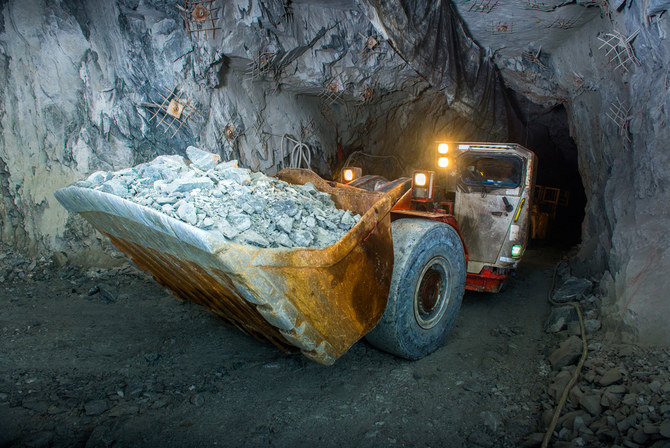
Manara Minerals was formed in January following an announcement at the Future Minerals Forum in Riyadh (Shutterstock)
Short Url
Updated 28 July 2023
Follow

Saudi mining firm makes global mark with 10% stake in Vale Base Metals

RIYADH: Saudi Arabia has made a significant investment in the global mining industry after the Kingdom’s Manara Minerals secured a 10 percent share in Brazil company Vale Base Metals Ltd.

The Saudi firm — a joint venture between the Saudi Arabian Mining Company, also known as Ma’aden and the Kingdom’s Public Investment Fund — will now have access to supply chains across strategic minerals, including nickel, copper, and cobalt.

The move will boost the growth of the Kingdom’s mining sector in line with the objectives of the Vision 2030 initiative to diversify the Saudi economy away from oil.

VBM also sold a 3 percent stake to investment group Engine No.1, with the total equity value of the two deals coming in at $26 billion. 

Robert Wilt, executive director of Manara Minerals and CEO of Ma’aden, said: “This investment is an important milestone for Manara Minerals. Through our investment in VBM, we are increasing the supply of strategic minerals and enabling Saudi Arabia to play a growing role in the global energy transition supply chains.

“Our proactive approach is a step further towards Saudi Vision 2030. It will support local industrial development, create jobs across the Kingdom, and strengthen the position of the mining sector as the third pillar of the economy.”

Eduardo Bartolomeo, Vale’s CEO, described the deal as a “major milestone” as the company works to expand its operations.

“With our high-quality portfolio, we are uniquely positioned to meet the growing demand for green metals essential for the global energy transition, while remaining committed to strong social and environmental practices and sustainable mining,” he added.

Formed in January following an announcement at the Future Minerals Forum in Riyadh, Manara Minerals aims to invest in mining assets globally to secure strategic minerals that are essential for the resilience of global supply-chains, according to a press release.

In an interview with Arab News in June, Mohammed Al-Dawood, head of industrials and mining sector for Middle East and North Africa investments at PIF, said the company will help to establish the mining sector as the third pillar of the Kingdom’s economy, along with providing an opportunity to explore new territories. 

“This is a really exciting development that is going to give the PIF and Ma’aden an extensive international footprint in the mining space. It’s going to give the partners a platform to access minerals not available in Saudi Arabia and gives us an opportunity to move into new geographical territories,” he said.


Islamic banks’ market share in Turkiye rises to 9.2%: Fitch Ratings

Updated 18 February 2026
Follow

Islamic banks’ market share in Turkiye rises to 9.2%: Fitch Ratings

RIYADH: Islamic banks in Turkiye lifted their asset market share to 9.2 percent in 2025 from 8.1 percent a year earlier, as financing and deposits outpaced the broader banking sector, a new analysis showed. 

In its latest report, Fitch Ratings said financing and deposit market shares rose to 7.9 percent and 10.4 percent, respectively, by the end of 2025, compared with 7.3 percent and 9.4 percent in 2024.

The agency noted that new digital Islamic banks are emerging in the country, with investment from Gulf Cooperation Council countries expected to continue. 

Turkiye’s strong ties with Islamic countries across the Balkans, Africa and the Middle East support the development of its Islamic banking sector, attracting investors and contributing to the industry’s growth.

In its latest report, Fitch stated: “Three recently established private Islamic banks (two digital) grew rapidly in the first nine months of 2025. Investment in digital participation banking from the Gulf Cooperation Council countries underscores the potential for further investment from the region.” 

It added: “Planned establishment of new participation banks, and rapid growth of recently established banks – albeit from small bases – means that the segment landscape may be reshaped in 2026.” 

Dubai Islamic Bank PJSC’s investment in digital bank TOM underscores the potential for further GCC investment. 

Turkish regulators have approved the establishment of Halk Katilim Bankasi A.S. and Adil Katilim Bankasi A.S. (digital), while BIM Birlesik Magazalar A.S.’s application is pending. 

Fitch added that state-owned participation banks may merge or pursue initial public offerings, potentially reshaping the banking landscape. 

The report predicts Islamic banks’ market share will rise further in 2026, supported by strong internal capital generation and growth appetite. However, the non-performing financing ratio may increase moderately due to high inflows. 

“The segment’s non-performing financings ratio deteriorated to 2 percent at end-2025 compared to 1.2 percent in 2024 but remained below the sector average of 2.5 percent,” said Fitch. 

It added: “We expect pressure to persist given still-high financing rates, high but declining inflation, and the sensitivity of unsecured retail (lower share than conventional banks) and SME segments to economic cycles. We forecast a moderate increase in the segment NPF ratio in 2026.”