African leaders press Putin on grain deal and peace plan for Ukraine

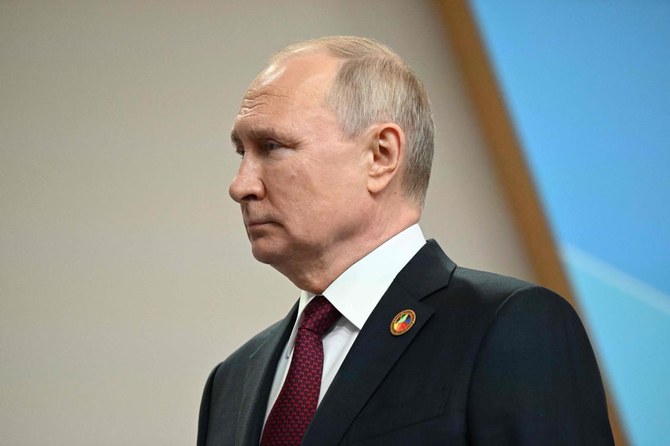
African leaders presented their peace initiative last month to both Putin and Ukrainian President Volodymyr Zelenskiy. (AFP)
Short Url
Updated 28 July 2023
Follow

African leaders press Putin on grain deal and peace plan for Ukraine

  • African leaders presented their peace initiative last month to both Putin and Ukrainian President Volodymyr Zelensky
  • Egyptian President Abdel Fattah El-Sisi urged Russia to revive the Black Sea grain deal

ST.PETERSBURG: African leaders pressed Russian President Vladimir Putin on Friday to move ahead with their peace plan to end the Ukraine war and renew a deal on the export of Ukrainian grain that Moscow tore up last week.
While not directly critical of Russia, their interventions on day two of a summit with Putin served as pointed reminders to him of the depth of African concern at the consequences of the war, especially for food prices.
“The African (peace) initiative deserves the closest attention, it mustn’t be underestimated,” Congo Republic President Denis Sassou Nguesso told Putin and fellow African leaders in St. Petersburg.
“We once again urgently call for the restoration of peace in Europe,” he said via a translator.
Egyptian President Abdel Fattah El-Sisi urged Russia to revive the Black Sea grain deal which, until Moscow refused to renew it last week, had allowed Ukraine to export grain from its seaports despite the war.
El-Sisi, whose country is a key buyer of grain via the Black Sea route, told the summit it was “essential to reach agreement” on reviving the deal.
Putin responded by arguing, as he has in the past, that rising world food prices were a consequence of Western policy mistakes that long predated the Ukraine war.
He says Russia quit the Black Sea agreement last week because it was not getting grain to the poorest countries and the West was not keeping its side of the bargain.
Since withdrawing from the deal, Russia has repeatedly bombed Ukrainian ports and grain depots, prompting accusations from Ukraine and the West that it is using food as a weapon of war, and global grain prices have risen again.
Putin is using the St. Petersburg summit to try to inject new momentum into Russia’s ties with Africa, promising increased trade and investment there as part of a drive to counter what he portrays as a hegemonic US-dominated world order.
On Thursday, he promised to deliver free Russian grain in the next several months to six of the countries attending the summit.
In Friday’s remarks, he said Moscow respected the African peace proposal on Ukraine and was carefully studying it.
Putin gave the plan a cool reception when a group of African presidents presented it to him last month, responding with a litany of Russian grievances against Ukraine and the West.
Russia has long said it is open to talks but that these must take account of the “new realities” on the ground, where it controls nearly a fifth of Ukraine’s territory after 17 months of war and has claimed four Ukrainian regions as its own.
Ukrainian President Volodymyr Zelensky has rejected the idea of a cease-fire now that would leave Russia in control of that land and give its forces time to regroup.


‘A den of bandits’: Rwanda closes thousands of evangelical churches

Updated 22 December 2025
Follow

‘A den of bandits’: Rwanda closes thousands of evangelical churches

  • A 2018 law introduced new rules on health, safety, and financial disclosures, and requires all preachers to have theological training
  • Observers say the real reason for the closures comes down to control, noting that even those who complied with the law had been shut down 
  • President Kagame has described the church as a relic of the colonial period, a chapter of its history with which the country is still grappling


KIGALI: Grace Room Ministries once filled giant stadiums in Rwanda three times a week before the evangelical organization was shut down in May.
It is one of the 10,000 churches reportedly closed by the government for failing to comply with a 2018 law designed to regulate places of worship.
The law introduced new rules on health, safety, and financial disclosures, and requires all preachers to have theological training.
President Paul Kagame has been vocal in his criticisms of the evangelical churches that have sprouted across the small country in Africa’s Great Lakes region.
“If it were up to me I wouldn’t even reopen a single church,” Kagame told a news briefing last month.
“In all the development challenges we are dealing with, the wars... our country’s survival — what is the role of these churches? Are they also providing jobs? Many are just thieving... some churches are just a den of bandits,” he said.
The vast majority of Rwandans are Christian according to a 2024 census, with many now traveling long and costly distances to find places to pray.
Observers say the real reason for the closures comes down to control.
Kagame’s government is saying “there’s no rival in terms of influence,” Louis Gitinywa, a lawyer and political analyst based in Kigali, told AFP.
The ruling party “bristles when an organization or individual gains influence,” he said, a view also expressed to AFP by an anonymous government official.

‘Deceived’ 

The 2018 law requires churches to submit annual action plans stating how they align with “national values.” All donations must be channelled through registered accounts.
Pastor Sam Rugira, whose two church branches were shut down last year for failing to meet fire safety regulations, said the rules mostly affected new evangelical churches that have “mushroomed” in recent years.
But Kagame has described the church as a relic of the colonial period, a chapter of its history with which the country is still grappling.
“You have been deceived by the colonizers and you let yourself be deceived,” he said in November.
The closure of Grace Room Ministries came as a shock to many across the country.
Pastor Julienne Kabanda, had been drawing massive crowds to the shiny new BK Arena in Kigali when the church’s license was revoked.
The government had cited unauthorized evangelical activities and a failure to submit “annual activity and financial reports.”
AFP was unable to reach Kabanda for comment.

‘Open disdain, disgust’ 

A church leader in Kigali, speaking to AFP on condition of anonymity, said the president’s “open disdain and disgust” for churches “spells tough times ahead.”
“It is unfair that even those that fulfilled all requirements are still closed,” he added.
But some say the clampdown on places of worship is linked to the 1994 Rwandan genocide in which around 800,000 people, mostly ethnic Tutsis, were slaughtered.
Ismael Buchanan a political science lecturer at the National University of Rwanda, told AFP the church could sometimes act as “a conduit of recruitment” for the Democratic Forces for the Liberation of Rwanda (FDLR), the Hutu militia formed in exile in DR Congo by those who committed the genocide.
“I agree religion and faith have played a key role in healing Rwandans from the emotional and psychological wounds after the genocide, but it also makes no sense to have a church every two kilometers instead of hospitals and schools,” he said.
Pastor Rugira meanwhile suggested the government is “regulating what it doesn’t understand.”
It should instead work with churches to weed out “bad apples” and help them meet requirements, especially when it comes to the donations they rely on to survive, he said.