

6 killed in Damascus suburb bombing near Shiite Muslim shrine

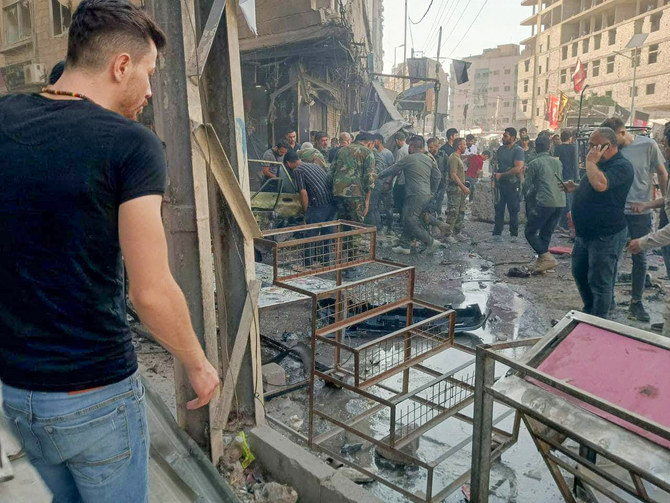
People gather at the site of an explosion in the town of Sayyida Zeinab on the outskirts of Damascus on July 27, 2023. (AFP)
Short Url
Updated 28 July 2023
Follow

6 killed in Damascus suburb bombing near Shiite Muslim shrine

  • Authorities had initially said the bomb was hidden in a taxi, but later reported that the explosives were on a motorcycle that exploded next to the cab

BEIRUT: A motorcycle planted with explosives detonated in a Damascus suburb near a Shiite Muslim shrine Thursday, killing at least six people and wounding dozens a day before the solemn holy day of Ashoura, state media reported, citing the interior ministry.

Syrian Health Minister Hassan Al-Ghabash said in a statement that 26 people wounded in the blast in the Sayida Zeinab neighborhood were being treated at several hospitals. Twenty others were treated on site or discharged, he said.

Authorities had initially said the bomb was hidden in a taxi, but later reported that the explosives were on a motorcycle that exploded next to the cab.

The Britain-based opposition war monitor Syrian Observatory for Human Rights said that a woman was among those who died and that her three children were wounded. The Observatory said the explosion occurred close to positions of Iranian militias, a key ally of Syrian President Bashar Assad alongside Russia in Syria’s civil conflict now in its 13th year.

Photos shared by Al-Ikhbariya and pro-government media show a charred taxi surrounded by large crowds of people and men in military fatigues. Green, red and black Ashoura flags and banners hung from buildings in the area.

In a video shared on social media, people carried two men covered in blood and dust off the ground while calling for help. The glass facades of shops nearby had shattered, while one was on fire.

The neighborhood is named after the shrine for Sayida Zeinab, the granddaughter of the Prophet Muhammad. Protecting the shrine became a rallying cry for Shiite fighters backing Assad in the early years of the conflict as it turned from an anti-government uprising into a sectarian civil war.

Ashoura is the 10th day of the Islamic month of Muharram, which is one of the holiest months for Shiite Muslims. It marks the martyrdom of the Prophet Muhammad’s grandson, Imam Hussein, and his 72 companions in the battle of Karbala in the 7th century in present-day Iraq. Ashoura marks the peak of the mourning procession.

The explosion was the second in the Sayida Zeinab neighborhood in the days leading to Ashoura. On Tuesday, Syrian state media citing a police official said that two civilians were wounded when a motorcycle laced with explosives was detonated.


Egypt’s historic mosques drenched in spirituality during Ramadan

Updated 5 sec ago
Follow

Egypt’s historic mosques drenched in spirituality during Ramadan

  • Arab News visits some of Cairo’s most historic mosques, including Al-Azhar, Sultan Hassan, and Amr ibn Al-As
  • ‘I have experienced an exceptional atmosphere in Egypt during Ramadan,’ says Mazen, a student at Al-Azhar University who is from Java in Indonesia

CAIRO: Cairo is home to more than 400 Islamic landmarks that represent a rich diversity of heritage and architectural styles, and the already spiritual atmosphere in the Egyptian capital receives a boost during Ramadan.

During the first week of the holy month, Arab News visited some of the city’s most historic mosques, including Al-Azhar, Sultan Hassan, and Amr ibn Al-As.

Al-Azhar Mosque hosts iftar, the evening meal that breaks the daily fast during Ramadan, at which it welcomes students from more than 100 countries as well as faculty members from Al-Azhar University. Thousands sit in organized circles throughout the mosque as they enjoy their meals.

“This is the third year I have attended this iftar since joining Al-Azhar University to study at the Faculty of Usul Al-Din (Islamic Theology),” Mazen, a student from Java in Indonesia, told Arab News. “I have experienced an exceptional atmosphere in Egypt during Ramadan.”

Gamal Abdel Rahim, a professor of Islamic antiquities, told Arab News that iftar tables first appeared in Egyptian mosques during the era of Ahmad ibn Tulun, founder of the Tulunid dynasty (835 to 884 A.D.). They became more widespread during the Mamluk and Fatimid periods at places of worship such as Amr ibn Al-As Mosque, one of the oldest in the country. The tradition continues.

“Ramadan preparations in Egypt’s historic mosques usually begin in the months of Rajab and Shaban, during which the mosque carpets are replaced,” Abdel Rahim said. “In olden times, mishkat (lamps) were filled with fresh olive oil during Ramadan.”

In the days of the Tulunid dynasty, he added, Ahmad ibn Tulun regulated working hours during Ramadan so that mosque workers could return home to their families after Asr prayer.

One of the most distinctive features of the holy month in Egypt is the firing of the Ramadan cannon, he said, a tradition that began in 1454 A.D. during the era of Sultan Khushqadam Al-Ahmadi.

“This ritual continues, linking modern practices to centuries of Islamic heritage,” he added.

At the Sultan Hussein Mosque, where original features of its construction in 1356 A.D. have been preserved, a large number of Muslims perform Taraweeh (late-night) prayers during Ramadan enveloped in a deeply spiritual and serene atmosphere that reflects the historical and religious significance of the mosque.

The mosque is also distinguished by its school, which is dedicated to teaching the four main schools of Sunni jurisprudence (Madhab). It features uniquely designed lamps that reflect the exquisite craftsmanship of its era and add to a spiritual ambiance that has attracted worshippers and scholars for centuries.

At Amr ibn Al-As Mosque, worshippers who gather for Isha and Taraweeh prayers are immersed in an atmosphere of devotion. The mosque is particularly notable for the magnificent dome at the center of its courtyard, which is a hallmark of its historic and architectural significance.

In areas around Egypt’s historic mosques, traditional lanterns and Ramadan decorations adorn the streets as Egyptians gather in these historic districts at night during the holy month to celebrate and socialize into the early hours, creating a lively and festive atmosphere that blends tradition and spirituality with communal joy.