

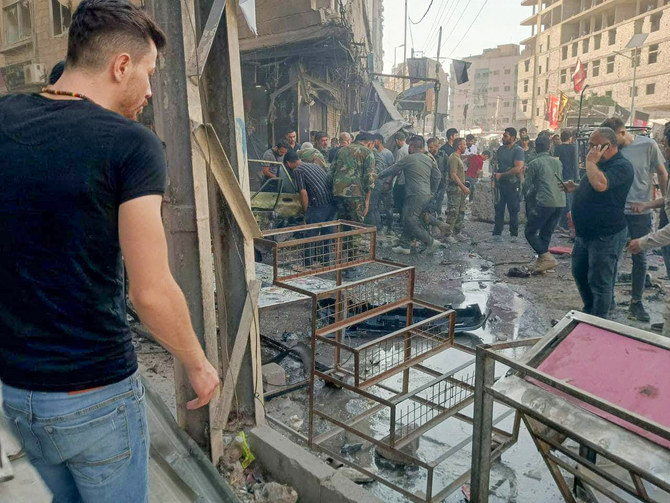

BEIRUT: A motorcycle planted with explosives detonated in a Damascus suburb near a Shiite Muslim shrine Thursday, killing at least six people and wounding dozens a day before the solemn holy day of Ashoura, state media reported, citing the interior ministry.
Syrian Health Minister Hassan Al-Ghabash said in a statement that 26 people wounded in the blast in the Sayida Zeinab neighborhood were being treated at several hospitals. Twenty others were treated on site or discharged, he said.
Authorities had initially said the bomb was hidden in a taxi, but later reported that the explosives were on a motorcycle that exploded next to the cab.
The Britain-based opposition war monitor Syrian Observatory for Human Rights said that a woman was among those who died and that her three children were wounded. The Observatory said the explosion occurred close to positions of Iranian militias, a key ally of Syrian President Bashar Assad alongside Russia in Syria’s civil conflict now in its 13th year.
Photos shared by Al-Ikhbariya and pro-government media show a charred taxi surrounded by large crowds of people and men in military fatigues. Green, red and black Ashoura flags and banners hung from buildings in the area.
In a video shared on social media, people carried two men covered in blood and dust off the ground while calling for help. The glass facades of shops nearby had shattered, while one was on fire.
The neighborhood is named after the shrine for Sayida Zeinab, the granddaughter of the Prophet Muhammad. Protecting the shrine became a rallying cry for Shiite fighters backing Assad in the early years of the conflict as it turned from an anti-government uprising into a sectarian civil war.
Ashoura is the 10th day of the Islamic month of Muharram, which is one of the holiest months for Shiite Muslims. It marks the martyrdom of the Prophet Muhammad’s grandson, Imam Hussein, and his 72 companions in the battle of Karbala in the 7th century in present-day Iraq. Ashoura marks the peak of the mourning procession.
The explosion was the second in the Sayida Zeinab neighborhood in the days leading to Ashoura. On Tuesday, Syrian state media citing a police official said that two civilians were wounded when a motorcycle laced with explosives was detonated.


