


In English folklore, there is a myth attributed to Saint Swithun, who died in 863 AD. In the last 10 years of his life, he was Bishop of Winchester, and requested that he should be buried outside the north wall of his cathedral “where the sweet rain of heaven may fall upon my grave.”
A century later, church reformers made him patron of the cathedral. On July 15, 971, his remains were moved and an indoor shrine built to him. Records suggest that a heavy shower occurred on that day.
Another source records that a great storm took place on that day in 1315. Either way, a myth was born. If rain falls on July 15, St Swithun’s day, it is expected to fall on the following 40 days and nights, although how widespread is unspecified. There is no statistical significance to the claim and much evidence to dispel it.
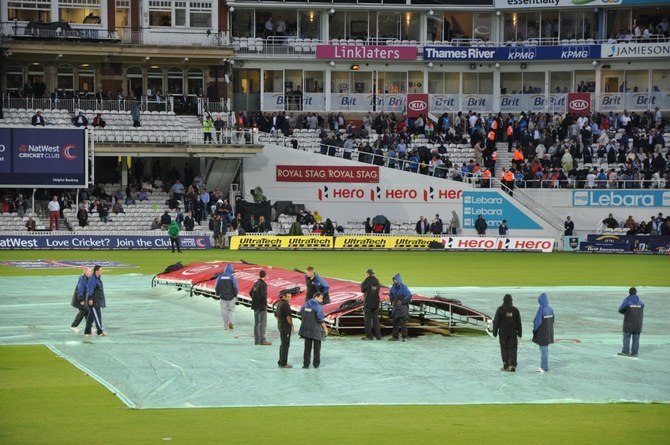
However, those who support the English men’s cricket team might feel that the myth has resonance. In parts of England there was rain late in the day on July 15, 2023 and on subsequent days. The fourth Ashes Test began on July 17 in Manchester. There, rain stayed away for the first three days. On the fourth day, it arrived to curtail play, with England in a dominant position. The final day was abandoned because of rain, the match declared a draw. Victory for England would have placed the series at 2-2, with a fifth and deciding match scheduled for the Oval, London, starting on July 27. An exhilarating climax to the series was denied. Disappointingly, more rain is forecast for the Oval.
So, once again, talk has turned to measures which could be enacted to counter the pernicious influence of rain on cricket. A previous column (Nov. 4, 2022) discussed the economics and feasibility of retractable roofs. Existing stadia do not lend themselves to the installation of a roof because of uneven historic designs. Newly built stadiums, unless multi-purpose, do not provide economic returns on investment. In addition, switching to indoor play may change the playing conditions to an unacceptable extent.
Men’s test matches are of five days duration. Each day’s play has six scheduled hours of play, divided into three sessions of two hours. The International Cricket Council’s Standard Test-Match Playing Conditions specify a minimum of 15 overs should be bowled in an hour, 90 overs per day. In theory, this provides for 450 overs per test match, subject to allowable breaks, such as decision reviews.
In practice, teams have not been achieving this minimum on a consistent basis, even though the day’s last session may be extended by 30 minutes after the scheduled cessation time. This failure is much to the displeasure of spectators, especially if the conditions and light are good enough for play. On several occasions in tests this summer play has ended in bright sunshine. Another source of irritation to spectators is that, if any of the minimum target number of overs have not been bowled by the day’s scheduled completion time, those overs are lost to the game.
The average number of overs bowled by the fielding side in an hour of play is calculated and used as a basis for deciding if penalties for slow over rates need to be levied. The penalties are a combination of deductions from match fees and points deductions from the World Test Championship table. In a move guaranteed to displease spectators, the ICC’s Cricket Committee announced last month that reductions were to be made to the amount that players can be penalized. Surprisingly, the ICC is worried that players may be deterred from playing test cricket if they face large fines. As surprising was the implementation of the change midway through the Ashes series, in which both teams attracted heavy penalties. The paying public ought not to be impressed. The players contend that, since they are providing great entertainment, no one should begrudge them slower over rates.
It is reasonable to assume that the public would prefer to receive value for money. One potential way of achieving this would be to have a reserve day. WTC finals in 2021 and 2023 had one allocated, proving decisive in 2021. It is reasonable to assume that many cricket followers would regard the Ashes as equally deserving of this facility. A factor mitigating against this may be a judgement that a minimum gap of three days should exist between tests in a series. Looking back to 2004, England’s then captain felt that a two-day gap was hard on the bowlers, limiting their recovery time. However, if a reserve day was activated, the bowlers would have had time off from playing during weather delays.
Another, more recent, England captain suggested that not enough was being made of the hours of daylight in England. Play usually starts at 11 a.m. and closes at 6 or 6:30 p.m. subject to weather impact. He wondered whether play could start earlier and finish later. Others have asked why the 40-minute lunch and 20-minute tea must be rigidly adhered to, especially when they coincide with drier conditions, as happened on the fifth day at Manchester. Over the first three days of that match, 26 of the available overs were not bowled, equivalent to one session. In the last 40 years, one in eight tests in England has lost the equivalent of a day’s play.
The rescheduled test between England and India in 2022 did start at 10:30 a.m. to fit television schedules and audiences in India. Perhaps this is where the lack of flexibility arises — television schedules and the attendant revenues. At Manchester, a clear message emerged. Those responsible for organizing, promoting and broadcasting cricket should be less rigid. They must adopt ways and behaviours which seek to ensure that at every stage, within the boundaries of safety, every opportunity is found to ensure that cricket is staged. Setting aside St Swithin, English summers are unpredictable. It is not wise to hide behind this reality.


