

Pakistan’s parliament grants additional powers to caretaker government ahead of polls

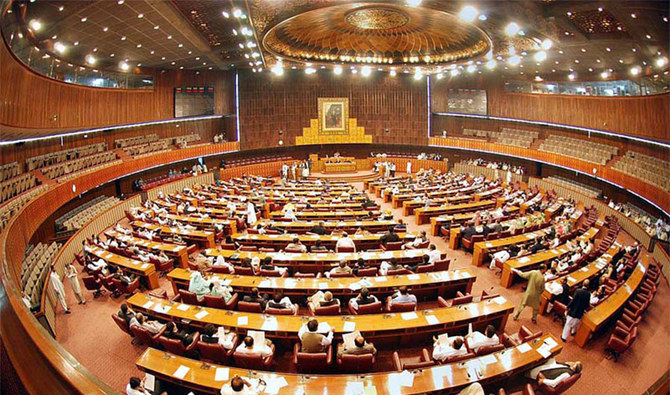
This file photo taken on January 12, 2018, shows Pakistan's National Assembly in Islamabad. (Photo Courtesy: Government of Pakistan/File)
Short Url
Updated 26 July 2023
Follow

Pakistan’s parliament grants additional powers to caretaker government ahead of polls

  • Law minister says caretaker government empowered to take decisions about ‘existing bilateral, multilateral, ongoing projects’
  • Opposition rejects move to grant additional powers to caretaker setup, terms it ‘soft coup’ and 'murder of the constitution'

ISLAMABAD: Pakistan’s parliament on Wednesday approved legislation that grants additional powers to any caretaker government, empowering it to take important decisions and engage with international institutions ahead of the upcoming general elections. 

The development takes place a day after Prime Minister Shehbaz Sharif's government introduced multiple amendments to the Election Act, 2017, days before the five-year constitutional tenure of the present National Assembly is due to expire. Section 230 of the Elections Act empowers caretaker setups to make important decisions like elected administrations of the country.

A leading coalition partner of the government, the Pakistan Peoples Party (PPP) objected to the proposed amendments on Tuesday, stating that they put caretaker governments "on the same pedestal" as elected ones.

However, during Wednesday's parliamentary session, the government managed to allay its allies' concerns and managed to get the legislation passed by a majority vote. Former Prime Minister Imran Khan's Pakistan Tehreek-e-Insaf (PTI) and the opposition Jamaat-e-Islami (JI) rejected the move.  

“The caretaker government can look into urgent matters only, we have tried our best to empower the caretaker government while remaining within the framework of the constitution,” Federal Law Minister Azam Nazir Tarar briefed the joint sitting of the parliament. 

Article 230 of the legislation empowers the caretaker government to take important decisions about “existing bilateral, multilateral and ongoing projects” already signed with international institutions like the World Bank and the International Monetary Fund (IMF). 

“The kind of economic crisis we have been passing through, it is important to empower the caretaker government to sign bilateral and multilateral agreements,” the minister explained.

He said while Pakistan was receiving some investments, other agreements worth hundreds of millions of dollars, such as the one with the World Bank, are expected to be signed in September. These agreements, the minister said, should be handled by the interim government. 

“No new authority is being awarded [to the caretaker government] …. They will take care of only day-to-day affairs,” Tarar assured the house, adding that the caretaker government would intervene only where the federal cabinet has already approved some deals which require consequential work. 

Senator Mushtaq Ahmad of the JI said empowering the caretaker setup through legislation is a “soft coup” that would make the upcoming general elections controversial. 

“I cannot support it,” he said, emphasizing that caretaker governments in Punjab and Khyber Pakhtunkhwa provinces were already working on an agenda instead of performing their duties in a neutral and unbiased manner as mandated by Pakistan's constitution. 

Ahmad said the government's move was against the “spirit of the constitution” that could be used as a pretext to extend the tenure of the interim setup. 

PTI's Senator Ali Zafar opposed the empowering the caretaker setup, describing it as a “murder of the constitution” and saying that the powers of an elected government were granted to a caretaker setup.  

“The only job of the caretaker government is to hold free and fair elections,” he said, warning that the Supreme Court would strike the amendments down for being in violation of the constitution. 

The ruling Pakistan Muslim League-Nawaz's (PML-N) head of the parliamentary committee on electoral reforms, Ayaz Sadiq, clarified that the proposed legislation would not be used to delay general elections. 

“It is categorically written in the bill that they would take decisions only regarding bilateral, multilateral, and ongoing projects," he said.  
The proposed legislation would become law after President Dr Arif Alvi grants his assent to it. 


Pakistan PM reviews internal, regional security after Khamenei killing, Afghanistan strikes

Updated 4 sec ago
Follow

Pakistan PM reviews internal, regional security after Khamenei killing, Afghanistan strikes

  • At least 16 people were killed and dozens more injured in clashes over killing of the Iranian supreme leader
  • The unrest came amid Pakistan’s offensive against Afghan forces, which officials say has killed 415 fighters

ISLAMABAD: Prime Minister Shehbaz Sharif on Sunday convened a high-level meeting to review internal and regional security situation, Sharif’s office said, amid nationwide protests over the killing of Iran’s Supreme Leader Ayatollah Ali Khamenei and Islamabad’s ongoing military operation against Afghan forces.

Protests erupted in several cities across Pakistan on Sunday after the killing of the Iranian supreme leader in US-Israeli joint strikes, with at least 16 people killed and dozens more injured in clashes with law enforcement agencies.

The unrest came amid Pakistan’s ongoing military operation against Afghan forces following a series of tit-for-tat strikes by the neighbors which began after Islamabad hit what it said were Tehreek-e-Taliban Pakistan and Daesh camps in Afghanistan on Feb 21-22.

During Sunday’s meeting, officials briefed PM Sharif and other participants about the country’s internal situation and security arrangements in place to thwart any untoward incident, according to Sharif’s office.

“Pakistan’s role and various measures to establish peace in the region were reviewed at the meeting,” Sharif’s office said. “The situation in Afghanistan was also reviewed in detail at the meeting.”

The development came shortly after Pakistan’s Information Minister Attaullah Tarar said that 415 Afghan Taliban fighters had been killed and more than 580 wounded since the latest phase of hostilities between the neighbors began on Thursday.

Afghan officials earlier said that dozens of Pakistani soldiers had been killed and several Pakistan posts had been captured by their forces. None of the casualty figures or battlefield claims from either side could be independently verified.

Earlier in the day, gunshots and explosions were reported in Kabul. Afghan government spokesperson Zabihullah Mujahid said the sounds were the result of Afghan forces targeting Pakistani aircraft over the capital.

“Air defense attacks were carried out in Kabul against Pakistani aircraft,” Mujahid wrote on X. “Kabul residents should not be concerned.”

KHAMENEI KILLING ‘VIOLATION’ OF INTERNATIONAL LAW

Separately, Sharif said the killing of Khamenei was a “violation” of international law.

“People of Pakistan join the people of Iran in their hour of grief and sorrow and extend the most sincere condolences on the martyrdom [of Khamenei],” he wrote on X.

“Pakistan also expresses concern over violation of the norms of international law.”

EVACUATION OF PAKISTANIS FROM IRAN

At Sunday’s meeting, officials of the foreign ministry also briefed the prime minister on the evacuation of Pakistani citizens from Iran, according to a statement issued from Sharif’s office.

“The evacuation of Pakistani citizens from Iran is being made possible through Azerbaijan,” they were quoted as saying.

Pakistan earlier asked its citizens in Gulf countries to exercise caution, avoid travel and strictly follow official adviseries, amid escalating tensions following the killing of Khamenei.

The foreign ministry shared emergency contact details of Pakistani embassies and consulates for the facilitation of Pakistani nationals abroad.