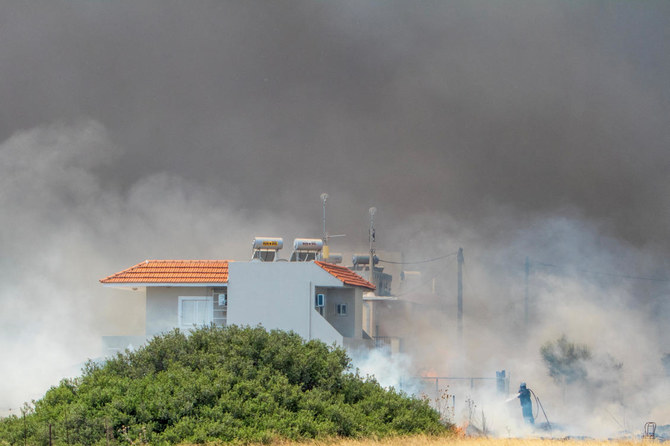
Rhodes: Greece braced for a new wave of soaring temperatures Tuesday, as wildfires raged on several popular tourist islands, forcing mass evacuations.
In the capital city of Athens the mercury is expected to soar to 41 degrees Celsius (106 degrees Fahrenheit), and reach up to 44C in central Greece, according to the national weather forecaster EMY.
Many regions of the country were on “red alert,” meaning there is an extreme risk of dangerous forest fires exacerbated by strong winds.
The very hot weather comes after a weekend of intense heat as thousands of locals and tourists fled forest fires on the Greek islands of Rhodes and Corfu, with the prime minister warning the heat-battered nation is “at war” with the flames.
Authorities evacuated nearly 2,500 people from the Greek island of Corfu on Monday, after tens of thousands of people had already fled blazes on the island of Rhodes, with many frightened tourists scrambling to get home on evacuation flights.
More than 260 firefighters were still battling flames for an eighth consecutive day on Rhodes, supported by two helicopters and two planes.
Fires were also raging on Greece’s second largest island of Evia, where Greek civil protection authorities issued an overnight evacuation order in one northern locality.
The mercury hit 46.4C in Gythio, in the southern Peloponnese peninsula on Sunday, though failed to reach the hottest temperature nationally on record of 48C.
“We are at war and are exclusively geared toward the fire front,” Greek Prime Minister Kyriakos Mitsotakis told parliament on Monday.
He warned that the country faced “another three difficult days ahead” before high temperatures are forecast to ease.
The severe heatwave in Greece has also been reflected across much of southern Europe and Northern Africa.
In Algeria at least 34 people have died as wildfires raged through residential areas, forcing mass evacuations.
In southeastern France officials Monday issued a fire warning at the highest level in the Bouches-du-Rhone region, warning that the weather conditions make the risk of flames “very high compared to normal summers.”
The exceptional temperatures in Greece have forced key tourist sites such as the Acropolis in Athens to close at the hottest times of the day.
Vassilis Kikilias, Greece’s civil protection minister, said crews had battled over 500 fires around the country for 12 straight days.
The fires are particularly devastating on very touristic islands such as Rhodes and Corfu where the season is in full swing and hotels are often full.
Volunteers had come to the aid of foreign tourists in the north of the island where nearly 200 people are still camped out at a school after being evacuated from the fires on Saturday.
School director Kyriakos Kyriakoulis told AFP that dozens of local volunteers and school staff had come forward to help those stranded.
“I can’t believe they are so nice, they gave so much in every way,” said 69-year-old British tourist Christine Moody, who was spending her first vacation in Greece when the fires hit.
“I am very moved,” she said.
In the village of Vati, in the southeast of the island, local mayor Vassilis Kalabodakis said that the impact on the region was “tragic.”
“The village has been ordered to evacuate but we can’t abandon it,” he said. “We are leading the fight to protect our home.”
Scientists from the World Weather Attribution group said Tuesday that the heatwaves that have hit parts of Europe and North America this month would have been almost impossible without human-caused climate change.

Greece faces new heatwave as wildfires rage
https://arab.news/8mb69
Greece faces new heatwave as wildfires rage
- The severe heatwave in Greece has also been reflected across much of southern Europe and Northern Africa
- exceptional temperatures in Greece have forced key tourist sites such as the Acropolis in Athens to close at the hottest times of the day.
US and Mideast countries seek Kyiv’s drone expertise as Russia-Ukraine talks put on ice
KYIV, Ukraine: The United States and its allies in the Middle East are seeking Ukraine's expertise in countering Iran's Shahed drones, according to Ukrainian President Volodymyr Zelenskyy.
Various countries, including the United States, have approached Ukraine for help in defending against the Iranian drones, Zelenskyy said late Wednesday. He said he has spoken in recent days with the leaders of the United Arab Emirates, Qatar, Bahrain, Jordan and Kuwait about possible cooperation.
Russia has fired tens of thousands of Shaheds at Ukraine since it invaded its neighbor just over four years ago, launching a swarm of more than 800 drones and decoys in its biggest nighttime barrage. Iran has responded to joint U.S.-Israeli strikes by launching the same type of drones at countries in the Middle East.
Ukrainian assistance in countering Iranian drones will be provided only if it does not weaken Ukraine's own defenses, and if it adds leverage to Kyiv's diplomatic efforts to stop the Russian invasion, according to the Ukrainian leader.
"We help to defend from war those who help us, Ukraine, bring a just end to the war" with Russia, Zelenskyy said. Later Thursday, Zelenskyy said he had received a U.S. request for support to defend against the drones in the Middle East and had given the order for equipment to be provided along with Ukrainian experts without providing further details.
"Ukraine helps partners who help our security and the protection of our people's lives," he added in a social media post.
Trump, in an interview Thursday with Reuters, said, "Certainly I'll take, you know, any assistance from any country."
Ukraine has battle-tested drone defenses
Ukraine has pioneered the development of cut-price drone killers that cost as little as $1,000, rewriting the air defense rule book and making other countries take notice.
European countries got a wake-up call last September on the changed nature of air defense when Poland scrambled multimillion-dollar military assets, including F-35 and F-16 fighter jets and Black Hawk helicopters, in response to airspace violations by cheap drones.
Ukrainian manufacturers have developed low-cost interceptor drones specifically designed to hunt and destroy Shaheds, and its rapidly expanding drone industry is producing excess capacity.
Zelenskyy announced earlier this year that Ukraine would begin exporting the battle-tested systems.
The European Union's top diplomat, Kaja Kallas, said before chairing a meeting of EU and Gulf foreign ministers via video link Thursday that the talks would look at how Ukraine's experience can help countries counter Iranian drones.
Middle East war delays Russia-Ukraine talks
The Iran war, now in its sixth day, has drawn international attention away from Europe's biggest conflict since World War II, and forced the postponement of a new round of U. S-brokered talks between Russia and Ukraine planned for this week, Zelenskyy said.
Western governments and analysts say the Russia-Ukraine war has killed hundreds of thousands of people, while there is no sign that yearlong U.S.-led peace efforts will stop the fighting any time soon.
"Right now, because of the situation around Iran, there are not yet the necessary signals for a trilateral meeting," Zelenskyy said. "But as soon as the security situation and the overall political context allow us to resume that trilateral diplomatic work, it will be done."
Zelenskyy thanked the United States for the return from Russia on Thursday of 200 Ukrainian prisoners of war. Russia's Defense Ministry also said it received the same number of prisoners from Ukraine and thanked the U.S. and United Arab Emirates for mediating.
Prisoner swaps have been one of the few tangible results of the talks. Vladimir Medinsky, a Russian negotiator, said on social media that a total of 500 prisoners from each side would be exchanged between Thursday and Friday.
Oleksandr Merezhko, the head of Ukraine's parliamentary foreign affairs committee, said Russian President Vladimir Putin is trying to drag out the negotiations so that he can press on with Russia's invasion while escaping further U.S. sanctions.
He urged the U.S. administration to look at the Russia-Ukraine war and the war in the Middle East as linked.
"In reality, Russia and Iran are close allies that act in concert — Iran supplies weapons and Russia helps Iran develop its defense industry. These are interconnected conflicts," Merezhko told The Associated Press.
Ukraine's army has recently pushed back Russian forces at some points along the roughly 1,250-kilometer (750-mile) front line, according to the Institute for the Study of War.
Localized Ukrainian counterattacks liberated more territory than Ukrainian forces lost in the last two weeks of February, the Washington-based think tank said this week, estimating the recovered land at about 257 square kilometers (100 square miles) since Jan. 1.


