At last, oil pumped out of Red Sea ‘time bomb’ FSO Safer tanker

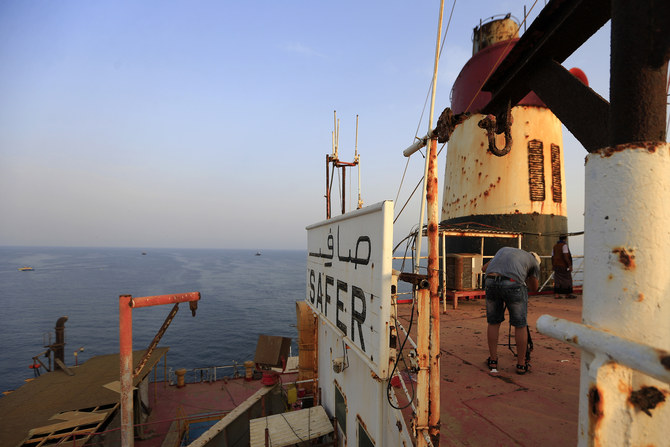
A worker stands on the deck of the beleaguered Yemen-flagged FSO Safer oil tanker in the Red Sea off the coast of Yemen's contested western province of Hodeida on July 15, 2023. (AFP)
Short Url
Updated 26 July 2023
Follow

At last, oil pumped out of Red Sea ‘time bomb’ FSO Safer tanker

  • Transfer is expected to take around three weeks
  • UN hopes $143 million operation will eliminate risk of environmental disaster

JEDDAH: UN engineers on Tuesday began pumping more than a million barrels of oil out of a rusting and decaying storage vessel in the Red Sea, ending an eight-year standoff with the Houthi militia in Yemen.

The war in Yemen led to the suspension in 2015 of maintenance operations on the FSO Safer, which has been moored off the country’s coast for more than 30 years.

The three-week $143 million operation to pump out the oil will “defuse what might be the world’s largest ticking time bomb,” UN Secretary-General Antonio Guterres said. It was a “critical next step in avoiding an environmental and humanitarian catastrophe on a colossal scale.”

Saudi Arabia welcomed the start of the operation in a statement issued Wednesday morning.

UN officials have warned for years that the Red Sea and Yemen’s coastline were at risk from the Safer. Itcould leak four times as much oil as the 1989 Exxon Valdez disaster off Alaska, and a spill would cost $20 billion to clean up.
UN Development Programme spokesperson Sarah Bel warned that any spilled oil could reach the African coast, damaging fish stocks for the next 25 years and destroying 200,000 jobs. It would also close ports that bring food and supplies to Yemen, where about 17 million people rely on humanitarian aid.


Safer is a rapidly decaying and the unstable oil tanker that could leak, spill or explode at any time. (File/AFP)

Because of the Safer's position in the Red Sea, a spill would also cost billions of dollars a day in shipping disruptions through the Bab al-Mandab strait to the Suez Canal, while devastating ecosystems, coastal fishing communities and lifeline ports.

Meanwhile the UN engineers are crossing their fingers —scorching summer temperatures, ageing pipes and sea mines lurking in surrounding waters all pose threats to the operation.
“Because it is the start of the emergency phase of the project to remove the oil, we need to be very cautious,” Bel said.
Even if the transfer succeeds, the Safer “will pose a residual environmental threat, holding viscous oil residue and remaining at risk of breaking apart,” the UN said.
Disputes are also expected over ownership of the oil and the Nautica, the replacement vessel into which the oil is being pumped, pitting the Houthis against the legitimate government in Aden.

But most people see progress on the Safer issue as a positive sign. “I hope it will be the beginning of the peace process,” said Fathi Fahem, the Yemeni business leader who proposed a replacement vessel for the Safer two years ago.


Morocco pushes to reform social security system amid inflation and economic pressure, PM says

Updated 54 min 35 sec ago
Follow

Morocco pushes to reform social security system amid inflation and economic pressure, PM says

  • Speaking at the World Economic Forum in Davos, Aziz Akhannouch said his government had expanded healthcare to more than 80 percent of its population

DUBAI: Morocco’s prime minister said on Tuesday that the country was pursuing radical social and economic reforms in the wake of inflationary and economic pressures.

Speaking at the World Economic Forum in Davos, Aziz Akhannouch said his government had expanded healthcare to more than 80 percent of its population, up from just 42 percent when he took office three years ago.

He said this also coincided with consistently strong economic growth and headline inflation reducing to below 1 percent. 

“In a world that doubts itself, Morocco has decided to protect its population, reform and look forward,” he told attendees in Davos.

In late 2025, Morocco was rocked by its largest demonstrations in over a decade as youth‑led groups mobilized nationwide against deteriorating public services, deepening social inequality, and chronic unemployment.

Akhannouch said the country was aware of the difficulties facing Moroccans and was determined to ensure the country would remain on a positive trajectory.

Part of this included the provision of financial aid to more than 12 million citizens, and the formation of trusts for orphans to be paid out when they turn 18.

“Health means dignity, if you want to have a decent life you have to have good health,” he said.

Nevertheless, Akhannouch noted that the government had not forgone its budgetary principles — and had in fact balanced the country’s debt payments and achieved successful fiscal reforms. He noted S&P’s decision in 2025 to raise Morocco’s sovereign rating to BBB‑/A‑3 and restore its investment‑grade status.

Speaking on the World Cup, set to be co-hosted with neighbors Spain and Portugal in 2030, he said the project was seen as a nation-building exercise that would help spur Morocco to develop its underlying infrastructure and provide employment opportunities for young Moroccans.

“It will be a growth accelerator,” he said.

“When we build new rail networks and upgrade cities it will have a long-term impact on people.”