

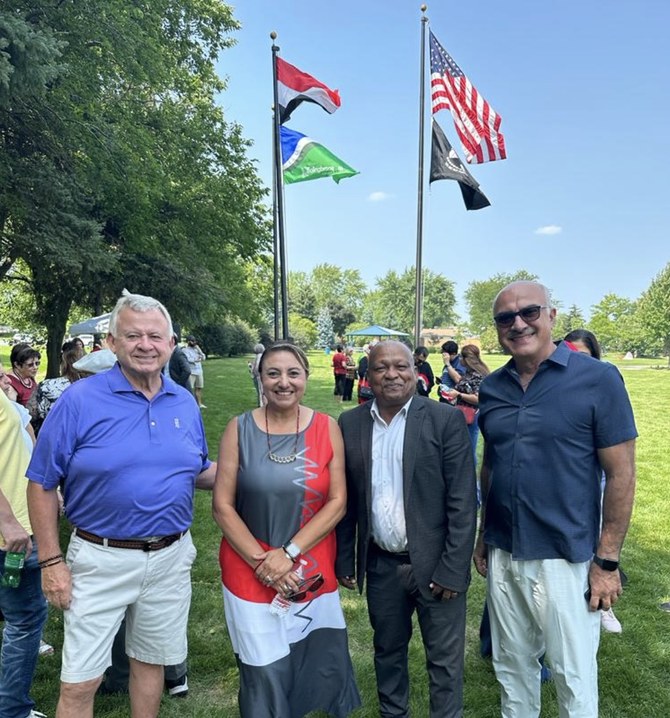
Egyptian-American community celebrate Egypt’s independence day

Former Bolingbrook Mayor Roger Claar, Mayor Mary Alexander-Basta, IDOT Omer Osman, and Teera ENgineering official George Ghareeb. Photo courtesy of Mayor Mayor Alexander-Basta. (Supplied)
Short Url
Updated 25 July 2023
Follow

Egyptian-American community celebrate Egypt’s independence day

  • US’ only female Egyptian-American mayor, Mary Alexander-Basta, marks 71st year as a republic
  • Diversity of Bolingbrook, Illinois, lauded by speakers at ceremony

BOLINGBROOK, ILLINOIS: The Egyptian flag was raised in the Village of Bolingbrook, Illinois, on Sunday, July 23, to mark Egypt’s 71st National Day and its start as a republic.

Although Bolingbrook, the 16th-largest of 1,299 municipalities in Illinois, is located more than 9,600 kilometers from Cairo, and only 53 kilometers from Chicago, the village has a unique distinction of being led by the country’s only female Egyptian-American mayor, Mary Alexander-Basta.

A 17-year resident of Bolingbrook, Basta was elected in 2019 as a trustee and the following year appointed mayor to succeed Roger C. Claar, who retired after serving 33 years. Basta was reelected overwhelmingly by voters in April 2021 as Bolingbrook’s chief executive.

Basta and her husband Dr. Emad Basta have been longtime supporters of the Egyptian-American community — and she has never shied away from her heritage. Basta emphasized her roots in the flag-raising ceremonies held at Meyer Park in Bolingbrook saying Egypt and America have much in common.

“Today is a momentous occasion. We gather here to celebrate our heritage and unity. And I am deeply honored to stand here today as the mayor of Bolingbrook and as the first female Egyptian mayor in the United States,” Basta told the gathering of Egyptian officials, Bolingbrook officials and residents.

“It is a privilege to serve this remarkable community and also to represent my homeland, Egypt. As we raise the Egyptian flag high today, we not only honor the land of the Nile and its rich history but also recognize the diverse tapestry of cultures that make up the heart of Bolingbrook.”

Among the dignitaries present were Egypt’s Consul General Sameh Aboul-Enein, Deputy Consul General Bassel Taman, Illinois Secretary of Transportation Omar Osman, Egyptian American Society President Dina Rashid, and former mayor Claar.

Also in attendance was Deputy Mayor of Bolingbrook Michael Lawler and several village officials and department heads. Prayers were offered by Father Theodore Labib and Sheikh Hassan Aly.

“Our town is a true melting pot where people from all corners of the globe come together to create a vibrant and thriving community. I take great pride in my Egyptian roots and I see them as a village that connects us with the borders of the world,” Basta told the gathering.

“Egypt has been a cradle of civilization leaving an incredible mark on human history, science and culture. The legacy of the pharaohs, the brilliances of the pyramids, and the timeless treasures of ancient Egypt inspire us to reach a greatness and embrace the wisdom of our ancestors.”

According to the US Census, Bolingbrook is a diverse community of Whites, Blacks, Asians and Hispanics. It also has a large population of citizens with Egyptian and Arab heritage. However, Arabs are categorized in the census as White and not listed separately to determine their population size.

Despite the census’ flaws, Basta said “diversity” breeds unity and understanding. “Let us remember the richness of our community lies not in our differences but in our shared humanity. Together we build a place where dreams are nurtured, where opportunities abound and everyone, regardless of their background can thrive and succeed.”

Similar flag raisings were organized by Egyptian-American groups around the country and in Canada.


Editorial: The threat of Yemen’s fragmentation is far reaching

President of Yemen’s Presidential Leadership Council Rashad Mohammed Al-Alimi. (SABA Net)
Updated 25 December 2025
Follow

Editorial: The threat of Yemen’s fragmentation is far reaching

  • The southern issue is a just cause — one that must be addressed in any future political settlement and not reduced to the ambitions of any single individual, including the likes of Aidarous Al-Zubaidi

RIYADH: As Yemen’s political landscape continues to shift at a dizzying pace, it is worth pausing to reflect on the official Saudi position — and the commentary of some of our leading Saudi columnists — regarding the recent unilateral moves by the Southern Transitional Council (STC) in the governorates of Hadramout and Al-Mahrah. These actions, taken without the consent of the Presidential Leadership Council (PLC) or coordination with the Arab Coalition, represent a dangerous gamble with the future of a fragile nation — one that Saudi Arabia, like its Arab neighbors, wishes only peace, stability, and prosperity.
There is no ambiguity in the Kingdom’s stance: it has worked tirelessly to preserve calm in Hadramout and Al-Mahrah, steering both regions away from military escalation and toward peaceful solutions. In a bid to contain the situation, Saudi Arabia, in coordination with its brothers and partners in the United Arab Emirates and the PLC, dispatched a joint team to negotiate with the STC. The goal was clear — facilitate the withdrawal of STC forces and hand over military sites to the National Shield Forces.
Yet despite Riyadh’s call for de-escalation and its appeal to the STC to prioritize national interest and social cohesion, the Council has persisted in its confrontational posture, seemingly indifferent to the grave consequences of its actions.
Observers in Riyadh will note that the Kingdom remains steadfast in its support for the PLC and Yemen’s internationally recognized government. Its commitment to Yemen’s stability is not rhetorical — it is political, economic, and developmental. Saudi Arabia’s vision is to shepherd Yemen from the shadows of conflict into an era of peace, prosperity, and regional integration. This is not merely a function of geography or shared borders; it is a reflection of the Kingdom’s religious, political, and economic responsibilities in the Arab and Islamic world.
From this vantage point, the newspaper firmly believes that the STC’s unilateral actions in Hadramout constitute a blatant violation of Yemen’s transitional framework. They undermine the legitimacy of the recognized government, threaten the fragile peace, and jeopardize the political process. Worse still, they echo the very tactics employed by the Houthi militias — an alarming parallel that should not be ignored.
It is therefore essential to reiterate the Kingdom’s position: the STC must withdraw its forces from Hadramout and Al-Mahrah, restoring the status quo ante. This is not a punitive demand, but a necessary step to safeguard national security and prevent further military flare-ups.
At the same time, Saudi Arabia has consistently affirmed that the southern issue is a just cause — one that must be addressed in any future political settlement. It is enshrined in the outcomes of Yemen’s National Dialogue and must be resolved inclusively, reflecting the aspirations of all southern Yemenis — not reduced to the ambitions of any single individual, including the likes of Aidarous Al-Zubaidi or other STC figures.
Ultimately, we urge the separatists to choose reason over recklessness. Partitioning Yemen will not bring peace — it will sow the seeds of future wars, embolden extremist actors, and pose a threat not only to Yemen’s internal cohesion but to regional and international stability. As Western and American policymakers know all too well: what happens in Yemen never stays in Yemen.