

Jordanian army downs drone headed from Syria carrying drugs

1 / 2
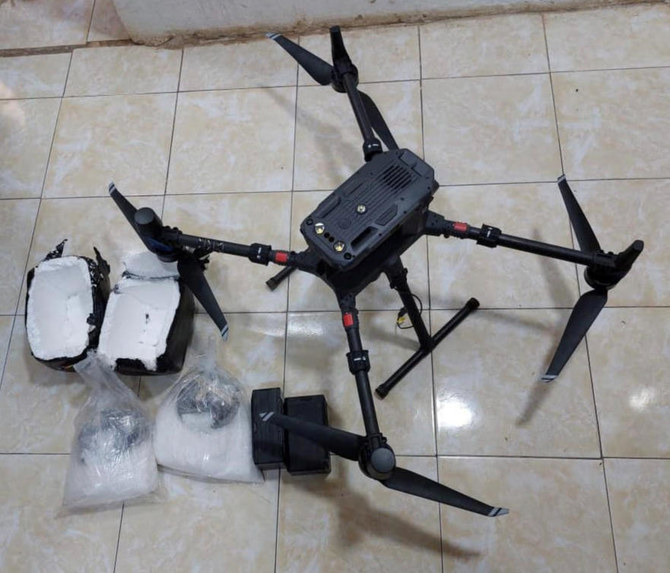
A picture released by the Jordanian Armed Forces website shows what it said are drugs carried by a drone from Syria that the Jordanian army intercepted and downed on Jordan's side of the border, Jordan July 24, 2023. (Reuters)
2 / 2
A picture released by the Jordanian Armed Forces website shows what it said is a drone carrying drugs from Syria that the Jordanian army intercepted and downed on Jordan’s side of the border, Jordan July 24, 2023. (Reuters)
Short Url
Updated 24 July 2023
Follow

Jordanian army downs drone headed from Syria carrying drugs

  • The plane, which was carrying two kilos of crystal methamphetamine, was intercepted and downed on Jordan’s side of the border

AMMAN: Jordan’s Eastern Military Zone troops shot down a drug-smuggling drone from Syria on Monday, Jordan News Agency reported. 

An official military source at the General Command of the Jordanian Armed Forces said: “Border Guard forces, in coordination with the military security services and the Anti-Narcotics Department, tracked a drone trying to illegally cross the border from Syria into Jordan, and it was shot down inside Jordanian territory.”

The drone was found to be carrying 2 kg of crystal meth, which was confiscated and turned over to the authorities.

The source added that the JAF will deal with any threat to Jordan’s borders, as well as any attempt to undermine its security or people, with full force and severity.

It comes a day after army and security chiefs from Jordan and Syria met to discuss ways to curb the growing smuggling problem. Despite pledges by Damascus, Jordan says it has not seen any real attempt to clamp down on the illicit trade.

Jordan has blamed pro-Iranian militias, who it says are protected by units within the Syrian army, for smuggling drugs across its borders toward Gulf markets.

Damascus says it is doing its best to curb smuggling and continues to bust smuggler rings in the south. It denies complicity by Iranian-backed militias linked to its army and security forces.

War-torn Syria has become the region’s main site for a multi-billion-dollar drug trade, with Jordan a main transit route to Gulf states for a Syrian-made amphetamine known as captagon, Western anti-narcotics officials and Washington say.

(With Reuters)

The Kingdom vs Captagon
Inside Saudi Arabia's war against the drug destroying lives across the Arab world

Enter


keywords

What to know about Gaza’s Rafah border crossing

Updated 7 sec ago
Follow

What to know about Gaza’s Rafah border crossing

  • The Rafah crossing into Egypt — often called Gaza’s “lifeline” — was the only border access for the territory that does not pass through Israel

CAIRO, Egypt: Pedestrians are set to begin passing through the Rafah border crossing between the Gaza Strip and Egypt on Monday, after it was largely shut for close to two years since Israeli forces seized the Palestinian side.
The reopening, demanded by the United Nations and aid groups, is a key part of the second phase of US President Donald Trump’s truce plan for the Palestinian territory.
AFP looks at what to know about this crucial crossing:

- Vital access point -

COGAT, the Israeli defense ministry body coordinating Palestinian civilian affairs, has said it will only be open for the passage of “residents in both directions.”
AFP images showed ambulances lined up on the Egyptian side of the border, preparing to receive medical evacuees, who are expected to be the first groups allowed out.
The Rafah crossing into Egypt — often called Gaza’s “lifeline” — was the only border access for the territory that does not pass through Israel.
It now lies in an area held by Israeli forces following their withdrawal behind the so-called “Yellow Line” under the terms of the US-brokered ceasefire.
For a long time, the crossing was the main exit point for Palestinians from Gaza who were authorized to leave the narrow strip of land, under Israeli blockade since 2007.
From 2005 to 2007, it was the first Palestinian border terminal controlled by the Palestinian Authority, and later became a symbol of Hamas control over the Gaza Strip after the militant group seized power.

- Under Israeli control -

On May 7, 2024, the Israeli army took control of the Palestinian side, claiming that the crossing was being “used for terrorist purposes.”
Many access points have since been mostly closed, including those used by the United Nations.
Rafah briefly reopened for medical evacuations during a short ceasefire between Israel and Hamas in January of last year.
Israel has said it will “conduct security clearance of individuals” permitted in and out of Gaza, which is meant to be administered by a 15-member Palestinian technocratic body.
The National Committee for the Administration of Gaza is also waiting to enter the territory, after Israel’s approval.
No agreement has yet been reached on the number of Palestinians permitted through, sources said, noting that Egypt plans to admit “all Palestinians whom Israel authorizes to leave.”
Palestinians intending to return to Gaza will be allowed limited luggage, no metal or electronic items and limited amounts of medication, according to the Palestinian embassy in Cairo.

- EU-Palestinian mission -

COGAT said “an initial pilot phase” began Sunday, “in coordination with the European Union Border Assistance Mission (EUBAM), Egypt, and all relevant stakeholders.”
“The actual passage of residents in both directions will begin upon completion” of preliminary preparations, it added.
The Palestinian side of the crossing is expected to be administered by EUBAM and a delegation from the Palestinian Authority.
The EU had set up a civilian mission in 2005 to help monitor the Rafah crossing, but it was suspended two years later after the Islamist militant group Hamas took control of Gaza.
The European mission aims to provide a neutral, third-party presence at the key crossing and involves police from Italy, Spain and France. It was briefly redeployed in January of last year but suspended again in March.
Both the EUBAM and the Palestinian Authority delegation have arrived at the crossing, sources at the border told AFP.

- Aid entry -

Trump’s plan, which underpins the ceasefire agreement between Israel and Hamas, stipulates the reopening of the Rafah crossing and the entry of 600 aid trucks per day.
But Israeli authorities have stalled on the matter and life-saving aid remains inadequate, according to aid groups.
International aid is generally routed from Egypt, through the Rafah checkpoint, before trucks are directed to the nearby Israeli crossing of Kerem Shalom — which currently processes three-quarters of aid entering Gaza.
Drivers disembark their vehicles, which go through strict Israeli inspection before being unloaded and reloaded onto other vehicles authorized to enter Gaza.
Two aid sources on the Egyptian side told AFP on Thursday that Israel has continued to obstruct aid delivery, returning “dozens” of trucks without unloading them.
Other access points have operated in the past, but Israeli authorities have not communicated on whether they will reopen.