

Pakistan warns of floods, landslides as next monsoon spell due from July 31 to August 6

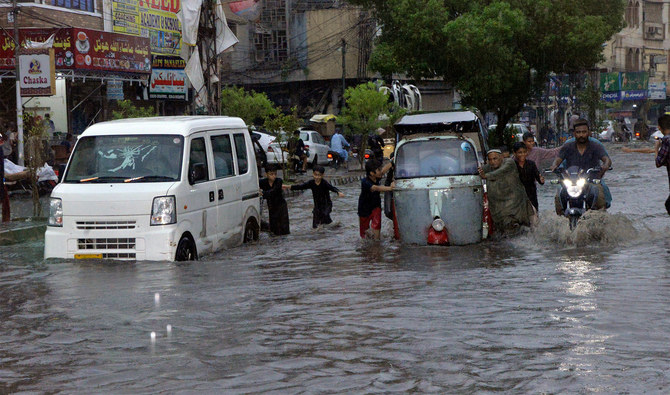
Motorcyclists and cars drive through a flooded road caused by heavy monsoon rainfall in Hyderabad, Pakistan, on July 23, 2023. (AP)
Short Url
Updated 24 July 2023
Follow

Pakistan warns of floods, landslides as next monsoon spell due from July 31 to August 6

  • At least 133 people have died across Pakistan since June 24 when monsoon rains began
  • Monsoon season, which officially began on July 1, will continue until September in Pakistan

ISLAMABAD: Pakistan’s National Disaster Management Authority said on Monday the country’s next monsoon spell was expected from July 31 to August 6, warning of fresh risks of flash and urban flooding as well as landslides.

At least 133 people have died in weather-related incidents across Pakistan since June 24 when monsoon rains began. In one incident, at least 11 construction workers were killed when a wall collapsed on them during heavy monsoon rains on the outskirts of Islamabad last week. The workers, from a nearby construction site, were inside a makeshift tent set up under the wall to take shelter from the rain when the wall fell on them.

Landslides caused by rain hit several roads in the northern districts of Chitral, Dir and Battagram in the northwestern Khyber Pakhtunkhwa province on Sunday. Authorities were trying to clear roads to restore traffic in the mountainous areas well into Monday. 

Heavy rains have swollen three main rivers — the Jhelum, Sutlej and Chenab in eastern Punjab province — prompting the disaster management agency to be on high alert for more flash floods, which have already affected at least 15,000 people in the past three weeks.

“According to the Meteorological Department, the next monsoon spell will continue from July 31 to August 6, due to which the risk of flash and urban flooding, landslides is likely to remain,” NDMA said on Twitter. “Due to heavy rains, there is a risk of increasing water flow in rivers, flooding in rivers and inundation of low-lying areas.”

Monsoon rains have returned to Pakistan a year after devastating floods killed 1,739 people across the country and affected over 30 million people.

The monsoon season, which officially began on July 1, will continue until September in the South Asian country.


Security forces kill four militants in Pakistan’s volatile southwest, military says

Updated 13 January 2026
Follow

Security forces kill four militants in Pakistan’s volatile southwest, military says

  • Balochistan, Pakistan’s largest province by land area bordering Iran and Afghanistan, has long been the site of a low-level insurgency
  • The Balochistan government has recently established a threat assessment center to strengthen early warning, prevent ‘terrorism’ incidents

ISLAMABAD: Pakistani security forces gunned down four militants in an intelligence-based operation in the southwestern Balochistan province, the military said on Tuesday.

The operation was conducted in Balochistan’s Kalat district on reports about the presence of militants, according to the Inter-Services Public Relations (ISPR), the Pakistani military’s media wing.

The “Indian-sponsored militants” were killed in an exchange of fire during the operation, while weapons and ammunition were also recovered from the deceased, who remained actively involved in numerous militant activities.

“Sanitization operations are being conducted to eliminate any other Indian-sponsored terrorist found in the area,” the ISPR said in a statement.

There was no immediate response from New Delhi to the statement.

Balochistan, Pakistan’s largest province by land area bordering Iran and Afghanistan, has long been the site of a low-level insurgency involving Baloch separatist groups, including the Balochistan Liberation Army (BLA) and the Balochistan Liberation Front (BLF).

Pakistan accuses India of supporting these separatist militant groups and describes them as “Fitna Al-Hindustan.” New Delhi denies the allegation.

The government in Balochistan has also established a state-of-the-art threat assessment center to strengthen early warning and prevention against “terrorism” incidents, a senior official said this week.

“Information that was once scattered is now shared and acted upon in time, allowing the state to move from reacting after incidents to preventing them before they occur,” Balochistan Additional Chief Secretary Hamza Shafqaat wrote on X.

The development follows a steep rise in militancy-related deaths in Pakistan in 2025. According to statistics released by the Pakistan Institute for Conflict and Security Studies (PICSS) last month, combat-related deaths in 2025 rose 73 percent to 3,387.

These included 2,115 militants, 664 security forces personnel, 580 civilians and 28 members of pro-government peace committees, the think tank said.