After Iran and India, Pakistan imposed highest number of internet restrictions in first half of 2023 – report

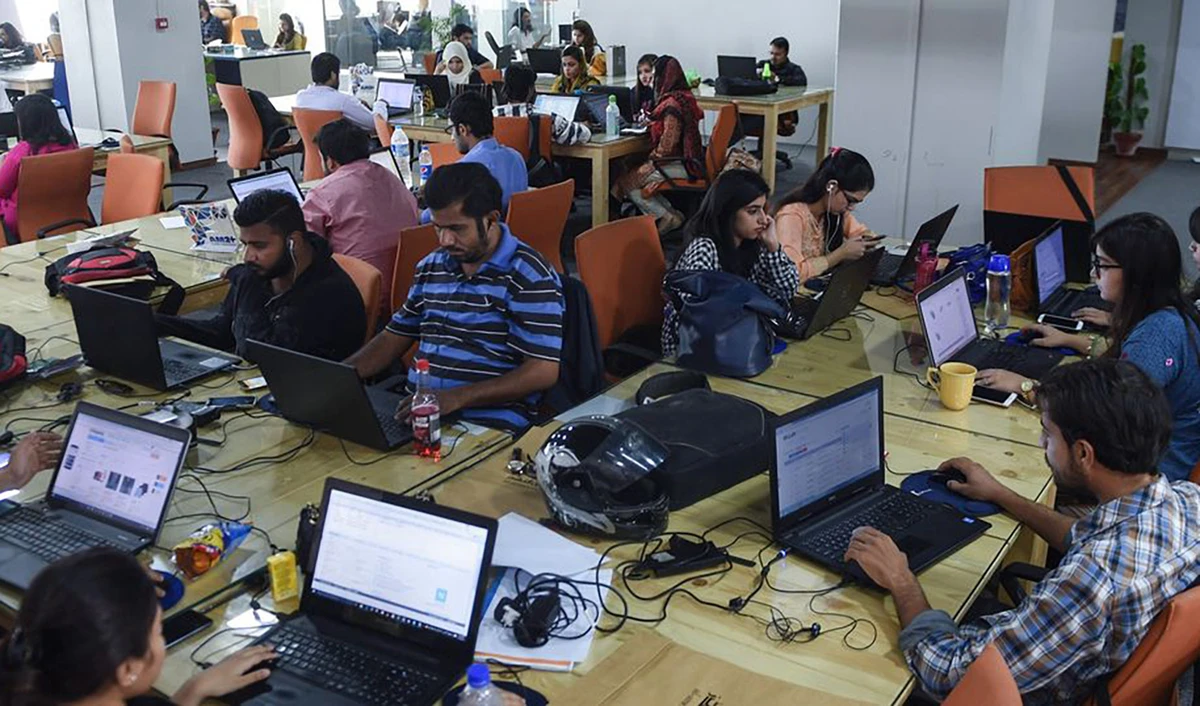
Employees of online marketplace company Kaymu at work in Karachi, Pakistan, on November 19, 2015. (AFP/File)
Short Url
Updated 24 July 2023
Follow

After Iran and India, Pakistan imposed highest number of internet restrictions in first half of 2023 – report

  • Iran imposed 14 Internet restrictions, India nine and Pakistan three, says VPN provider
  • All three of Pakistan’s Internet restrictions happened after ex-PM Khan’s arrest, says Surfshark

ISLAMABAD: Iran imposed the highest number of Internet restrictions during the first half of 2023, followed by India and Pakistan in the same period, a report released by Netherlands-based VPN provider Surfshark said on Monday. 

Surfshark tracks government-imposed Internet restrictions across the globe through its Internet Shutdown Tracker tool. In its latest report released last week, the VPN provider pointed out governments worldwide imposed 42 new Internet restrictions during the first half of 2023 compared to 61 in the same period in 2022. 

Pakistan imposed an Internet shutdown in many parts of the country after violent protests broke out following former prime minister Imran Khan’s arrest on May 9. The government also restricted access to social media platforms Twitter, Facebook and video-sharing platform YouTube during for three days before it began restoring mobile broadband services. The shutdown affected e-commerce, online services, home delivery and ride-hailing apps adversely, particularly in the twin cities of Islamabad and Rawalpindi. 

“In the first half of 2023, Pakistan was third in the world in new Internet restrictions, with 3 recorded cases,” Surfshark said in a statement, adding that all three of the country’s Internet shutdowns were sparked by Khan’s arrest. 

“Within the first half of this year, Pakistan has already had the same number of Internet restrictions as in all of 2022,” the VPN provider said in its report, adding that Asia accounted for 71 percent of all new restrictions imposed worldwide. “Iran was first in the world by new restrictions with 14 recorded cases, followed by India with 9 cases.”

The report said that all of Iran’s shutdowns were reported during protests in the Iranian city of Zahedan on a Friday, following protests against the Zahedan massacre. The majority of India’s restrictions happened during protests, the report added. 

Surfshark said Pakistan was among five countries that resorted to “nationwide” Internet restrictions in the first half of 2023, referring to the actions as the toughest of shutdowns and the most “economically devastating.”

“In Africa alone, three countries imposed nationwide restrictions: Mauritania (twice), Senegal, and Sudan. Pakistan and Cuba were the other two countries that imposed nationwide restrictions,” Surfshark wrote in its report. 

It said social media platform Facebook was restricted for use by five countries during the first half of 2023, as opposed to four in 2022. These five countries included Ethiopia, Guinea, Senegal, Pakistan, and Suriname. 


China, Pakistan sign livestock tech agreements under second phase of economic corridor

Updated 6 sec ago
Follow

China, Pakistan sign livestock tech agreements under second phase of economic corridor

  • Agreements signed on sheep IVF, dairy cow breeding and joint research and development 
  • Initiative aligns with shift from infrastructure to industrial, agricultural collaboration under CPEC

ISLAMABAD: China and Pakistan are expanding cooperation in livestock technology and agricultural research, with new agreements signed during a recent Chinese delegation’s visit to Pakistan, Radio Pakistan reported on Thursday, as both sides seek to deepen economic collaboration under the second phase of the China-Pakistan Economic Corridor (CPEC).

The collaboration follows a visit by Jinan Animal Husbandry Industry Craftsman College to Pakistan in January during the 2026 China-Pakistan Agriculture Investment Conference, where multiple cooperation documents were signed.

CPEC, launched in 2015 as part of China’s Belt and Road Initiative, initially focused on large-scale infrastructure projects including highways, energy plants and the development of Gwadar port. In recent years, the corridor has entered what officials describe as “CPEC 2.0,” aimed at shifting toward industrial cooperation, agriculture modernization, technology transfer and private-sector partnerships.

Agriculture and livestock are central to Pakistan’s rural economy, employing millions and contributing significantly to agricultural output. Expanding technical cooperation in breeding, veterinary sciences and value-added production is seen as part of broader efforts to diversify bilateral economic ties beyond infrastructure.

“The collaboration injects new impetus into bilateral livestock industry development, aligning with the advancement of China-Pakistan Economic Corridor (CPEC) 2.0,” Radio Pakistan reported on a visit by Jinan Animal Husbandry Industry Craftsman College to Pakistan from Jan. 19-24.

During the visit, two key cooperation documents were signed. A Framework Agreement on Industrial and Technological Cooperation and Talent Training was concluded with the Pak-China Joint Chamber of Commerce & Industry (PCJCCI) to establish a China-Pakistan Animal Husbandry and Veterinary Industry Technology Cooperation Center. The center is expected to focus on technological research and development, standard-setting and customized training programs.

In addition, a Memorandum of Understanding was signed with GO DAIRY Private Limited covering the transfer of sheep in vitro fertilization technology and dairy cow breeding techniques, alongside technical guidance to address production bottlenecks.

Radio Pakistan reported that consensus was also reached with the University of Veterinary & Animal Sciences (UVAS) on curriculum collaboration and the development of a joint training base.

The report added that Chinese and Pakistani experts would focus on three areas of cooperation — Himalayan pink salt application, sheep in vitro fertilization and dairy cow breeding — and plan to establish a joint laboratory to support technology localization.