

15 dead, 19 missing after Indonesian ferry sinks off Sulawesi island

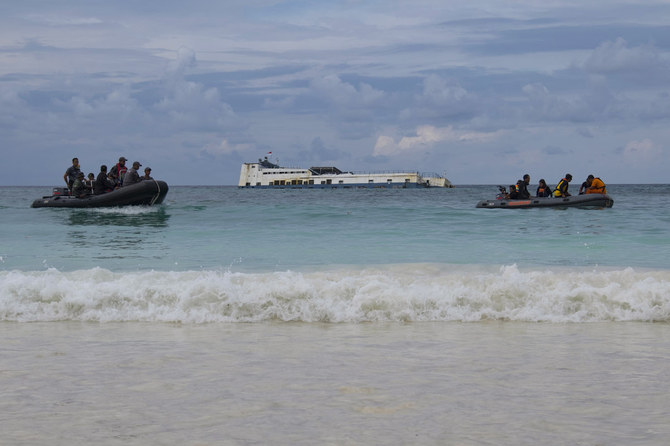
In this photo taken on July 5, 2018, rescuers search and examine a ferry  which ran aground off the coast of Selayar island in South Sulawesi. An overcrowded ferry that sank off of Sulawesi Island early Monday left at least 15 people dead. (AFP file) 
Short Url
Updated 24 July 2023
Follow

15 dead, 19 missing after Indonesian ferry sinks off Sulawesi island

KENDARI, Indonesia: At least 15 people were killed and 19 more were missing on Monday after a ferry sank off the coast of Indonesia’s Sulawesi island, search and rescue officials said.
The boat sank with 40 people onboard just after midnight local time (1700 GMT on Sunday), the local office of Indonesia’s search and rescue agency said in a statement.
Six people were rescued and taken to hospital for treatment, and the cause of the sinking was being investigated, it said.
“Provisionally, there are 19 people who are still being searched for,” Muhamad Arafah, head of the local search and rescue agency in Kendari city in southeast Sulawesi, said in the statement.
One search team will dive around the accident site, while another will search the water’s surface using boats, he said.
The ferry was crossing from Lanto village on Buton island to Lagili village on Muna island in Southeast Sulawesi, the agency said.
It shared images of rescuers mobilizing for the search effort, and several dead bodies covered by sarongs laid on tarpaulin at a local hospital.
It is common in Indonesia for the number of actual passengers on a boat to differ from the manifest.
Marine accidents occur frequently in the Southeast Asian archipelago nation of around 17,000 islands, where people rely on ferries and small boats to travel around despite poor safety standards.
In 2018, more than 150 people drowned when a ferry sank in one of the world’s deepest lakes on Sumatra island.
In May last year, a ferry carrying more than 800 people ran aground in shallow waters off East Nusa Tenggara province and remained stuck for two days before being dislodged.
No one was hurt in that accident.


Bangladesh halts controversial relocation of Rohingya refugees to remote island

Updated 29 December 2025
Follow

Bangladesh halts controversial relocation of Rohingya refugees to remote island

  • Administration of ousted PM Sheikh Hasina spent about $350m on the project
  • Rohingya refuse to move to island and 10,000 have fled, top refugee official says

DHAKA: When Bangladesh launched a multi-million-dollar project to relocate Rohingya refugees to a remote island, it promised a better life. Five years on, the controversial plan has stalled, as authorities find it is unsustainable and refugees flee back to overcrowded mainland camps.

The Bhasan Char island emerged naturally from river sediments some 20 years ago. It lies in the Bay of Bengal, over 60 km from Bangladesh’s mainland.

Never inhabited, the 40 sq. km area was developed to accommodate 100,000 Rohingya refugees from the cramped camps of the coastal Cox’s Bazar district.

Relocation to the island started in early December 2020, despite protests from the UN and humanitarian organizations, which warned that it was vulnerable to cyclones and flooding, and that its isolation restricted access to emergency services.

Over 1,600 people were then moved to Bhasan Char by the Bangladesh Navy, followed by another 1,800 the same month. During 25 such transfers, more than 38,000 refugees were resettled on the island by October 2024.

The relocation project was spearheaded by the government of former Prime Minister Sheikh Hasina, who was ousted last year. The new administration has since suspended it indefinitely.

“The Bangladesh government will not conduct any further relocation of the Rohingya to Bhasan Char island. The main reason is that the country’s present government considers the project not viable,” Mizanur Rahman, refugee relief and repatriation commissioner in Cox’s Bazar, told Arab News on Sunday.

The government’s decision was prompted by data from UN agencies, which showed that operations on Bhasan Char involved 30 percent higher costs compared with the mainland camps in Cox’s Bazar, Rahman said.

“On the other hand, the Rohingya are not voluntarily coming forward for relocation to the island. Many of those previously relocated have fled ... Around 29,000 are currently living on the island, while about 10,000 have returned to Cox’s Bazar on their own.”

A mostly Muslim ethnic minority, the Rohingya have lived for centuries in Myanmar’s western Rakhine state but were stripped of their citizenship in the 1980s and have faced systemic persecution ever since.

In 2017 alone, some 750,000 of them crossed to neighboring Bangladesh, fleeing a deadly crackdown by Myanmar’s military. Today, about 1.3 million of them shelter in 33 camps in the coastal Cox’s Bazar district, making it the world’s largest refugee settlement.

Bhasan Char, where the Bangladeshi government spent an estimated $350 million to construct concrete residential buildings, cyclone shelters, roads, freshwater systems, and other infrastructure, offered better living conditions than the squalid camps.

But there was no regular transport service to the island, its inhabitants were not allowed to travel freely, and livelihood opportunities were few and dependent on aid coming from the mainland.

Rahman said: “Considering all aspects, we can say that Rohingya relocation to Bhasan Char is currently halted. Following the fall of Sheikh Hasina’s regime, only one batch of Rohingya was relocated to the island.

“The relocation was conducted with government funding, but the government is no longer allowing any funds for this purpose.”

“The Bangladeshi government has spent around $350 million on it from its own funds ... It seems the project has not turned out to be successful.”