

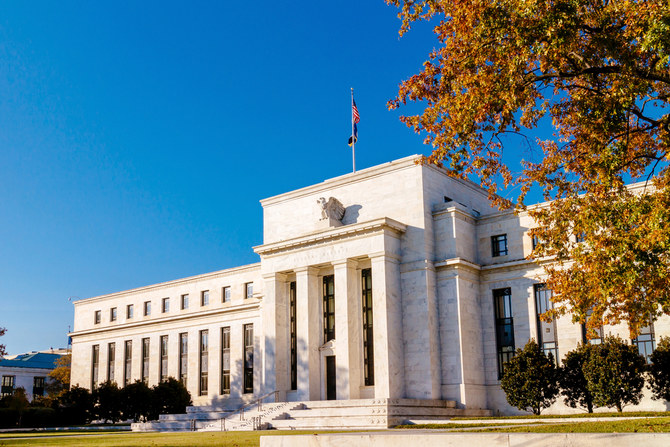

WASHINGTON: After pausing in June, the US Federal Reserve is widely expected to hike interest rates again on Wednesday, adopting its most restrictive monetary stance for 22 years despite recent signs of slowing inflation.
After 10 consecutive hikes in just over a year, the Fed halted its aggressive campaign of monetary tightening last month to give policymakers more time to assess the health of the US economy, and the impact of recent banking stresses on lending conditions.
In the weeks since, positive upgrades to economic growth and cooler inflation data have reinforced the likelihood that the Fed’s rate-setting committee will vote for a quarter-percentage-point hike on July 25-26.
This would raise the federal funds rate to a range between 5.25 and 5.5 percent — its highest level since 2001.
“If I had to bet, I would bet they would raise the Fed funds rate 25 basis points at the next meeting,” Joseph Gagnon, a senior fellow at the Peterson Institute for International Economics (PIIE), told AFP.
“The cooling of the economy is only happening slowly,” Bank of America’s chief US economist Michael Gapen wrote in a recent investor note.
“We think most committee members believe further rebalancing of supply and demand is needed to ensure disinflation will continue,” he added, explaining why he expects another hike on Wednesday.
Futures traders now assign a probability of more than 99 percent that the Fed will hike its base rate by 25 basis points at its next meeting, according to CME Group.
While a July rate hike is now widely expected, questions remain about how much further the Fed will need to go this year to bring inflation back down to its long-term target of 2 percent.
Since the Fed’s decision to pause in June, its favored measure of inflation has slowed to less than four percent year-on-year, while unemployment has remained close to record lows.
Economic growth has also been revised upward significantly for the first quarter on the back of stronger-than-expected consumer spending.
The positive economic news has raised the chances of a so-called soft landing, in which the Fed succeeds in bringing down inflation by raising interest rates while avoiding a recession and a surge in unemployment.
“We see the line between mild recession and soft landing as increasingly fine and view the probabilities of the latter outcome undeniably on the rise,” Deutsche Bank economists wrote in a recent note to clients.
Goldman Sachs recently cut its probability of the US economy entering a recession in the next 12 months to 20 percent from 25 percent, although it remains slightly above average postwar levels.
“Recent data have reinforced our confidence that bringing inflation down to an acceptable level will not require a recession,” the bank’s chief economist Jan Hatzius wrote in a note to investors.
At its June meeting, Fed officials indicated that they expect two additional quarter-percentage-point hikes will be needed this year to tackle inflation.
With the first interest rate hike widely expected on Wednesday, analysts have turned their attention to what the Fed does next.
Some economists predict another rate hike as soon as the Fed’s next rate meeting in September, while others think it could hold rates steady once more.
“My feeling is that, although they’re going to move slowly, 25 basis points a meeting or even every other meeting, I don't think they’re going to stop,” said Joseph Gagnon from PIIE.
Due to the uncertainty about September, Fed Chair Jerome Powell’s press conference after the rate decision will be closely scrutinized for hints at what the US central bank might do next.
“In the press conference, we look for Chair Powell to provide more clarity on what markers the Committee would need to see to be comfortable moving into an extended hold,” Morgan Stanley economists wrote in a recent note to clients.


