

Algeria applies to join BRICS group

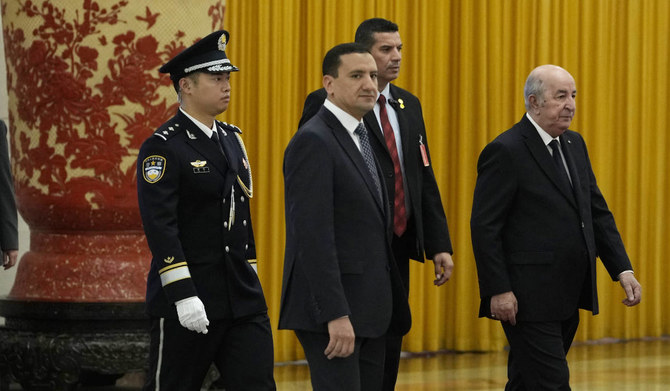
Algerian President Abdelmadjid Tebboune, right, arrives for talks with Chinese Premier Li Qiang, unseen, at the Great Hall of the People in Beijing, Wednesday, July 19, 2023. (AP)
Short Url
Updated 22 July 2023
Follow

Algeria applies to join BRICS group

  • The BRICS group of nations comprises Brazil, Russia, India, China, and South Africa. It account for more than 40% of the world's population and about 26% of the global economy

TUNIS: Algeria has applied to join the BRICS group and submitted a request to become a shareholder member of BRICS Bank with an amount of $1.5 billion, Ennahar TV quoted Algerian President Abdelmadjid Tebboune as saying. It added that Tebboune said at the end of his visit to China that Algeria had sought to join the BRICS to open new economic opportunities.
The North Africa country is rich in oil and gas resources and seeking to diversify its economy and strengthen its partnership with countries such as China.
The BRICS group of nations comprises Brazil, Russia, India, China, and South Africa. It account for more than 40 percent of the world’s population and about 26 percent of the global economy.
“We officially applied to join the BRICS group, we sent a letter asking to be shareholder members in the bank ... Algeria’s first contribution in the bank will be $1.5 billion,” Ennahar quoted Tebboune as saying.
More than 40 countries have expressed interested in joining the BRICS group of nations, South Africa’s top diplomat in charge of relations with the bloc said this week.
Argentina, Iran, the UAE, Cuba, Democratic Republic of Congo, Comoros, Gabon, and Kazakhstan are among countries that expressed interest.
China will invest $36 billion in Algeria across sectors including manufacturing, new technology, the knowledge economy, transport, and agriculture, local media quoted Tebboune as saying this week.


UAE to withdraw counter-terrorism units in Yemen, reiterates respect for Saudi sovereignty

Updated 28 min 22 sec ago
Follow

UAE to withdraw counter-terrorism units in Yemen, reiterates respect for Saudi sovereignty

  • Abu Dhabi emphasized its commitment to maintaining close coordination with Riyadh on all matters of mutual concern

ABU DHABI: The UAE announced the withdrawal of its remaining counter-terrorism units in Yemen on Tuesday, citing recent developments and concerns over the safety and effectiveness of ongoing operations.

In a statement issued on Tuesday and carried on Emirates News Agency, the Ministry of Defense said the decision was taken voluntarily and in coordination with relevant international partners, ensuring the safety of UAE personnel

The move follows a comprehensive assessment of current conditions and aligns with the UAE’s broader commitments to regional security and stability, the statement added.

The ministry reiterated that the UAE formally ended its military presence in Yemen in 2019 after completing its agreed missions as part of the Arab Coalition supporting Yemen’s legitimate government.

Since then, its presence had been limited to specialized counter-terrorism teams operating alongside international partners.

The UAE has been part of the Arab Coalition since 2015, contributing to efforts to support legitimacy in Yemen, combat terrorist organisations, and promote security and stability in the country, the statement added.

Earlier on Tuesday, the UAE reaffirmed its unwavering commitment to Saudi Arabia’s security and sovereignty, rejecting any actions that could threaten the Kingdom or undermine regional stability.

In a statement issued in response to recent remarks by Saudi Arabia regarding developments in Yemen, the UAE stressed that it fully respects Saudi Arabia’s national security and considers the fraternal and historical ties between the two countries a cornerstone of regional stability.

Abu Dhabi emphasized its commitment to maintaining close coordination with Riyadh on all matters of mutual concern.

The UAE said its position since the start of events in Yemen’s eastern governorates of Hadramawt and Al-Mahra has been focused on containing tensions, supporting de-escalation, and working toward understandings that preserve security, stability, and the protection of civilians, in coordination with Saudi Arabia.

Abu Dhabi categorically rejected any attempt to implicate it in tensions between Yemeni factions, condemning allegations that it pressured or directed any party to carry out military operations that threaten Saudi Arabia’s security or target its borders.

The UAE also called for recent developments in eastern Yemen to be handled responsibly to prevent escalation, urging reliance on verified facts and coordination among all relevant parties to safeguard shared interests and maintain regional security and stability.