

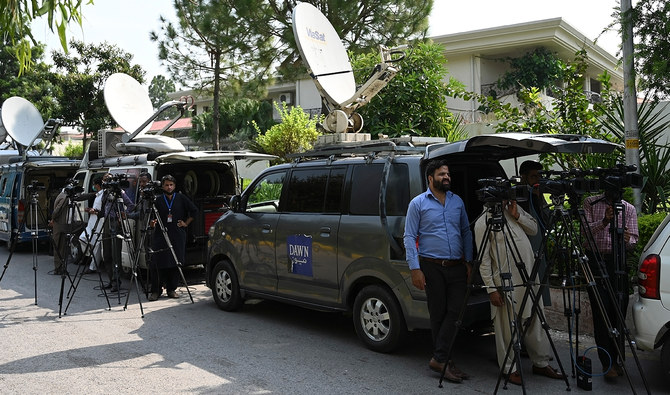
Pakistani journalists express concerns over diminishing media freedom amid deepening political polarization

Members of the media prepare for the news broadcast in Islamabad on October 10, 2021. (AFP/File)
Short Url
Updated 22 July 2023
Follow

Pakistani journalists express concerns over diminishing media freedom amid deepening political polarization

  • Senior journalists warn of ongoing editorial constraints, foreseeing no imminent relief from media restrictions
  • Pakistan ranks 150th in Press Freedom Index, with journalist threats and attacks surging 60 percent in a year

ISLAMABAD: Senior Pakistani journalists warned on Saturday media freedom had been under intense pressure for over a year due to increasing political polarization in the country, adding they anticipated these restrictions to persist until the next elections scheduled to be held in October this year.

Political uncertainty engulfed Pakistan following the removal of former Prime Minister Imran Khan from power through a parliamentary vote of no-confidence in April last year, leading to heightened pressure on the media to water down his criticism against the government and military establishment during the public rallies.

Pakistan ranks 150 out of 180 countries on the Press Freedom Index by Reporters Without Borders (RSF). There has been more than 60 percent increase in the number of threats and attacks against journalists between May 2022 and March 2023, according to Freedom Network’s annual Pakistan Press Freedom Report that recorded at least 140 such cases during the same period.

“There is no editorial independence and no media freedom in Pakistan at the moment,” senior journalist and talk show host Mohammad Malick told Arab News. “The current curbs on the press freedom are one of the toughest in the last 25 years.”

“There is definitely serious curtailment on media freedom when you cannot even mention the name of a political party [leader],” he continued while referring to an unofficial ban on mentioning of ex-premier Imran Khan’s name on the media.

“This serious undeclared infringement on the press freedom is not going to ease up at least in the next five to six months,” he said, adding the situation was likely to continue even after the upcoming general elections.

Pakistan is scheduled to hold nationwide polls in October after the expiry of five-year term of the national and provincial assemblies, though uncertainty still looms over the exact dates of the electoral contest along with the number of parties and candidates who would participate in them.

“Political uncertainty in Pakistan has contributed to this squeeze on press freedom and freedom of expression,” RSF country representative and Freedom Network’s executive director Iqbal Khattak told Arab News.

“The squeeze on press freedom is against Pakistani constitution and fundamental rights of the people,” he noted. “Therefore, the superior judiciary should intervene to lift the curbs on the media.”

Khattak said journalist unions had been weakened and divided over the unannounced censorship in the country, making it easy for various power centers to stifle dissenting voices since journalists could no longer present a “united front.”

However, some broadcast journalists noted press freedom also depended on individual journalists.

“It is the choice of individual journalists if they want to self-censor things or be bold like me and say whatever they want to say in public interest,” senior journalist and talk show host Sana Bucha told Arab News.

She admitted there were instructions not to mention the name of ex-PM Khan on television or invite some lawyers and political leaders on current affairs programs, though she added she did not have any issue if someone who wanted “to spread anarchy in the society” was banned from the media.

Pakistan Federal Union of Journalists (PFUJ) also acknowledged media censorship in the country while urging all political parties and civil society groups to work with the journalists to strengthen the press freedom and freedom of expression in the country.

“A vibrant democracy and media freedom go hand in hand in any country, but in Pakistan the press freedom has worsened in the last eight to ten years with political and economic uncertainty,” a former PFUJ president, Shahzada Zulfiqar, told Arab News.

“Political parties support journalists and press freedom while they are in opposition. But they tend to impose restrictions when they come into power,” he added.


Pakistan opposition rallies in Khyber Pakhtunkhwa to demand release of Imran Khan

Updated 07 December 2025
Follow

Pakistan opposition rallies in Khyber Pakhtunkhwa to demand release of Imran Khan

  • PTI-led gathering calls the former PM a national hero and demands the release of all political prisoners
  • Government says the opposition failed to draw a large crowd and accuses PTI of damaging its own politics

ISLAMABAD: Pakistan’s opposition led by the Pakistan Tehreek-e-Insaf (PTI) party demanded the release of jailed former prime minister Imran Khan at a rally in the northwestern Khyber Pakhtunkhwa province on Sunday, describing him as a national hero who continues to command public support.

The gathering came days after a rare and strongly worded briefing by the military’s media chief, Lt. Gen. Ahmed Sharif Chaudhry, who dismissed Khan as “narcissistic” and “mentally ill” on Friday while responding to the former premier’s allegations that Pakistan’s chief of defense forces was responsible for undermining the constitution and rule of law.

He said that Khan was promoting an anti-state narrative which had become a national security threat.

The participants of the rally called for “civilian supremacy” and said elected representatives should be treated with respect.

“We, the people of Pakistan, regard Imran Khan as a national hero and the country’s genuinely elected prime minister, chosen by the public in the February 8, 2024 vote,” said a resolution presented at the rally in Peshawar. “We categorically reject and strongly condemn the notion that he or his colleagues pose any kind of threat to national security.”

“We demand immediate justice for Imran Khan, Bushra Bibi and all political prisoners, and call for their prompt release,” it added, referring to Khan’s wife who is also in prison. “No restrictions should be placed on Imran Khan’s meetings with his family, lawyers or political associates.”

Addressing the gathering, Sohail Afridi, the chief minister of Khyber Pakhtunkhwa, denied his administration was not serious about security issues amid increased militant activity. However, he maintained the people of his province had endured the worst of Pakistan’s conflict with militancy and urged a rethinking of long-running security policies.

The resolution asked the federal government to restore bilateral trade and diplomatic channels with Afghanistan, saying improved cross-border ties were essential for the economic stability of the region.

The trade between the two neighbors has suffered as Pakistan accuses the Taliban administration in Kabul of sheltering and facilitating armed groups that it says launch cross-border attacks to target its civilians and security forces. Afghan officials deny the claim.

The two countries have also had deadly border clashes in recent months that have killed dozens of people on both sides.

Some participants of the rally emphasized the restoration of democratic freedoms, judicial independence and space for political reconciliation, calling them necessary to stabilize the country after years of political confrontation.

Reacting to the opposition rally, Information Minister Attaullah Tarrar said the PTI and its allies could not gather enough people.

“In trying to build an anti-army narrative, they have ruined their own politics,” he said, adding that the rally’s reaction to the military’s media chief’s statement reflected “how deeply it had stung.”

“There was neither any argument nor any real response,” he added, referring to what was said by the participants of the rally.